
Piano or guitar? How to choose your first instrument
Both are great ways into music. We compare the early learning curve, cost, portability, reading and styles so you can pick the one that suits you.
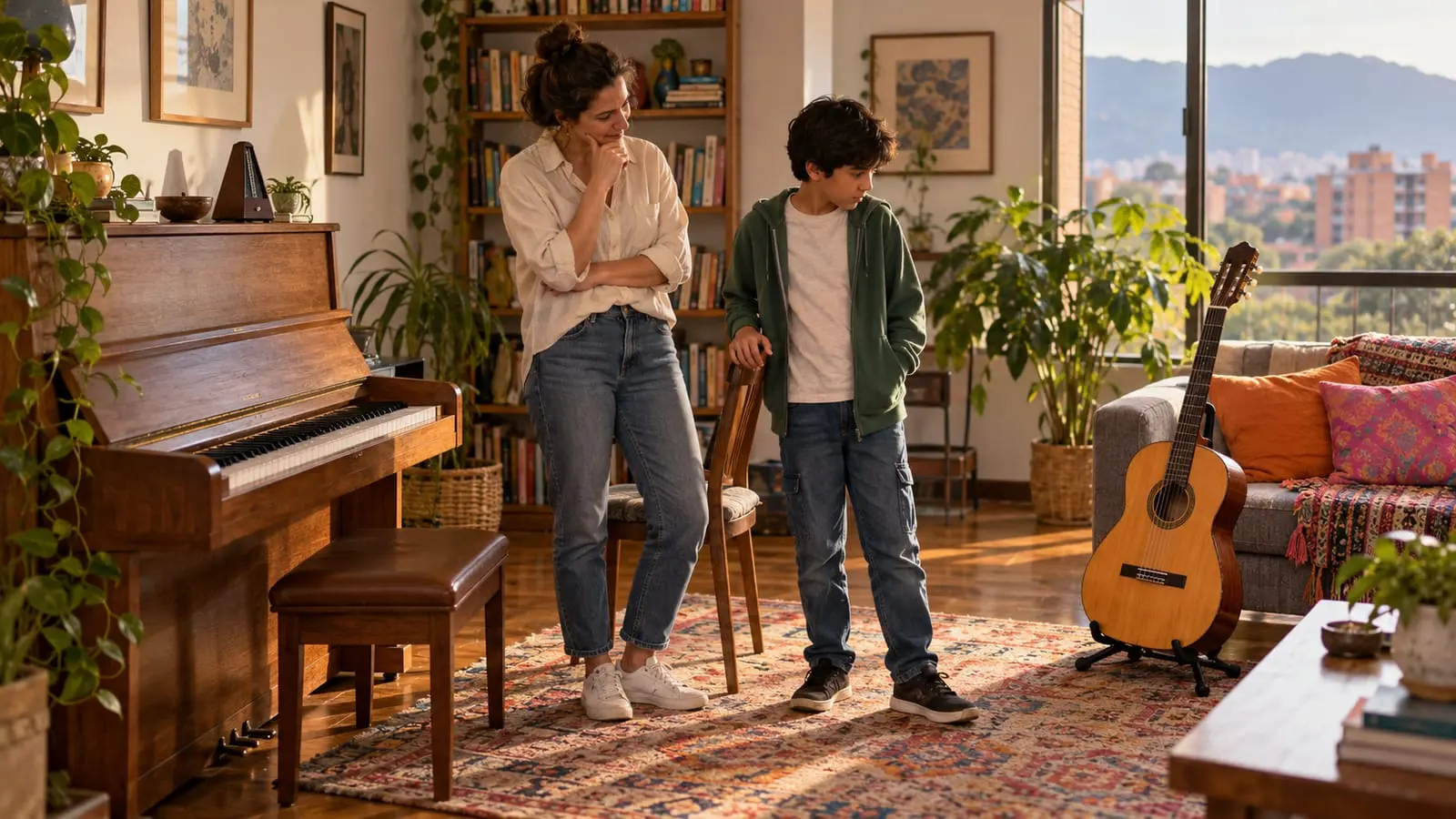
If you're more drawn to one, start there: motivation matters more than any comparison. If you're truly undecided, piano is usually gentler in the first few days and makes theory easy to see; guitar is more portable, easier to get hold of, and lets you accompany songs early on, although your fingertips may feel a little sore at first.
Neither is a bad choice. What you learn on one, such as rhythm, ear training, reading music, and discipline, will help with the other and any instrument you learn later.
In short
- Choose the instrument you hear in the music you listen to most and love: that motivation keeps you practicing.
- Piano is easier to start because each key sounds when you press it, and the keyboard lays out music theory clearly.
- Guitar lets you accompany songs with just a few chords, is portable, and usually costs less, but your fingers need a few weeks to adjust.
- For young children, piano is usually easier to start with; guitar is recommended around ages 6 or 7, using an appropriately sized instrument.
- If neither appeals to you, there are plenty of other ways in: singing, violin, percussion, bass, or wind instruments.
Piano vs. guitar: a side-by-side comparison
| Aspect | Piano | Guitar |
|---|---|---|
| Initial learning curve | Gentle: you get a clear sound from day one. The challenge comes when you coordinate two hands doing different things. | A little steeper: you need to press the strings correctly and change chords on time. Once you get past that, progress feels quick. |
| The first few weeks | You can play simple melodies early on; hand independence takes time. | Your fingertips hurt a little until calluses form; a few chords are enough to accompany songs. |
| Portability | Low. An acoustic piano stays in place; a keyboard can be transported, but takes effort. | High. It goes with you to gatherings, outings, or school. |
| Relative instrument cost | An acoustic piano is among the most expensive instruments; a digital piano or keyboard is a much more affordable alternative. | A beginner guitar is usually one of the most affordable ways to start. |
| Space and noise at home | Needs a permanent spot. A digital piano lets you practice with headphones. | Takes up little space. Acoustic guitar has a moderate volume; electric guitar can be practiced with headphones. |
| Music reading | You read two staves (treble clef and bass clef). It's a great foundation for theory and harmony. | You can start with chords, chord symbols, and tablature; staff notation is very useful but isn't essential at first. |
| Styles | Classical, pop, ballads, jazz, film music, salsa, and vocal accompaniment. | Pop, rock, boleros, Colombian music, bossa nova, flamenco, classical, and singer-songwriter music. |
| Suggested starting age | From age 5 or 6. | Around ages 6 or 7, with a smaller guitar. |
These ages are guidelines. For the full picture, see our guide to what age to start learning music.
Choose piano if…
- You're drawn to classical music, film music, jazz, or ballads.
- You want to understand how music works: scales and chords are easy to see on the keyboard.
- It's for a child aged 5 or 6 whose fingers aren't yet strong enough to press strings.
- You'd like to compose or arrange music later on.
- You have a permanent space at home for the instrument.
Piano lessons work on posture, reading music, hand coordination, and repertoire suited to your tastes from the start.
Choose guitar if…
- You dream of accompanying songs, singing while you play, or playing with friends.
- You listen to pop, rock, boleros, Colombian music, or singer-songwriter music.
- You want an instrument you can take anywhere.
- You'd rather start by playing by ear and with chords before reading sheet music.
Acoustic or electric guitar?
It depends on the music that moves you. An acoustic guitar needs no amplifier and is ideal for accompaniment; a nylon-string model, such as a classical guitar, will be gentler on your fingers than steel strings. Electric guitar has thinner strings and a comfortable neck but needs an amplifier, and if you like rock or blues, it may be your best starting point.
What you need to start each instrument
For piano
- An acoustic piano or a digital piano with full-size keys.
- For a digital instrument, ideally touch-sensitive, weighted keys that feel like a piano's.
- A bench or chair at the correct height, with your forearms parallel to the keyboard.
- Headphones, if you live in an apartment or practice during quiet hours.
For guitar
- A guitar sized to fit you or your child.
- A tuner, which can be a free phone app.
- A music stand for sheet music or chord charts.
- Short fingernails on your fretting hand.
Before buying, ask your teacher: they can help you avoid instruments that are hard to play, such as guitars with strings set too high or keyboards with keys that are too small.
What if neither is right for you?
Sometimes “piano or guitar?” hides another question: what music do I want to make? If you realize something else moves you, here are other good ways to start:
- Singing: you already carry your instrument with you and can start without buying anything.
- Violin: ideal if you love orchestral music, folk music, or the sound of bowed strings.
- Percussion: perfect if rhythm is your thing and you want to understand the foundation of cumbia, salsa, or rock.
- Electric bass: for those who enjoy holding down a band's groove.
- Tiple or Andean bandola: if Colombian Andean music appeals to you.
- Wind instruments such as flute, clarinet, saxophone, or trumpet, for those who dream of playing in a band or orchestra.
You can see all available instruments on the lessons page.
How to decide if you're still unsure
- Look at your music: list ten songs you love and notice which instrument takes the lead.
- Try both if you can, at a friend's or relative's home. Notice which one makes you want to play again.
- Think about your space and routine: where and when will you practice?
- Talk with a teacher before buying. Sharing your musical tastes and goal makes the decision much clearer; at Gissi, you can also message us on WhatsApp and we'll help you choose.
Choosing the instrument is only the first step; how to learn music from scratch gives you a realistic plan for your first weeks.
Frequently asked questions
Which is harder, piano or guitar?
Neither is harder in absolute terms. Piano is easier to start and becomes more challenging when you coordinate both hands; guitar takes a little more effort at first because you have to press the strings, but lets you accompany songs with a few chords.
Can I learn piano and guitar at the same time?
You can, but beginners are usually better off focusing on one for the first few months. Once you have a steady practice routine, adding the second is easier.
Can I use a keyboard to learn piano?
Yes, to start with. Ideally, it should have full-size keys and, if possible, touch sensitivity. Over time, a digital piano with weighted keys will help you develop better technique.
Is finger pain normal when learning guitar?
Yes, a little soreness in your fingertips during the first few weeks, while calluses form. Pain in your wrists, arms, or back isn't normal: if it happens, check your posture with your teacher.
Sources
We checked the facts in this article against these sources on October 22, 2026.