
Benefits of learning piano: what it really gives you
The piano lets you see music: melody, chords and bass on a single keyboard. We explain the skills it develops, where to play it in Colombia and the challenges it brings.
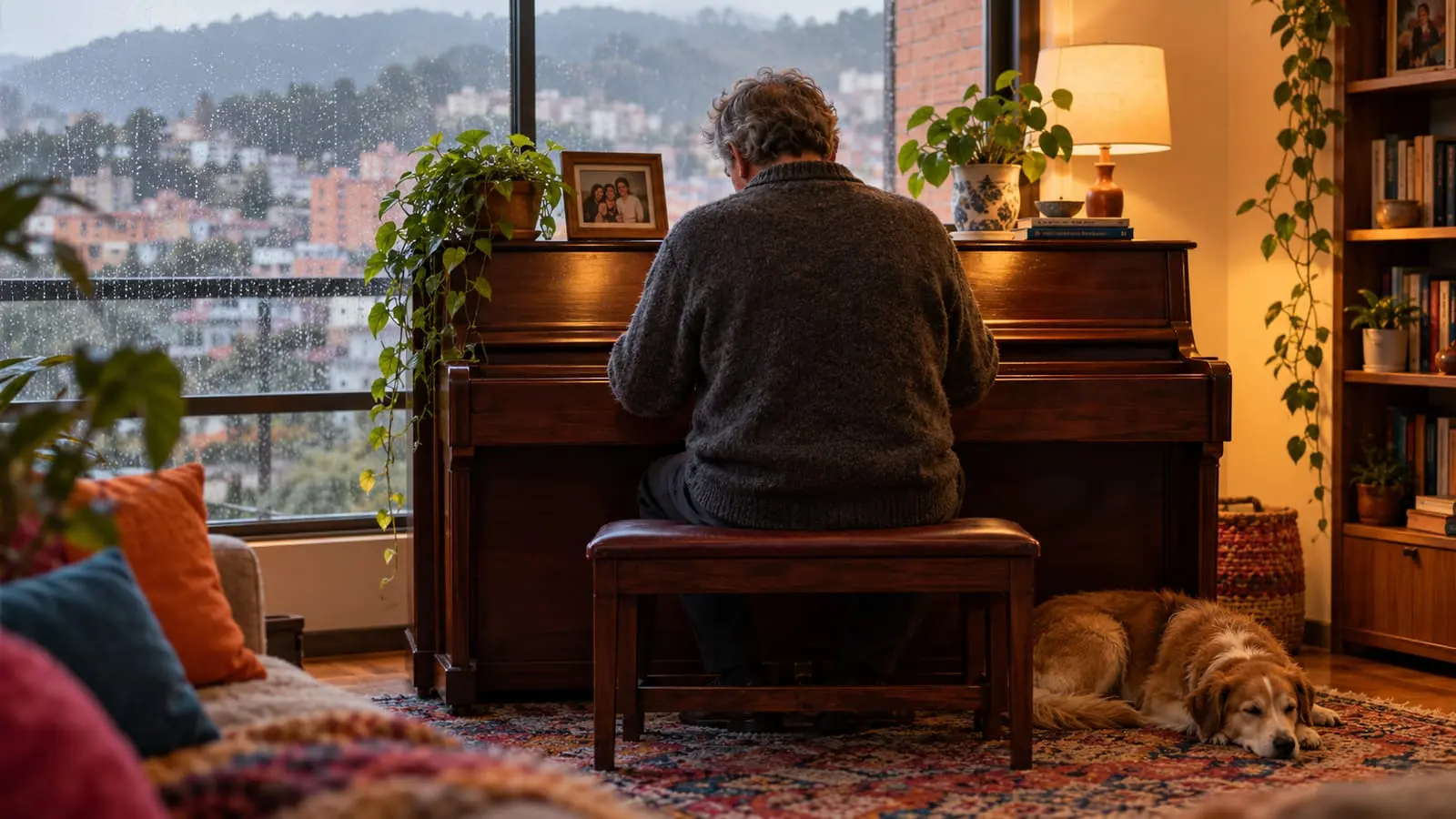
Learning piano gives you something few instruments offer: seeing the whole musical picture in front of you. On the keyboard, you play melody, chords, and bass at once, so you understand how a song works as you play it. Piano also develops coordination between two hands doing different things, provides a foundation for any other instrument, and lets you create a complete sound on your own.
You won't find miraculous promises here. We share what piano teachers see in their students week after week, where piano is played in Colombia, and which challenges are worth knowing about before you start.
In short
- Piano makes harmony visible: you can see scales, chords, and intervals on the keyboard, rather than just memorize them.
- It develops hand independence: one hand plays the melody and the other the accompaniment, sometimes with different rhythms.
- It's a solid foundation for singing, composing, studying theory, or moving to another instrument later.
- It sounds complete on its own and also has a place in churches, choirs, salsa orchestras, jazz groups, and bands.
- Its real challenges are reading two clefs, having patience through the first few months, and not being able to take it with you.
The specific skills piano develops
Benefits need to be concrete: piano doesn't magically make you smarter. It develops skills you practice every week, which show in how you play and listen.
Hand coordination and independence
The right hand sings a melody while the left supports it with chords or bass, sometimes in rhythms that don't line up. At first it seems impossible; with slow practice and separate-hand work, your fingers learn to share the tasks. The day both hands finally move freely is one of piano's most satisfying moments.
Fine control of sound
On an acoustic piano, or a digital one with touch-sensitive keys, the speed at which you press a key changes the volume and tone color. You learn to play one voice softly and another louder at the same time, and to use the pedal without blurring everything together.
Music reading
Piano music is read on two staves at once, in treble clef and bass clef. It's harder at first, but people who read piano music often find it easier to read sheet music for other instruments later on.
Understand harmony by seeing it
On guitar, a chord is a hand shape; on piano, it's a group of keys you can count. That's why so many theory and singing teachers ask students to have a keyboard, even a simple one.
- A major scale appears as a pattern of white and black keys that repeats from any starting note.
- You build a major or minor chord by skipping keys, and moving just one note changes its character.
- Inversions and seventh chords stop being unfamiliar terms and become specific positions.
- Accompanying songs from chord symbols (C, Am, F, G) helps you understand why certain chords sound good together.
That understanding later lets you work out songs by ear, create arrangements, or compose. If you want to go deeper, music theory lessons pair very well with piano.
A foundation for whatever comes next
Many musicians who now play another instrument started on piano, and that's no coincidence. What you learn on the keyboard stays with you:
| If you later want to… | What piano has already taught you |
|---|---|
| Singing | You can play your own starting notes, accompany yourself, and understand the harmony of what you sing. |
| Play guitar, bass, or tiple | You already know which notes make up each chord; you just need to find them on the fretboard. |
| Study music at university | Supplementary piano is often part of the curriculum in music degree programs, and arriving with a foundation takes some pressure off. |
| Compose or produce music | Music production software uses MIDI keyboards and a piano-roll view you'll immediately understand. |
| Play a wind or bowed string instrument | You arrive with music-reading skills, a steady beat, and an ear for harmony, so you can focus on the new technique. |
If you're considering a music degree, explore the music university preparation program: a foundation in piano, reading, and harmony makes preparation much more manageable.
Where you can play piano in Colombia
Piano has a reputation as a solitary instrument, and it does sound complete on its own. But it also opens many doors to playing with others:
- Churches and worship groups: keyboards accompany Masses, services, and choirs, and someone who can read chord symbols is almost always needed.
- Choirs: the accompanist provides starting notes, supports the harmony in rehearsals, and accompanies performances.
- Salsa and tropical music orchestras: piano plays the montuno, the repeated pattern that drives the whole orchestra.
- Jazz, pop, and school or university bands: the keyboard player provides chords, sustained background textures, and sometimes even bass.
- Chamber music: accompanying a violinist, singer, or flutist is an excellent way to learn to listen.
- At home: a piano in the living room becomes a gathering place for singing at birthdays and December novenas.
Is piano for you? Who tends to enjoy it
- You like understanding how things work, rather than just repeating them.
- You want to play alone at home without needing a band or accompanist.
- You sing or would like to compose your own songs.
- You enjoy progressing in stages and seeing improvement week by week.
- You're an adult looking for focused time to yourself; find ideas for learning piano as an adult here.
For children, piano is a rewarding first instrument: a note sounds in tune as soon as they press the key, without having to produce the sound with breath or a bow. Those early results are very motivating.
An honest look at piano's challenges
Every instrument has its difficulties, and it's better to know them from the start:
- Two clefs and two hands at once: reading develops more slowly than on instruments with a single melodic line.
- You can't take it with you: it doesn't come along on outings or to a friend's house, so you get used to playing whatever instrument is available.
- Space and neighbors: in an apartment, an acoustic piano takes up space and makes noise. A digital piano with headphones solves much of this; we explain the differences in digital piano or keyboard.
- Tension you may not notice: it's easy to play with tight shoulders and wrists if nobody corrects it early.
- The early plateau: at some point, pieces become more demanding and you feel as though you're not progressing. This is normal and can be overcome with consistent practice.
Frequently asked questions
Is piano a good first instrument?
Yes, it's one of the best starting points: sound comes as soon as you press a key, and you can see the theory on the keyboard. Still, the best first instrument is the one you feel like practicing; if guitar or violin appeals to you more, start there.
Can playing piano help you relax?
Many people experience it that way: concentrating on a piece leaves little room to think about other things, and ending a practice session with something you play well feels satisfying. It isn't therapy or a substitute for professional care, but it can offer some time to yourself during the week.
Do you need talent to learn piano?
A good ear or a natural feel for rhythm helps, but regular, well-guided practice matters most. Hand coordination, often the most intimidating part, develops step by step through slow exercises.
Is learning piano useful if I want to sing?
Very much so. Being able to play your starting note, accompany yourself with simple chords, and understand your songs' harmony gives you independence. That's why many singers learn piano alongside their singing lessons.
Sources
We checked the facts in this article against these sources on October 22, 2026.