
Learning music as a family or as a couple: a practical guide
Playing with your partner, your kids or your parents is one of the best reasons to learn. Here's how to organize lessons, choose instruments that go together and build a routine at home.
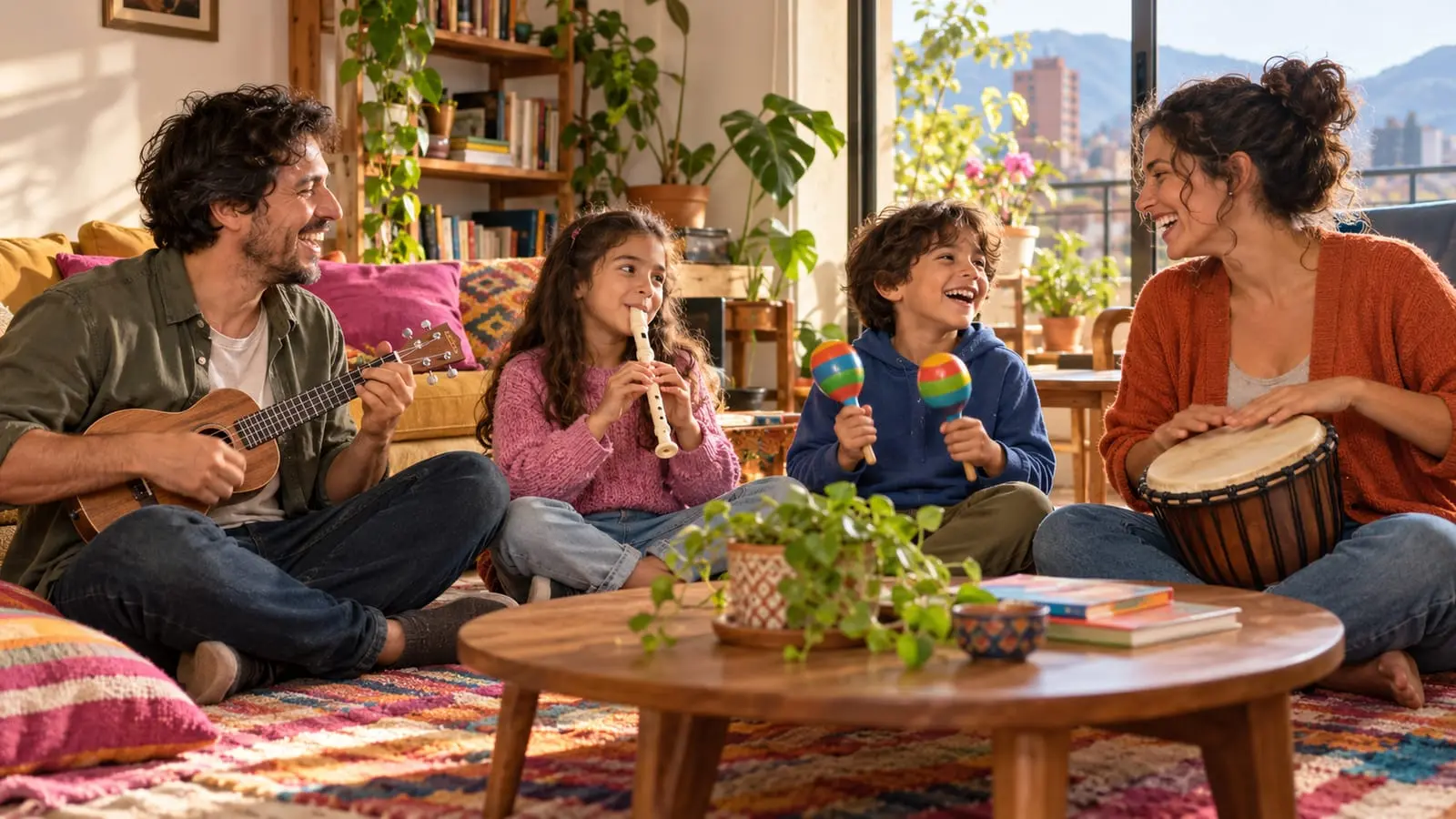
Learning music as a family or a couple works very well when everyone has space to make their own progress and time set aside to play together. The most practical approach is usually a shared lesson if you are at similar levels, or back-to-back individual lessons with the same teacher if you are not, plus a short family rehearsal each week.
Here, we explain how to choose a lesson format, which instruments work well together, how to handle different levels without competing, and how to plan your first project together.
In short
- Share a lesson if your levels are similar; book back-to-back individual lessons if your levels or instruments differ.
- Guitar and singing, piano and voice, or guitar and cajón are combinations that sound good from the start.
- Keep individual practice separate from family rehearsals, and give everyone time of their own.
- For couples, choosing different instruments avoids comparisons and lets you play together sooner.
- A project with a deadline, such as a song for the Christmas novena, brings everyone together around a goal.
Shared or separate lessons
| Format | Advantages | When it makes sense |
|---|---|---|
| Shared lesson, same instrument | You learn together, motivate each other, and practice the same things at home. | Couples or siblings who start at the same time and progress at a similar pace. |
| Small group, different instruments | You sound like a small ensemble from the start. | Families with a shared goal, such as playing songs together. |
| Back-to-back individual lessons | Everyone progresses at their own pace, with the same teacher on the same day. | Very different levels, such as a beginner mother and an experienced daughter. |
| Mixed | Individual lessons and an occasional ensemble session together. | When you want to work on individual technique and also play together. |
With in-home lessons, scheduling them back to back is especially practical because the teacher can work with several people in one visit. If you are unsure which format to choose, read individual or group music lessons.
Different levels under one roof
Someone will almost certainly progress faster. A child might memorize a melody before their dad does, while the dad may understand the theory before the child. That does not have to be a problem:
- No one corrects anyone else, unless asked. Feedback is the teacher's job.
- Everyone has their own part: the teacher can write arrangements where the more advanced player takes the melody and the beginner plays a simple accompaniment.
- Celebrate everyone's progress, without comparisons.
- The more advanced player accompanies rather than teaches: playing together is what helps most.
When parents and children learn at the same time, children see that adults also make mistakes, practice, and improve. That example carries more weight than any lecture about sticking with something.
Instruments that work well together
| Combination | Why it works | Repertoire idea |
|---|---|---|
| Guitar and singing | The guitar accompanies with a few chords, while the voice carries the melody. | Ballads, boleros, and Latin American music. |
| Piano and singing | The piano supports the harmony and lets the voice take the lead. | Popular songs, Christmas carols, and church music. |
| Piano four hands | Two people on the same instrument, with parts at different difficulty levels. | Four-hand arrangements for beginners. |
| Guitar and percussion | The cajón or maracas keep the beat and add energy. | Cumbia, rumba, and acoustic pop. |
| Tiple and guitar | They form the foundation of Colombian Andean music. | Bambucos and pasillos. |
| Piano and violin | A classic combination with an enormous repertoire. | Short pieces for violin and piano. |
For the youngest family members, percussion is a natural starting point: they can play with adults from day one by keeping the beat. For anyone looking for a versatile accompaniment instrument, acoustic guitar and piano are the most common choices.
A routine that works at home
The key is to keep two sessions separate: individual practice, where everyone works on their own material, and a shared rehearsal, where you play together.
- Take turns on the instrument: if you have only one piano, a schedule on the refrigerator helps prevent arguments.
- Headphones: with a digital piano or electric guitar, one person can practice without interrupting anyone else's conversation or tasks.
- A regular family rehearsal: 20 to 30 minutes a week, perhaps on Sunday after lunch.
- A music corner: music stands, chairs, and the instrument ready so it is easy to get started.
- Mini concerts: occasionally play for the grandparents over a video call or for visitors.
Family rehearsals complement individual practice. Everyone still needs their own time to work on the teacher's assignments.
As a couple: learning without competing
Learning with your partner can be a lovely activity or a source of friction. Here are some tips to keep it enjoyable:
- Choose different instruments that work together, such as guitar and singing. This avoids direct comparisons and lets you play together sooner.
- Respect each other's pace: one of you might practice daily and the other twice a week, and that is fine.
- Do not teach each other at home: if your partner has not asked, do not correct them.
- Have a shared project: a song for your anniversary, a friend's wedding, or simply to play on a Friday night.
- Be each other's audience: listening warmly to what your partner has learned is part of the experience too.
If one of you already plays, you can accompany the other as they learn, but lessons with a teacher still matter for both of you.
First project: a song for the Christmas novena
In Colombia, December is the perfect excuse to play music as a family. A Christmas song such as “Tutaina”, “Mi burrito sabanero”, or “Los peces en el río” uses only a few chords, is familiar to everyone, and works with instruments at every skill level. Here is how to put it together:
- Choose the song with your teacher, in a key that suits your family's voices.
- Assign parts by level: melody on piano or flute, chords on guitar, a steady beat on maracas or tambourine, and singing for everyone.
- Rehearse the parts separately: everyone practices their own part during the week.
- Put it all together at the family rehearsal, slowly at first and then at tempo.
- Perform it at the novena, without pressure: the aim is to enjoy yourselves, not give a perfect concert.
Frequently asked questions
At what age can children take lessons with their parents?
It depends on the format. Young children can take part in introductory music activities with an adult; for a shared instrument lesson, it helps if the child can already follow instructions and stay focused for a while. Your teacher can help you choose a suitable format.
Can one teacher teach the whole family?
Yes, if they teach the instruments you have chosen. Some teachers teach more than one instrument, such as piano and singing or guitar and tiple. Otherwise, everyone can have their own teacher and meet occasionally to play as an ensemble.
What if one of us progresses much faster?
That is normal. Arrangements that give each person a part suited to their level, along with avoiding comparisons, solve the problem. What matters is that you both enjoy playing together.
Can families take online lessons together?
Yes. Position the camera so the teacher can see everyone, or take turns in front of it. For ensemble playing, a good microphone that picks up the whole group is helpful.
How can we involve the grandparents?
They can join family rehearsals by singing, playing small percussion instruments, or learning an instrument of their own. If you want to help them get started, read about giving music lessons to your dad, mom, or grandparents.
Sources
We checked the facts in this article against these sources on October 22, 2026.