
How to practice music at home: a 20-minute routine
Practicing well matters more than practicing a lot. This 20-minute routine helps you progress on any instrument, with tips for kids and families.
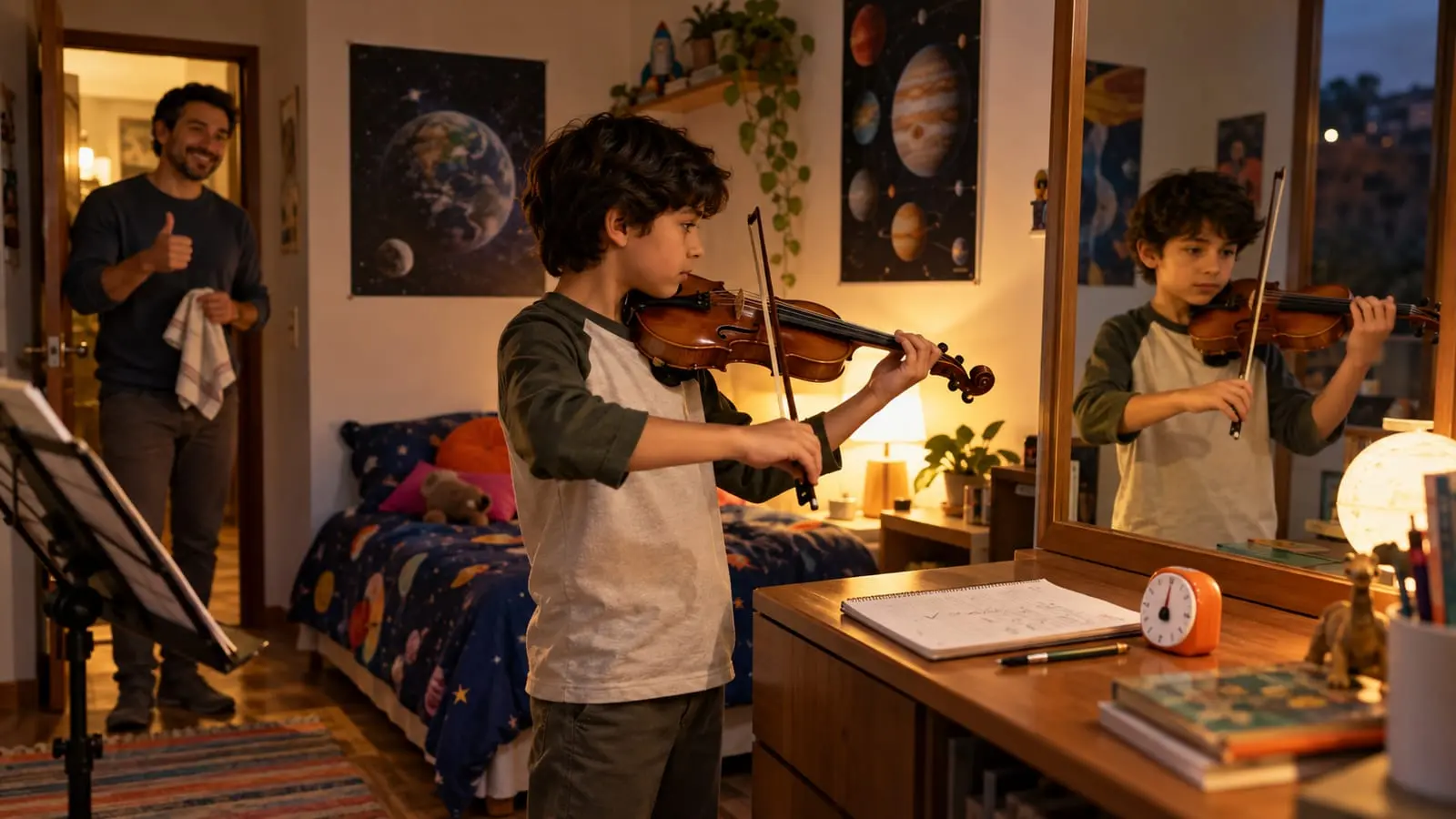
Practicing well matters more than practicing a lot. Twenty well-organized minutes most days will do more for you than one long weekend session. The formula is simple: warm up, work on one aspect of technique, learn your piece in short passages, review something you already know, and finish with something you enjoy.
This routine works for any instrument and for singing, for children through adults. Adjust the times to your age and your teacher's instructions.
In short
- Consistency wins: 20 minutes most days is more effective than two hours once a week.
- Divide practice into blocks: warm-up, technique, your piece, review, and a free-choice ending.
- Practice slowly in short passages; increase the metronome speed only when you can play the passage cleanly.
- Recording yourself and keeping a practice log reveals progress and mistakes you don't notice while playing.
- With children, the adult provides support and celebrates effort; they don't replace the teacher or turn practice into punishment.
The 20-minute routine, step by step
| Block | Time | What to do |
|---|---|---|
| 1. Warm-up | 3 minutes | Tune, relax your body, and play something slow and simple. |
| 2. Technique | 4 minutes | Just one exercise: a scale, a chord change, a bow stroke, or a vocal exercise. |
| 3. Piece | 8 minutes | Work on a passage from the piece or song you're learning. |
| 4. Review | 3 minutes | Play something you already do well, all the way through and with musical intention. |
| 5. Play and explore | 2 minutes | Improvise, work out a song by ear, or create something of your own. |
1. Warm-up
Gently stretch your shoulders, neck, and hands, tune your instrument, and play something slow: a scale, long notes, or a simple exercise. If you sing, begin with breathing exercises, lip trills, and gentle sirens; in your first singing lessons, we explain why you shouldn't skip this step.
2. Technique
Choose one goal per day: the one your teacher assigned. Four focused minutes on a chord change are better than ten minutes running through everything without a focus.
3. Piece
This is the heart of practice. Don't play the whole piece over and over: identify the passage that gives you the most trouble and work on it separately. Below, we explain how.
4. Review
Playing something you've already mastered reinforces memory, builds confidence, and reminds you that you're making progress. Use it to focus on tone, dynamics, and expression.
5. Play and explore
Finish with something open-ended: improvise using a scale, try to work out the chorus of a favorite song by ear, or invent a melody. This is the block that makes you want to come back tomorrow.
If what you want is to unwind from your day rather than make progress, learning an instrument to manage stress suggests a session designed for being present and enjoying yourself.
How to work on your piece without getting frustrated
- Break the piece into short passages of two to four measures.
- Start with the difficult passage, rather than always starting at the beginning.
- Play slowly—as slowly as you need to play without mistakes.
- On piano, practice hands separately first, then together.
- Once you can play a passage well several times in a row, connect it to the next one.
- Use a pencil to mark fingerings, breaths, or reminders on your sheet music.
If a mistake keeps happening in the same place, it isn't bad luck: that spot needs more slow practice. Write it down so you can ask your teacher about it.
Metronome, recordings, and a practice log
Make the metronome your ally
Find the speed at which you can play the passage cleanly and with ease, even if it's very slow. Play it several times at that tempo, then raise the metronome by a few beats per minute. If things fall apart, take a step back. A free phone app is enough.
Record yourself
While playing, your attention is on your hands, and you don't hear everything. Recording a passage on your phone and listening afterward reveals details of rhythm, intonation, and tone that you miss in the moment. Saving one recording a week also lets you see how far you've come.
Keep a practice log
A simple notebook or a note on your phone is enough. For each session, record:
- The date and minutes practiced.
- The technique you worked on and the passage you practiced.
- The metronome tempo you reached.
- What went better than yesterday.
- The questions you want to ask your teacher.
Tips for children and families
- Set the same practice time each day, such as after the afternoon snack or before bath time.
- For younger children, five- to ten-minute blocks may be enough; it's better to stop while they still want to play than when they're tired.
- Use a calendar with stickers or check marks to make consistency visible.
- Support your child without correcting everything: ask what the teacher taught them and invite them to show you.
- Organize mini concerts for the family to celebrate what's been learned.
- Never use practice as a punishment or cancel it as a reward.
- Stay in touch with the teacher: share what works at home and what's difficult.
If your child is in early music education, home practice is mainly play: singing, dancing, clapping a steady pulse, and exploring sounds.
Set up a practice corner
The easier it is to get started, the more you'll practice. A ready-to-use space removes excuses:
- Keep the instrument visible and within reach on its stand, if it's safe to leave it out of its case.
- A music stand at eye level and good lighting.
- A chair or bench at the right height for your instrument.
- A pencil, eraser, practice notebook, tuner, and metronome.
- Your phone on do-not-disturb mode, except when using it for the metronome or recording.
If you take online lessons, you can use the same corner to connect. We explain how to prepare it in our guide to in-home or online music lessons.
Common practice mistakes
- Always playing the whole piece from beginning to end, carrying the same mistakes along.
- Going too fast before you can play the passage cleanly.
- Practicing only what you can already play and avoiding the difficult parts.
- Skipping the warm-up.
- Sitting down without a clear goal for the session.
- Cramming all the week's practice into one day.
Frequently asked questions
How many days a week should you practice?
Ideally, most days, with one or two days off. Regularity matters more than duration: your brain and hands consolidate learning better with frequent sessions.
What if my child doesn't want to practice?
Check whether the session is too long, whether your child likes the music, and whether there is a fixed practice time. Shortening sessions, adding a game at the end, and talking to the teacher about adjusting the repertoire usually help more than insisting.
How can I practice without disturbing the neighbors?
It depends on the instrument: a digital piano or electric guitar lets you use headphones, violins and other string instruments have practice mutes, and agreeing on reasonable practice times always helps. Ask your teacher about options for your instrument.
Is it wrong to practice for more than 20 minutes?
No. The 20 minutes are a realistic starting point. If you have more time, extend the technique and piece blocks, and take short breaks to rest your hands or voice.
Sources
We checked the facts in this article against these sources on October 22, 2026.