
How to learn music from scratch: where to start
You don't need prior talent or to know how to read sheet music. You need an instrument that motivates you, rhythm and ear training from day one, and a short but consistent routine.
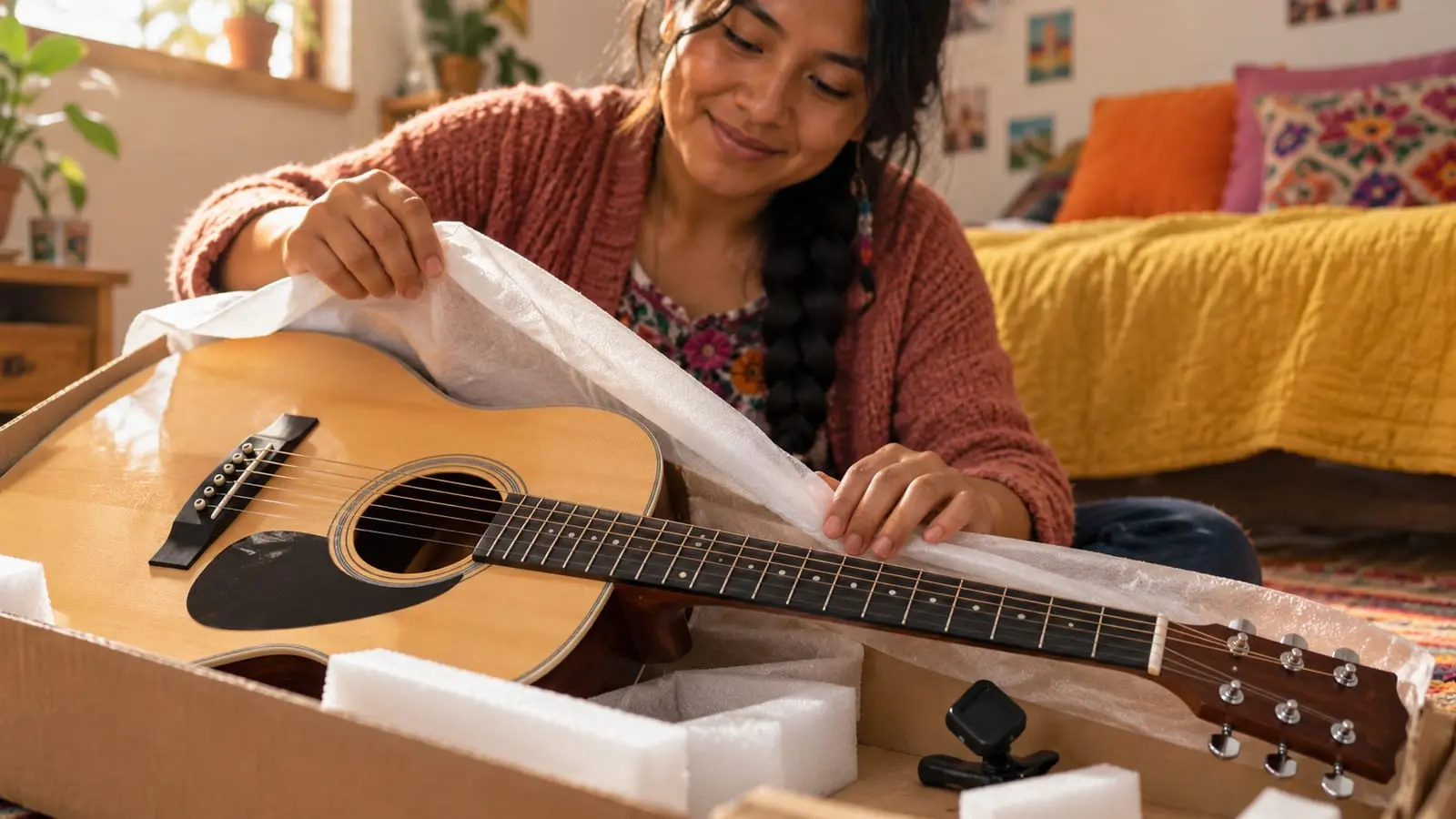
To learn music from scratch, start with three things at once: an instrument you want to play, rhythm and ear-training exercises from day one, and a short routine you can maintain almost every day. You don't need to read sheet music or have "talent": reading and theory develop as you play, not beforehand.
The most common mistake is spending weeks studying theory without playing, or the opposite: copying tutorials without understanding what's happening. Here's a structured path for your first few weeks.
In short
- You don't need existing talent or music-reading skills to begin: you develop those skills along the way.
- Choose your instrument based on the music you want to play, rather than which one seems easiest.
- Train your sense of pulse and your ear from day one: clap with a metronome, sing what you play, and work out simple melodies by ear.
- Theory pays off when you apply it to your instrument right away; learn it in small doses.
- Ten to twenty minutes almost every day, with someone to correct your posture early on, are worth more than weekend marathons.
What starting from scratch really means
If you recognize a song on the radio from its first notes or tap your foot to the beat without thinking, you already have a musical foundation. Starting from scratch means organizing what you already sense into four skills, practiced separately and then combined:
| Skill | What it is | How to practice it at first |
|---|---|---|
| Beat and rhythm | Feeling a steady beat and subdividing it | Clapping, walking to the beat, counting aloud with a metronome |
| Ear training | Recognizing and reproducing pitches | Singing, copying short melodies, comparing high and low notes |
| Technique | How your body produces sound on the instrument | Posture, slow exercises, feedback from a teacher |
| Reading and theory | Understanding and writing down what you hear | Note names, rhythmic values, basic scales and chords |
Nobody starts with all four skills at the same level. The important thing is not to neglect any of them: someone who only works on technique ends up playing without a feel for time, while someone who only studies theory can explain a chord but can't play it.
Step 1: choose an instrument that makes you want to practice
The useful question isn't which instrument is easiest, but which one you'll want to play on a Tuesday night when you're tired. Think about the music you listen to: if you like ballads and pop, try piano, guitar, or singing; if you like rock, electric guitar, bass, or drums; if salsa moves you, trumpet, trombone, or percussion; if Colombian Andean music appeals to you, tiple or bandola.
| Instrument | Getting started | Keep in mind |
|---|---|---|
| Piano or keyboard | Each key gives you an in-tune note from day one | Coordinating two hands takes patience |
| Acoustic guitar | You can accompany songs with just a few chords | Your fingertips hurt at first |
| Singing | You don't need to buy anything | It takes technique to avoid straining your voice |
| Violin | A clean sound and good intonation take longer to develop | Very rewarding once your bowing becomes steady |
| Wind instruments (saxophone, trumpet, flute) | First, you need to produce a steady sound | You train your embouchure with long tones |
Also consider space, neighbors, and your instrument budget. If you're deciding between the two most common options, read our comparison of piano or guitar as a first instrument.
Step 2: train rhythm and your ear from day one
These are the skills most often neglected when you start on your own, and the ones that stand out most when you play with others. You don't need an instrument to work on them:
- Set the metronome to a slow tempo and clap exactly on each click. Then count "one, two, three, four" aloud and accent beat one.
- Listen to a song and walk to the beat. Then try to identify where the kick drum or bass comes in.
- Play or listen to a note and sing it. If your voice is higher or lower, adjust until it blends with the sound.
- Work out familiar melodies by ear, such as Cumpleaños feliz, starting on any note.
- Listen to two notes in a row and say whether the second goes up, goes down, or stays the same.
Singing what you play is an underrated shortcut: if you can sing it, your ear has already grasped it. To learn more about how musical hearing works, read perfect pitch and relative pitch.
Step 3: learn just enough theory and apply it to your instrument
Theory isn't a prerequisite for starting, but it saves you months of guesswork. Learn it in this order and apply each topic to your instrument that same week:
- Solfège syllables: do, re, mi, fa, sol, la, si. In Colombia, songbooks often use letter notation (C, D, E, F, G, A, B), so learn both systems.
- Pulse and basic note values: whole, half, quarter, and eighth notes, always counting and playing.
- Meter: why some songs are counted in four and others in three, such as pasillo or waltzes.
- The C major scale and the concepts of whole steps and half steps.
- Major and minor chords: three notes sounding together that underpin almost every song.
- Reading on the staff, gradually and with very simple pieces.
If you want to understand music in depth or plan to study it at university, music theory lessons organize all of this through reading, rhythm, and listening exercises.
Your first few weeks: a realistic path
Everyone progresses at their own pace, but here's a guide to what usually happens when you practice a little almost every day and take a weekly lesson:
| Stage | What to work on | Signs you're on track |
|---|---|---|
| First two weeks | Posture, first notes or chords, pulse with a metronome | You sit or stand without tension and produce a clear sound |
| First month | A very simple song or piece, C major scale, quarter- and eighth-note rhythms | You play a complete passage without stopping |
| Second and third months | Complete short pieces, first chord changes or playing with both hands, basic reading | You learn a new piece faster than your first one |
To organize each session, follow our 20-minute practice routine. That's enough at first: consistency matters more than duration.
Common mistakes when starting from scratch
- Trying to play fast from the beginning. Speed comes from playing slowly and cleanly many times.
- Learning only from tutorials with nobody checking your posture. Bad habits take hold in weeks and take months to correct.
- Buying the cheapest instrument you can find, or the most expensive, without advice. A poorly adjusted instrument makes everything seem harder than it is.
- Skipping rhythm because "I can already play the notes." Playing the right notes out of time still sounds bad.
- Comparing yourself to videos of musicians with years of experience.
- Giving up at the first plateau: those weeks when you feel you're not progressing. It almost always comes just before a breakthrough.
Frequently asked questions
Can you learn music without knowing how to read sheet music?
Yes. Many musicians start by playing by ear or using chords and learn to read later. Reading helps you learn new repertoire independently, so it's worth adding gradually, but it isn't a condition for starting.
What's the easiest instrument to learn from scratch?
No instrument is entirely easy; each presents challenges at a different stage. Piano gives you in-tune notes from the start, guitar lets you accompany songs early on, and singing doesn't require buying anything. The easiest is usually the one you like most, because that's the one you'll practice.
Am I too old to start learning music?
No. Adults often learn more systematically and grasp theory quickly; what changes is their goals and available time. With short sessions and repertoire you enjoy, you can progress at any age.
Do I need an instrument before my first lesson?
Ideally, you should have one to practice between lessons, but talk to your teacher before buying. They can advise you on size, type, and what to check so you don't end up with an instrument that makes learning harder.
Sources
We checked the facts in this article against these sources on October 22, 2026.