Dara C.🇨🇴
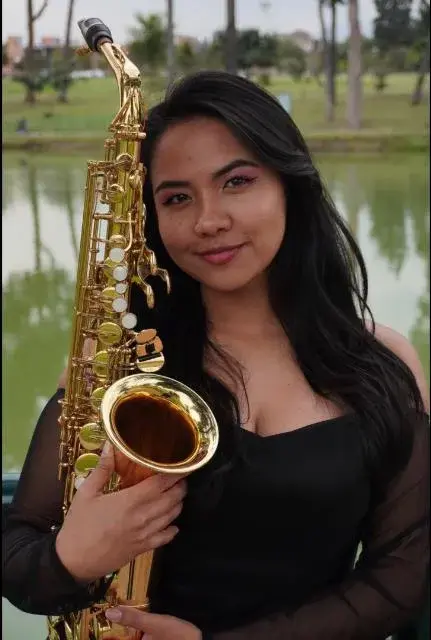
I'm Dara, a saxophonist who helps you fall in love with performing. Come explore this world full of magic with me.
WhatsApp
- Bogotá
- Online
- At home

Although made of metal, the saxophone belongs to the woodwind family because it produces sound with a reed, just like the clarinet. It is a defining instrument of jazz and also features in soul, funk, pop and Colombian tropical bands. Lessons work on tone, reading and improvisation from the start, using repertoire drawn from the music you enjoy listening to.
From USD 69.99 per 90-minute class (an hour and a half). See prices
Every teacher has passed our assessment of musical skills, teaching ability and personal qualities before their first lesson. Explore their profile and contact them directly.
I'm Dara, a saxophonist who helps you fall in love with performing. Come explore this world full of magic with me.
From age 9
As a guideline, many children start around age 9 or 10, almost always on alto saxophone, which has the most manageable size and weight. Before that age the instrument can feel heavy and the keys sit too far from the fingers, so some children start with recorder and move on to sax later. It's only a rough guide: the teacher looks at each child's hand size, posture and motivation. Adults can start at any age, and many come to the sax out of a love of jazz or soul.
You can work on improvisation from the beginner level, which turns every practice session into a creative space.
It fits into lots of groups: big bands, jazz combos, rock and soul bands, tropical orchestras and concert bands.
Its flexible, voice-like sound invites you to develop your own personal phrasing.
It's very motivating for teens and adults who want to play the music they listen to every day.
Online lessons from anywhere or at home in Bogotá and the surrounding area, for kids, teens and adults.
Message us on WhatsApp with your age, level, availability and whether you prefer online lessons or lessons at home.
We recommend the teacher who best suits your goals, or you can choose directly from their profile.
Lessons at your pace, with clear practice tasks and feedback on your progress.
Lessons are live video calls with the same teacher each week. They are in Spanish, and some teachers also teach in English. Colombia keeps the same time year-round (UTC−5), so it's easy to arrange a regular time wherever you are.
The same time as Bogotá.
One hour behind Bogotá.
The same time in winter and one hour ahead in summer.
Three hours behind in winter and two in summer.
Two hours ahead of Bogotá.
Six hours ahead in winter and seven in summer.
Most people start on alto saxophone, because its size, weight and resistance are in the middle of the range and there's plenty of study material for it. Tenor is a good option for teens and adults who want a deeper sound. Soprano is usually left for later, because it's harder to play in tune.
It's made of metal, but it's classified as a woodwind because the sound is produced by a reed vibrating against the mouthpiece, as on the clarinet. That's why the two share the single-reed embouchure and several fingerings.
Yes. The technical foundation (tone, intonation, reading) is the same for any style, but early on you can work on blues, simple standards and improvisation exercises. Your teacher balances technique and repertoire so you build solid fundamentals without losing motivation.
No. Reading is learned alongside the instrument, step by step, and at the same time you develop your ear to figure out melodies, which is key in jazz and popular music. If you want to work on reading separately, you can add music theory.
We give in-home lessons in and around Bogotá. Coverage depends on the neighborhood and each teacher’s availability, so send us your approximate address and we’ll confirm.
Yes, through live online lessons by video call, from any city in Colombia or abroad, with the same weekly follow-up. See how online music lessons work.
Each lesson lasts 90 minutes. With the monthly plan of 4 classes, each lesson costs less than a single class. See your rate on our pricing page.
Leave your name and WhatsApp number. We'll message you to understand what you're looking for and recommend teachers and times. No commitment.
Tell us your age, level and availability. We'll reply on WhatsApp with the teacher who best suits your goals.