
How to prepare for your first music recital
A good recital is prepared weeks ahead. This timeline tells you what to do at each stage, what to bring and how to handle performance day.
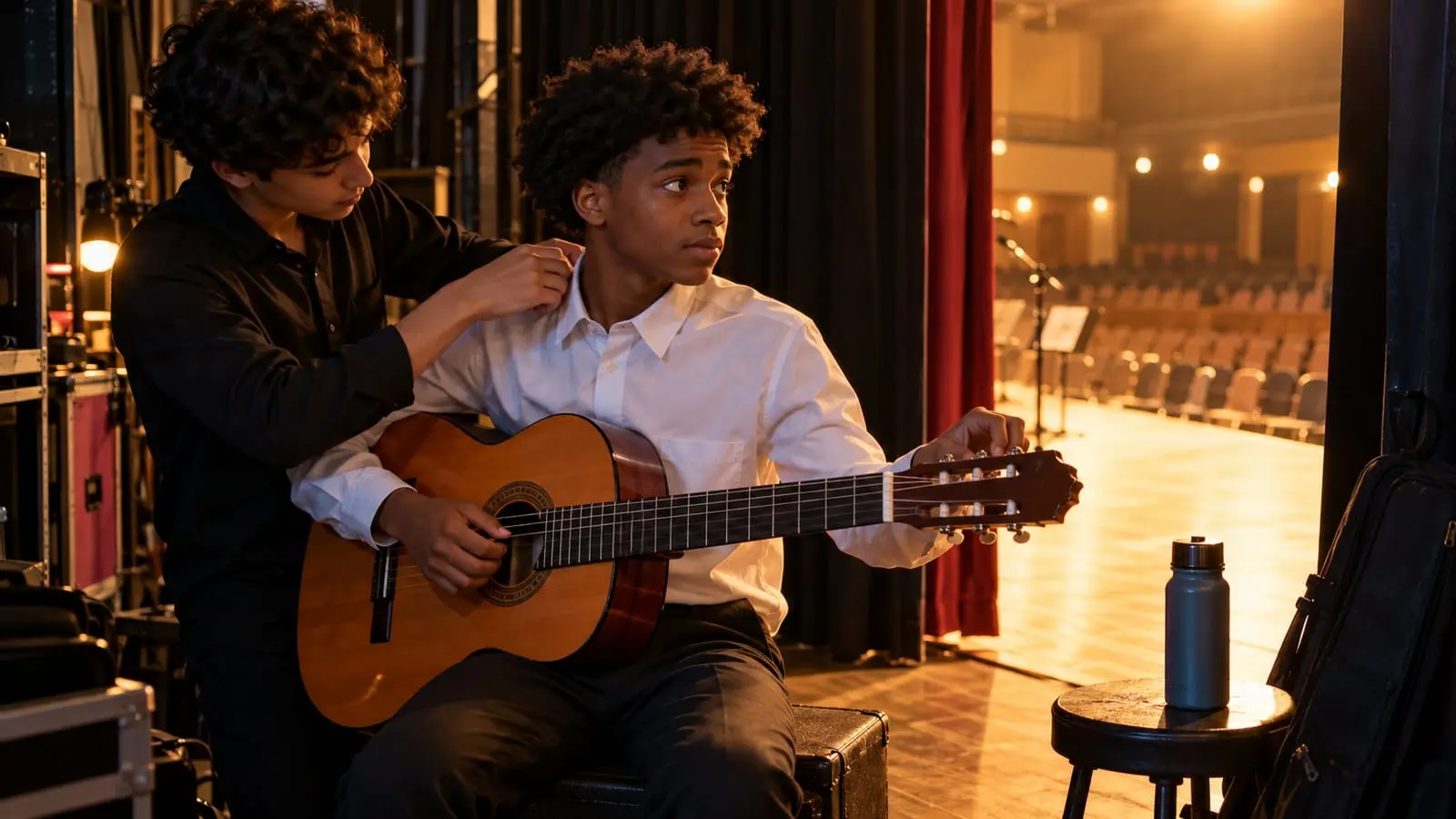
For your first recital, have your piece ready a few weeks before the date, rather than the night before. That extra time is for giving it a few test runs: playing it all the way through without stopping, in front of others, and in conditions similar to the performance itself. In the final week, you refine what you already know rather than learning anything new.
Here is a week-by-week schedule, advice on rehearsing for your instrument, what to bring, and what to do from the moment you arrive until your final bow.
In short
- Choose a piece with your teacher that is slightly below your maximum level: onstage, your playing may drop a little.
- You should be able to play the whole piece confidently at least two weeks beforehand; use the remaining time for practice performances.
- Rehearse the entire routine: walking on, greeting the audience, getting settled, tuning, starting, and finishing, wearing your recital outfit and shoes.
- Do not change fingerings, bowings, or breathing points in the final week.
- If you make a mistake, keep playing: stopping is much more noticeable than a wrong note.
Choose a piece you can play comfortably
Your first recital is not the time to debut the hardest piece you have attempted. Choose something with your teacher that you already play well at home and can enjoy. Under pressure, skills at the edge of your ability tend to fall apart; those you can manage comfortably hold up.
- Choose something you like: you will play it many times over the coming weeks.
- It should fit the recital's allotted time; student recitals usually feature short pieces.
- You should already be able to play its hardest passage cleanly at close to the performance tempo.
- For children, choose a piece they recognize and want to share with their family.
Timeline: from six weeks before to the day before
| Moment | Goal | What to do |
|---|---|---|
| Six to four weeks before | Secure notes and rhythm | Work through difficult passages slowly in small sections; settle on fingerings |
| Four to three weeks before | Performance tempo and expression | Increase the tempo with a metronome, work on dynamics and phrasing, and memorize if needed |
| Two weeks before | Play the entire piece without stopping | Play through from start to finish, record yourself, and play for your family |
| Final week | Stability | Dress rehearsals, slow run-throughs to check accuracy, no new changes |
| The day before | Rest | One relaxed run-through, prepare your outfit, sheet music, and instrument, and sleep well |
To increase your tempo without losing clarity, raise the metronome a few beats per minute at a time and go back if the passage becomes uneven. If you will be playing without sheet music, start memorizing early: we explain how in how to memorize a piece of music.
Rehearsals that recreate performance day
Playing well in your room is different from playing in a room full of people. Make your rehearsals more like the real performance:
- Play all the way through without stopping, whatever happens. This is a different skill from practicing in sections.
- Rehearse the full routine: walking on, greeting the audience, adjusting the bench or music stand, tuning, breathing, starting, and finishing with a bow.
- Play at least once in your recital outfit and shoes. New shoes change how you press the pedal or stand.
- If you have an accompanist, rehearse with them several times, rather than only the day before.
If you play piano
Ask whether you can try the venue's piano. If not, practice on other pianos you have access to: key weight and pedal response vary considerably. Learn to adjust the bench height in seconds. In piano lessons, you can ask your teacher to simulate the whole recital in one session.
If you play violin
Practice tuning quickly and quietly with the violin tuner, then by ear with your accompanist. Check your strings a few days beforehand, rather than on recital morning, so a new string has time to settle.
If you sing
Rehearse with the backing track or accompanist exactly as you will perform: the same key, the same introduction, and a microphone if you will use one. Practice coming in after the introduction without looking to someone else to count for you.
What to bring on recital day
| Instrument | Do not forget |
|---|---|
| Everyone | Sheet music (even if playing from memory), water, a light snack, and a cloth to dry your hands |
| Piano | Comfortable shoes with thin soles for pedaling, and a cushion if you need extra height |
| Violin and viola | Rosin, spare strings, shoulder rest, tuner, and cleaning cloth |
| Guitar | Spare strings, tuner, footstool or support, and filed nails if playing classical guitar |
| Singing | Room-temperature water, and your backing track on your phone plus a backup copy |
| Wind instruments | Spare reeds you have already tested, oil or grease, and a cloth for condensation |
For clothing, aim for smart but comfortable. If you need to lift your arms, sit, or breathe deeply, try playing in your outfit before the day.
Recital day, step by step
- Eat something light a few hours beforehand. Playing hungry or too full affects your concentration and breathing.
- Arrive with plenty of time. In Bogotá, allow for traffic and cold weather: bring something to keep your hands warm.
- Get to know the space: where you will stand or sit, where you enter, and how the room sounds.
- Keep your warm-up brief and gentle. Do not play the entire piece over and over backstage.
- Tune your instrument and have it ready before your turn.
- While you wait, breathe slowly and listen to the others instead of imagining possible mistakes.
- When you walk onstage, greet the audience, settle in without rushing, and think of the first phrase's tempo before starting.
- If something goes wrong, keep going. When you finish, pause briefly, lower your instrument, and acknowledge the applause.
If nerves are your main concern, we offer practical tools in how to overcome stage fright.
If it is your child's first recital
- A few weeks beforehand, take them to a concert or recital so they know what the atmosphere is like.
- Practice walking on and greeting the audience at home as a game, with the family as the audience.
- Before they go on, remind them to enjoy it; avoid comments such as “don't make a mistake.”
- Record without flash and avoid distracting them from the front row.
- Afterward, celebrate their effort and courage. Leave technical feedback to the teacher in the next lesson.
A positive recital experience makes you want to perform again. Too much pressure can have the opposite effect, especially for young children.
Frequently asked questions
Do I have to play from memory at my first recital?
It depends on the recital and what you agree with your teacher. Playing with sheet music is common at student recitals, especially the first time. If you choose to play from memory, start memorizing weeks beforehand and keep your sheet music handy anyway.
What should I do if I make a mistake during the recital?
Keep the pulse going and pick up at the next secure point in the piece. Do not repeat the passage or react visibly. The audience almost always remembers the overall impression, rather than a single note.
What should I wear to a music recital?
Formal or semiformal clothes that let you move and breathe freely. Try playing in them beforehand: wide sleeves, very short skirts, or new shoes can get in the way, depending on your instrument.
Is it a good idea to practice a lot on recital day?
No. One or two relaxed run-throughs and a short warm-up are enough. Too much practice tires your hands or voice and increases anxiety just before you perform.
Sources
We checked the facts in this article against these sources on October 22, 2026.