
In-home, online or hybrid music lessons: how to choose
What in-home and online lessons are like, what you need for each, and when it makes sense to combine them. A guide to choosing based on the learner and their instrument.
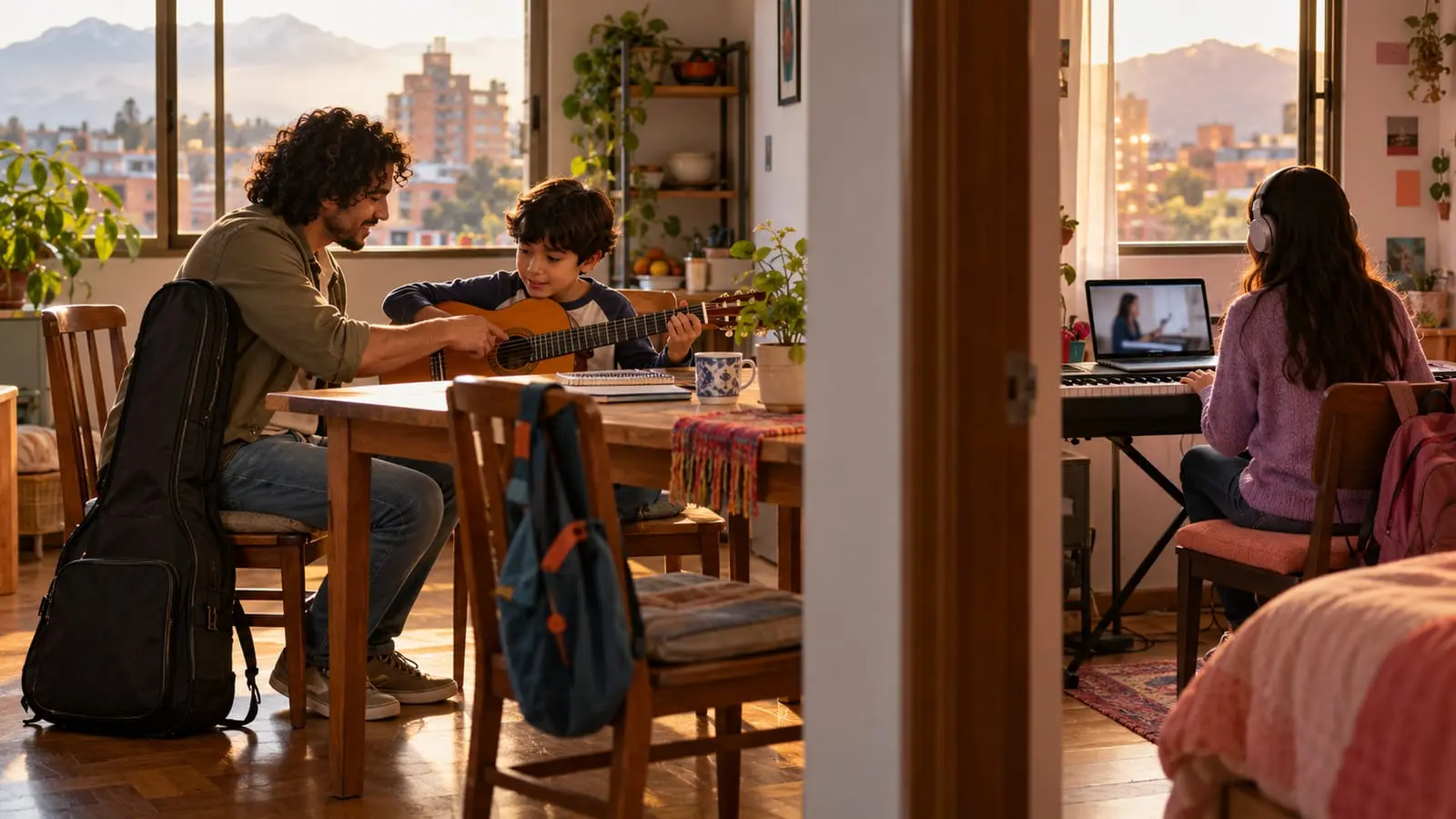
All three options work with a good teacher and consistent practice. Lessons at home work best for young children, complete beginners and instruments where posture is easier to correct with the teacher beside you. Online lessons save travel time and let you study from any city or country. And hybrid lessons combine both with the same teacher and the same plan.
At Gissi, in-home music lessons in Bogotá and online music lessons are one-on-one, taught by the same team of evaluated teachers, and cost the same (see our prices). This guide helps you decide which format suits you today and what each one is like.
In short
- In-home lessons suit young children, beginners and anyone who needs hands-on posture guidance; online lessons suit teens and adults with busy schedules or who live far away.
- Signal delay makes it impossible to play in sync over a video call, so online lessons use turn-taking.
- You don’t need a music room: for in-home lessons, a quiet, well-lit corner and an extra chair are enough; for online lessons, you need a stable connection and a camera that shows your hands and instrument.
- Singing, piano, guitar, and theory work very well online; violin, wind instruments, percussion, and introductory music lessons benefit more from having the teacher there in person at first.
- You don't have to choose forever: you can take some lessons at home and others online with the same teacher.
At home or online: a quick comparison
| Aspect | At home | Online |
|---|---|---|
| Posture correction | The teacher can see you from every angle and guide your hand and body position on the spot. | Depends on the camera angle; the teacher corrects through instructions and demonstrations. |
| Travel | You stay put: the teacher comes to your home. | No one travels; you just need an internet connection. |
| Schedule | They depend on your area and the teacher's travel time. | More flexible; they fit busy schedules and travel plans. |
| Young children | Ideal: direct interaction supports attention and play. | Possible from age 7 or 8, with an adult nearby to help. |
| Sound quality | The teacher hears the instrument’s actual sound and its nuances. | Audio travels through a microphone and the internet, and some nuances get lost. |
| Playing together | Duets and real-time accompaniment are possible. | Signal delay prevents synchronized playing; you take turns. |
| Where you live | Bogotá and the surrounding area. | Any city or country, taking the time difference into account. |
Neither column wins on every point. The useful question is what matters more in your situation: personal interaction and hands-on adjustments, or flexibility and distance.
What an in-home lesson is like
The teacher comes to your home on the agreed day and time, works with your own instrument, and gives you a specific assignment for the week. You coordinate through WhatsApp, and before you start, you can get to know the teachers in the directory. In-home lessons are available in Bogotá and the surrounding area, depending on your location and each teacher's availability.
What to expect from the first lesson
It's a lesson for getting to know each other. The teacher checks your instrument, listens to what you already know (even if you're starting from scratch), talks about your tastes and goals, and starts from there. The first few weeks focus on the foundation for everything else: posture, how to hold the instrument, a steady beat, and your first simple pieces. Progress may feel slow at first; this is when habits take shape.
What space you need
You don't need a special room. Here's what does make a difference:
- A quiet place away from the TV and household foot traffic.
- Good lighting on the instrument and sheet music.
- An extra chair for the teacher beside the student, rather than opposite: they usually need to observe and demonstrate from the side.
- A music stand, even a basic one. Reading music laid on a table makes you hunch over.
| Instrument | What to have ready |
|---|---|
| Piano or keyboard | An adjustable-height bench and a keyboard on a sturdy stand, not on the bed. If an acoustic piano hasn't been tuned in a long time, the teacher will let you know: an out-of-tune piano undermines ear training. |
| Violin or viola | A correctly sized instrument, a rosined bow and clear space on the right to move it. |
| Guitar | An armless chair and, for classical guitar, a footstool or guitar support. |
| Singing | Water, room to stand comfortably, and a keyboard nearby if you have one. |
| Early music education | Clear floor space for movement, a rug and no fragile objects nearby. |
One advantage of lessons at home is that the teacher sees where you actually practice. If your piano bench is too low or your music stand is in the shadows, they'll point it out on the first visit.
Punctuality and scheduling
- Have your instrument out of its case and your sheet music on the stand before the lesson starts; every minute spent waiting comes out of your lesson time.
- If you live in a residential complex or apartment building, let the front desk know the teacher is coming.
- If anything changes, let the teacher know through WhatsApp as early as possible. In Bogotá, a downpour or traffic jam can throw off any estimate, so it's best to agree from the start on how to handle changes and cancellations.
- Save the last few minutes for the week's practice assignment.
The family's role and safety
With children, the family is part of the process, but the role changes with age:
- Ages 3 to 6: in introductory music lessons, the teacher may invite an adult to join games and songs. If they do not ask, it is best to stay nearby without intervening.
- Ages 7 to 12: an adult can stay in the next room with the door open. Correcting or adding to what the teacher says during the lesson often distracts the child.
- Teens and adults: more independence; an occasional conversation with the teacher about progress and difficulties is enough.
Letting someone into your home takes trust. That's why every Gissi teacher is assessed on musicianship, teaching skills, and personal qualities before teaching their first lesson. With minors, it's also good practice to always have an adult at home, hold the lesson in a shared space or with the door open, and coordinate schedules with the parent or guardian. Your role during the week is to help make practice happen, not to become a second teacher.
What an online lesson is like
It's the same one-on-one lesson, live over a video call with an Gissi teacher, from whatever city or country you're in. To see how it works with our teachers, visit online music lessons.
What you gain
- Time: in a city like Bogotá, traveling to and from a lesson can take longer than the lesson itself. Online, connecting takes a couple of minutes, and that difference often determines whether you keep up lessons for months.
- Choose a teacher for what they teach, not where they live: if you live in a town with no lessons available for your instrument or outside Colombia, distance no longer limits your choices.
- Clearer theory lessons: the teacher can share their screen, show you the sheet music, point out a measure, or play a reference recording. For music theory, music reading, and harmony, the screen is an advantage.
- Continuity: a vacation or a week working out of town no longer means losing momentum, as long as you have a stable connection.
What to expect from the first lesson
Just as with lessons at home, the first lesson is a chance to get to know each other: the teacher listens to you, checks your instrument and camera setup, and helps you make basic adjustments so they can see your hands and hear clearly. It's normal for this to take up part of the session. Testing your setup the day before, rather than five minutes before, saves that time.
What you need
- A computer, tablet, or phone with a camera, plus a stand to position it to your side.
- A stable connection. If you can, use an Ethernet cable or sit near the router, and ask others at home to avoid downloading large files during the lesson.
- Audio without aggressive filtering: video call apps' noise suppression is designed for speech and can cut off sustained notes or quiet sounds. Zoom, for example, has an original sound mode for musicians.
- A regular practice spot with light coming from the front or side (never from behind you), your instrument tuned, a notebook, and anything the teacher asks for.
The equipment isn't expensive, but it helps to position it well. For cameras and microphones, see the equipment guide for online lessons; for lighting, camera angles, and your practice corner, see how to prepare your space.
The limits and how to work around them
| Limitation | What happens in practice | How to address it |
|---|---|---|
| Signal delay | You and the teacher can't play or sing together at the same time. | You take turns during the lesson: the teacher demonstrates, you play, and they give you feedback. |
| Compressed audio | Soft dynamics, tone color, and some intonation details come through less accurately. | Audio without noise filters and, if needed, short recordings made with a phone close to the instrument, which sound better than the call. |
| No physical contact | Your teacher cannot physically adjust your wrist, shoulder, or bow hold. | More precise instructions, demonstrations on camera, and, if needed, a few in-person lessons. |
| A single camera angle | Anything outside the frame cannot be corrected. | Move the camera to suit each part of the lesson. |
| Unstable connection or distractions | Video or audio cutting out, notifications, family, or pets. | Use an Ethernet cable or sit near the router, set your phone to Do Not Disturb, and treat the lesson as a scheduled appointment. |
If you have children, here's more detail on how to support your child during online lessons.
Which instruments and ages suit each format
Instruments
| Instrument | Online | Why |
|---|---|---|
| Singing, piano, acoustic and electric guitar, electric bass, music theory | Very well | With a good camera, the teacher can see the essentials and clearly hear what you play or sing. |
| Violin, viola, cello, flute, clarinet, saxophone, trumpet | Works, with extra care | The camera needs to show the bow or embouchure, and a good microphone makes subtle tuning differences easier to hear. Many students start with lessons at home and move online once their posture is well established. |
| Percussion | Better with in-person support | Microphones often distort or cut off loud strikes. |
| Early music education | Better in person | It's about play, movement, and interaction; attention spans are short in front of a screen. |
Ages and learner profiles
| Profile | Format that tends to work well | Why |
|---|---|---|
| Child under 7, starting with introductory music lessons | At home | Play, movement, and eye contact are part of the lesson. |
| A child aged 7 to 12 | Both; online with an adult nearby | The adult helps with the camera, audio, and staying focused. |
| Complete beginner on a bowed string or wind instrument | At home to start | Posture, bow technique, and embouchure develop better with the teacher by your side. |
| An adult starting piano, guitar, or singing | Online works very well | Usually independent, with a busy schedule, and values avoiding travel. |
| A young learner with some experience who wants to progress | Online or hybrid | Can follow instructions, record themselves, and prepare repertoire between lessons. |
| Someone preparing for admission to a music degree program | Hybrid | Theory, music reading, and dictation work well on screen; instrumental study benefits from having the teacher there in person. See also our music pre-university prep. |
| Someone who wants to play in a group or ensemble | At home | Signal delay prevents playing together in real time. |
If you're unsure because of age, what age to start learning music takes a closer look at what's possible at each stage.
Hybrid lessons: combining home and online
In private lessons, hybrid means alternating between two settings: sometimes the teacher comes to your home, and other times you meet over a video call. At Gissi, you can combine both formats, and since they cost the same, switching between them doesn't make lessons more expensive. What matters is keeping the same teacher and plan: that way, they stay familiar with your hands, your sound, and your habits, and pick up each week where you left off.
| Model | How it works | Best for |
|---|---|---|
| In stages | Start with lessons at home and, once your posture is solid, move online with occasional in-person check-ins. | Beginning violin, cello or wind students, and children just starting out. |
| Alternating | One week at home and the next online, or whatever pattern you agree on. | Students with some experience who want regular posture and technique checks without a visit every week. |
| In-person lessons with an online backup | Lessons are at home, but switch to video calls when you travel or traffic makes it impossible for the teacher to get there. | Families with unpredictable weeks. |
| By subject | Instrument and technique at home; theory, music reading, or dictation online. | Someone preparing for admission tests or combining instrumental study with theory. |
It also helps to schedule in-person lessons in the weeks before a recital: the teacher hears your actual sound, without compression, and works with you on the full performance. And if you live in a town near Bogotá, alternating visits with online lessons can make ongoing study possible, depending on the teacher's availability.
What to work on in each format
- At home: initial posture and hand position, bow hold, embouchure and breathing, tone and subtle nuances, playing duets or with accompaniment, and rehearsing for a recital or audition.
- Online: theory, music reading, and dictation (screen sharing helps), repertoire review, practice planning, and follow-up on skills already established.
How to organize it
- Plan the month, not just the week. Decide which lessons will be at home and which will be online, taking trips, exams, and special dates into account.
- Set a rule for changes. Agree on how much notice to give when switching a lesson from home to online, and how to communicate it.
- Keep your online setup ready even if most of your lessons are at home: stand, camera, and audio tested.
- Come to the in-person lesson with a list of what the teacher needs to see and hear in person: a passage with tone problems, tension in your shoulder.
- Keep a single record. A notebook or shared note with assignments, tempos and questions connects both formats into one learning process.
- Send a short recording before the online lesson, made with your phone close to the instrument, to give the teacher a reference for your actual sound.
Common pitfalls: treating online lessons as second-rate, switching formats at the last minute without ever testing the connection, leaving the most technical work for online lessons, or changing formats too often with young children, who benefit more from a consistent setting than from flexibility.
How to decide
- Who's learning. Under 7 or a complete beginner on bowed strings or winds: start at home. An independent teen or adult: online works very well.
- Which instrument. Singing, piano, guitar, and theory work well on screen; violin, winds, and percussion need more in-person support at first.
- Where you are. If you live in Bogotá or the surrounding area, you have all three options; outside the area, online.
- What your week looks like. If your schedule changes or you travel, keep online lessons as a backup or combine both formats.
- What you want to achieve. Playing in a group or preparing for a recital calls for in-person time; theory, music reading, and repertoire work well on screen.
If you're still unsure, tell us your age, instrument, and routine through WhatsApp, and we'll suggest a format. To assess a teacher in any format, use the questions in how to choose a music teacher, and give it two or three lessons before deciding. Whatever the format, what makes the biggest difference is practicing at home with a short routine.
After four to six weeks, you should be able to say that you leave every lesson knowing what to practice, that the teacher corrects specific things they see and hear, and that the connection or space is no longer an issue. If not, there's almost always something to adjust (the camera, audio, or lesson structure) before ruling out the format; and if posture is the problem, a few sessions at home can help you move forward.
Frequently asked questions
Do online music lessons work for children?
Yes, especially from age 7 or 8, or when the child already has some experience. For younger children, they work better with an adult present to help with the camera and reinforce the teacher's guidance. For introductory music lessons and children under 7, lessons at home are ideal.
Do you learn as quickly online as at home?
It depends more on your practice and teacher than on the format. A consistent student learning piano, guitar, singing, or theory can progress at a very similar pace online. The biggest difference comes at the beginning on bowed strings and wind instruments, because of posture.
How much does an in-home, online, or hybrid lesson cost?
Lessons at home and online cost the same, and combining them doesn't change the price. See the details on our pricing page or message us on WhatsApp with your instrument and preferred format.
Can I take online lessons with a teacher in Bogotá if I live in another city or country?
Yes. You just need a stable connection and to arrange a lesson time that takes any time difference into account.
How often should I have an in-person lesson if most of my lessons are online?
It depends on your instrument and level. For bowed strings and wind instruments, a periodic in-person check helps identify tension or posture habits that the camera may miss. Your teacher can suggest how often based on what they see in your online lessons.
Do I need an instrument before my first lesson?
Ideally, yes, because it is the instrument you will practice on all week. If you do not have one yet, talk to the teacher before buying: they can advise you on size, type and what to check.
Sources
We checked the facts in this article against these sources on October 23, 2026.
- MERLOT Journal of Online Learning and Teaching: perceptions and success in online and in-person music learning (2010)
- Zoom: how to change audio settings in a meeting (original sound for musicians)
- Wikipedia: networked music performance (signal delay prevents playing in sync)
- Yamaha: caring for your piano, tuning, and maintenance
- Yamaha: four tips to help your child start playing piano (parents’ role and practice)
- Pasadena Conservatory of Music: injury prevention guide for musicians (posture and instrument position)