
Hand independence exercises for piano
Hand independence is built in steps: first each hand on its own, then both together in short fragments, with difficulty that rises gradually. Eight exercises to get there.
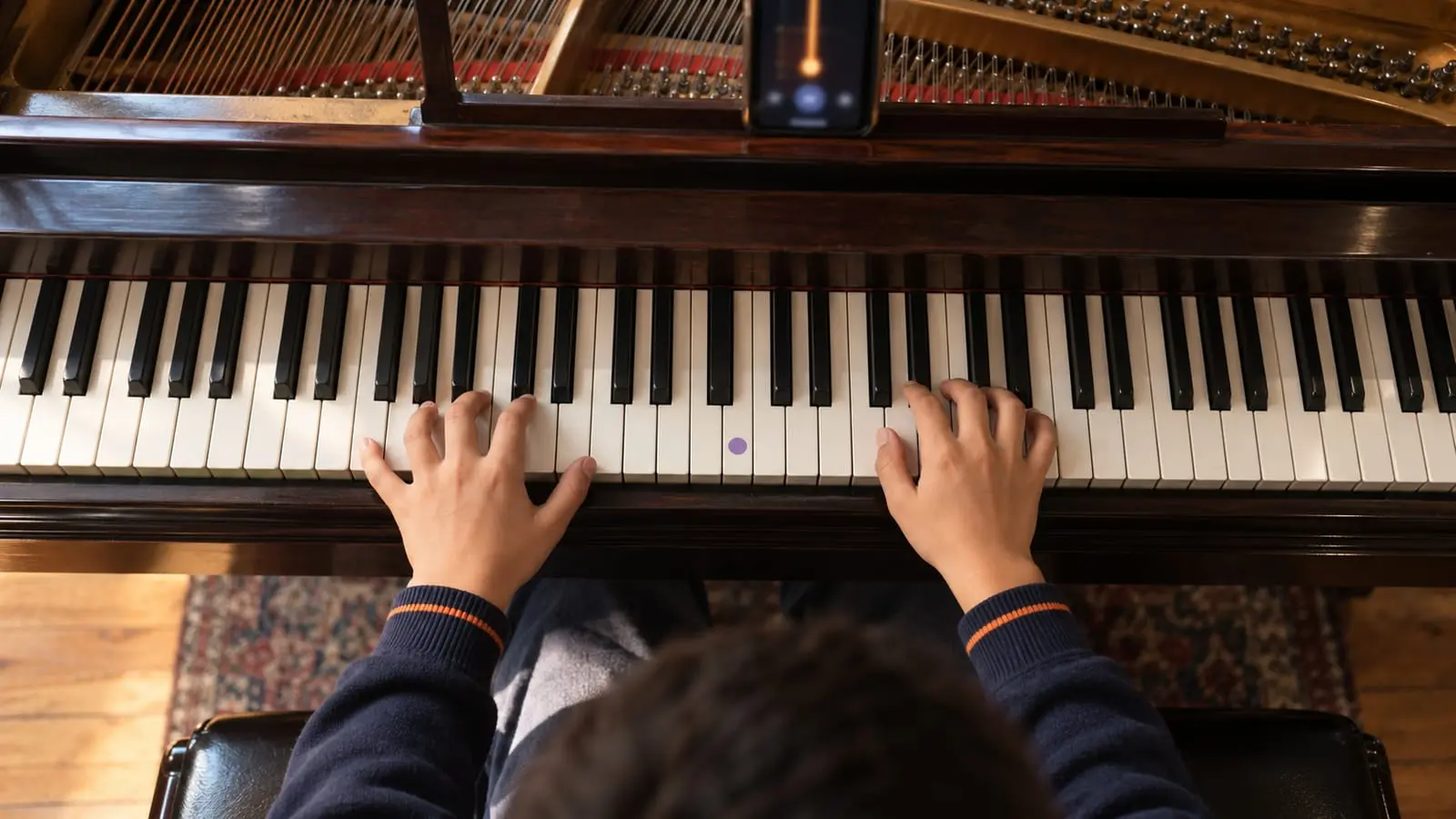
Hand independence on the piano comes from breaking down the challenge, rather than simply playing more. First, each hand learns its part until it feels automatic. Then you put them together very slowly in short sections, adding difficulty in order: both hands moving together (in mirror image or in parallel), one hand holding while the other moves, different articulations, different volumes and, finally, different rhythms.
Here is that progression in eight practical exercises, along with a method for putting hands together in any piece, exercises you can do away from the piano and advice for when one hand pulls the other along.
In short
- Before putting your hands together, each should be able to play its part alone, slowly and without hesitation.
- Put your hands together in sections of one or two measures, slower than you think you need to.
- Increase difficulty in this order: parallel or contrary motion, long notes against short notes, legato against staccato, loud against soft and different rhythms.
- Mark the points in the sheet music where both hands play together.
- Counting aloud with a slow metronome is the most helpful approach when one hand copies the other.
Why it is so hard to make your hands independent
Your body tends to synchronize both hands: if one plays fast, the other wants to do the same; if one presses harder, the other does too. On the piano, we almost always ask them to do something different, because each has its own role: the right hand carries the melody while the left accompanies with a different rhythm, volume and articulation.
That is why a common problem is the left hand copying the right hand's rhythm, or both hands stopping when a difficult note appears in either part. It is not a lack of talent: this is a skill you build in stages. If you have not yet found a comfortable position, first check correct hand position; tension makes everything harder.
A method for putting hands together in any piece
- Right hand alone, until you can play the section three times in a row without mistakes or pauses.
- Left hand alone, using the same standard. It often gets less practice, so give it more time.
- Mark the meeting points. Lightly draw a vertical pencil line where both hands play together. These are your anchors.
- Put two measures together at half the tempo you can already manage with hands separately.
- One hand plays, the other shadows it. Play one hand's part while the other silently makes its movements over the keys without pressing them down. Then switch.
- Link sections together. Once two measures are clean, work on the next two, then join them.
- Increase the tempo gradually, only once you can play the section three times in a row.
Count aloud
Saying “1 and 2 and” as you play makes both hands follow the same beat rather than each other. At first it may feel distracting; within a few days, it becomes a valuable aid.
Eight progressive exercises
Do all of these in a five-finger position at a slow tempo. Move on only when the previous exercise feels comfortable, and always repeat it with the hands' roles reversed.
| Exercise | How to do it | Skills it develops |
|---|---|---|
| 1. Contrary motion | The right hand starts on C with the thumb and ascends (C-D-E-F-G); the left starts on the C below with the thumb and descends (C-B-A-G-F) | Basic coordination: both hands use matching fingers in mirror image |
| 2. Parallel motion | Both hands in C position, an octave apart, move up and down together | Different fingers at the same time: the right hand uses 1-2-3-4-5 and the left 5-4-3-2-1 |
| 3. A long note against short notes | The left hand holds C and G together for four beats; the right plays four quarter notes | Keeping one hand still without releasing the notes |
| 4. Quarter notes against eighth notes | The left hand plays quarter notes on C; the right plays eighth notes up and down the five-finger position | Two note rates at the same time |
| 5. Legato against staccato | The right hand plays the five-finger pattern smoothly connected; the left plays the same notes short and detached | Independent articulation |
| 6. Loud against soft | The right hand plays the melody loudly and the left a soft accompaniment; then switch | Balancing melody and accompaniment |
| 7. Alberti bass | The left hand plays C-G-E-G in continuous eighth notes; the right plays a melody in half notes and quarter notes | A steady pattern in one hand and a freer line in the other |
| 8. Three against two | One hand plays three notes per beat and the other plays two | Rhythms that do not line up; explained below |
How to count three against two
Divide each beat into six equal parts, counting '1 2 3 4 5 6' evenly. The triplet hand plays on 1, 3 and 5; the two-note hand on 1 and 4. Together, they sound on 1 (both hands), 3, 4 and 5.
| Count | 1 | 2 | 3 | 4 | 5 | 6 |
|---|---|---|---|---|---|---|
| Hand playing three notes | X | X | X | |||
| Hand playing two notes | X | X | ||||
| Result | Both | Three | Two | Three |
Start by playing both hands on the same key, or tapping on the table, and only then move to different notes. This appears in many Romantic works, so it is worth mastering before you need it.
Exercises away from the piano: on a table and with your voice
- Beat and rhythm on a table. Tap quarter notes with your left palm and eighth notes with your right hand. Then have the right hand tap a rhythm with rests while the left keeps a steady beat. Switch hands.
- Foot and hands. Tap the beat with your foot while clapping a rhythm. This prepares you for using the pedal later.
- Sing one hand's part, play the other. Play only the left-hand part of your piece and sing the right-hand melody. If you can do this, putting your hands together will be much easier.
- Read the sheet music silently. Follow both parts with your eyes while listening to a recording, noticing where the hands play together.
How to use the metronome for these exercises
The metronome gives both hands an external reference so neither leads the other. Start between 50 and 60 beats per minute with the metronome, playing one note per click in quarter-note exercises and two in eighth-note exercises.
- Increase by four beats per minute only when you can play the exercise three times in a row without mistakes.
- If one hand rushes ahead, slow down instead of pushing on: you are playing at a speed you do not yet control.
- Occasionally try having the click only on beats 1 and 3: this makes you keep the beat internally.
See how to use a metronome for practice for more ways to make the most of it.
Common mistakes when putting hands together
| Error | What happens | Correction |
|---|---|---|
| Putting hands together too soon | Each hand's hesitations add up, and mistakes become ingrained | Return to hands-separate practice until each part feels automatic |
| The left hand copies the right hand's rhythm | The accompaniment becomes uneven | Exercises 3 and 4, plus counting aloud |
| Stopping at every mistake | You lose the beat and the piece never flows | Keep going and mark the spot to work on later |
| Watching only the right hand | The left hand gets lost in the leaps | Memorize the left hand's leaps |
| Always starting from the beginning | The opening is perfect, but the ending never is | Start with the hardest section |
| Tense shoulders when playing hands together | The sound becomes harsh and you tire out | Breathe, relax your arms and slow the tempo |
To apply these exercises to real music, see easy piano songs for pieces arranged by level, some chosen specifically for the hand independence they require. In piano lessons, your teacher chooses the exercise your piece needs at each stage.
Frequently asked questions
How long does it take to develop hand independence?
It is not a switch that flips one day: you develop it in stages throughout your training. With consistent practice, you can usually play your first pieces with a melody and simple accompaniment within the first few months; cross-rhythms such as three against two come much later.
Is it better to practice with hands separately or together?
Both, in that order. Practice hands separately to learn the notes, fingering and rhythm of each part; then together, in sections, to build coordination. Even in advanced pieces, pianists return to hands-separate practice when a passage becomes tricky.
Why is my left hand so clumsy?
In most cases, it gets less practice and has simpler roles in early pieces. Give it its own exercises and let it play the melody now and then, and you will see improvement. For left-handed players, the right hand may have the same problem.
Which pieces help develop hand independence?
Pieces with a melody in one hand and accompaniment in the other, such as Minueto en Sol from the Cuaderno de Ana Magdalena Bach, or pieces from Schumann's Álbum para la juventud, such as “El alegre campesino,” which ask each hand to do more.
Sources
We checked the facts in this article against these sources on October 22, 2026.