
What early music education is and why it's ideal for kids
Before choosing an instrument, children can learn music through play. Here's what early music education is, what a class looks like and which teaching approaches inspire it.
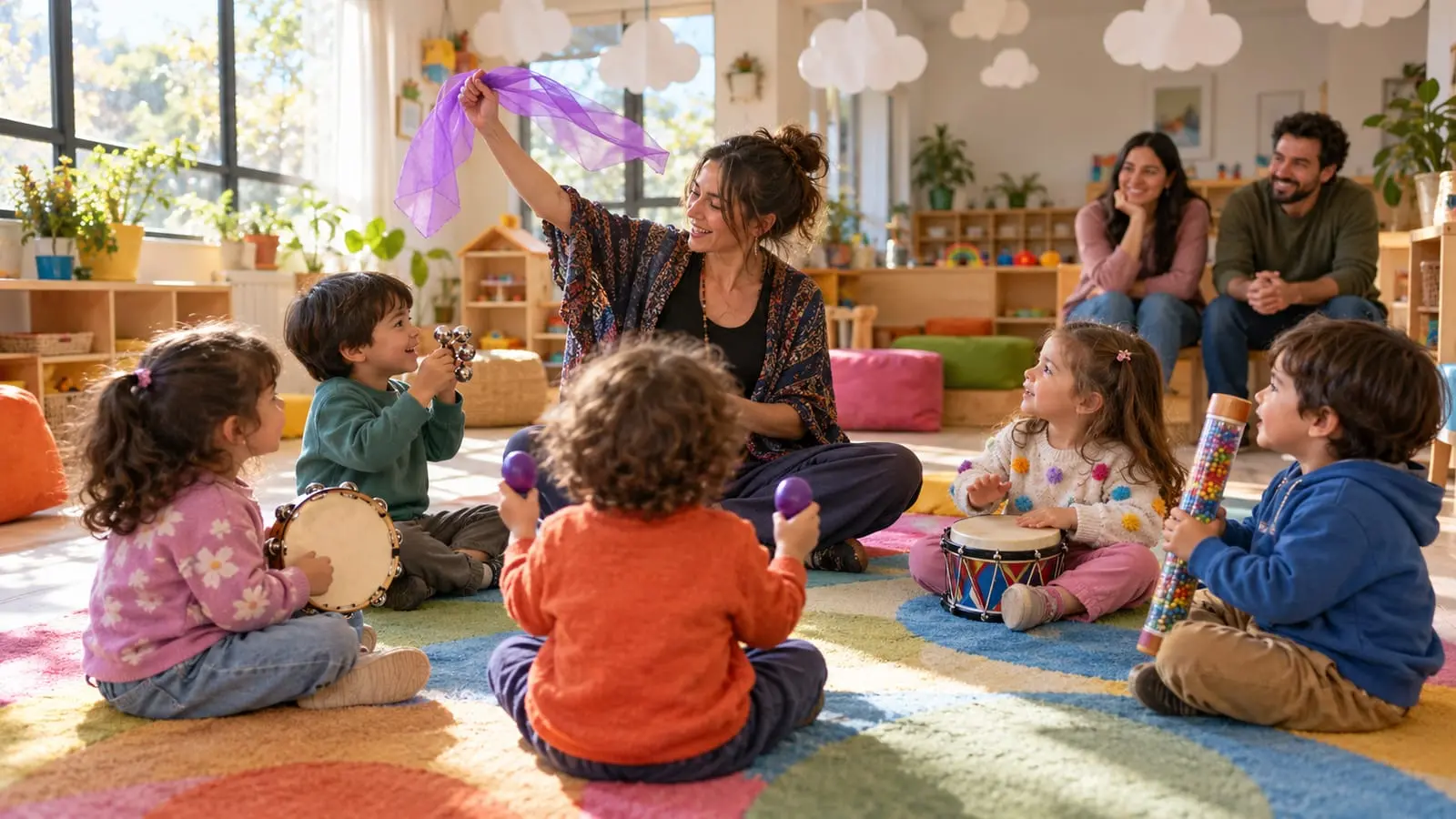
Early childhood music education is an introductory stage, designed mainly for children ages 3 to 7, in which they learn music through play: singing, moving, exploring small percussion instruments and developing their ears before focusing on a single instrument.
Its goal is not to train little concert performers, but to build a foundation in rhythm, listening and enjoyment of music that will make any instrument they learn later easier and more rewarding.
In short
- Early childhood music education means learning music through play: rhythm, singing, movement, listening and exploring simple instruments.
- It is usually for children ages 3 to 7, though each program adapts to the child's age and maturity.
- It develops a sense of beat, ear training, coordination, attention and expression: skills that later make learning an instrument easier.
- It draws on approaches such as Dalcroze, Orff, Kodály, Suzuki and Willems, which put experience before theory.
- The move to an instrument comes when a child shows sustained interest in one and has the physical readiness and attention span to work on it.
What early childhood music education is
It is young children's gateway to music. Instead of starting with sheet music or instrumental technique, children experience music with their whole body: singing, dancing, playing with their hands and listening attentively. Theory comes later, when experience has given it meaning.
Throughout this process, the child works on:
- Beat and rhythm: feeling the timing of the music and moving with it.
- Listening: distinguishing high and low, loud and soft, fast and slow sounds.
- Voice and pitch accuracy: singing simple songs and repeating short melodies.
- Coordination and motor skills: playing, walking, clapping and stopping in time.
- Attention and memory: following instructions and remembering songs and sequences.
- Expression and confidence: creating, improvising and sharing what they have learned.
What an early childhood music lesson is like
Activities are short and varied because attention spans at this age are short too. Each teacher adapts the lesson, but a typical session might look like this:
- A sung greeting: a song that marks the start and gives the child a sense of security.
- A beat-and-movement game: walking to the music, stopping when it stops and jumping on accents.
- Singing: children's and traditional songs, and echo games in which the child repeats what the teacher sings.
- Exploring instruments: maracas, claves, tambourines, triangles or drums to follow rhythms and create effects.
- Active listening: identifying whether a sound is high or low, the music is fast or slow, or which instrument is playing.
- Closing: a goodbye song or a brief chance to share what they have learned.
Instruments you will often find
Small percussion instruments take center stage because they respond immediately and do not require complex technique. For slightly older children, around age 6, the recorder is often the first melodic instrument: it is light, accessible and helps connect fingering, breath and reading. Some programs also include barred instruments such as xylophones or metallophones.
The teaching approaches behind it
Early childhood music education draws on several 20th-century teaching approaches that share one idea: first experience music, then give it names.
- Dalcroze: Swiss musician and educator Émile Jaques-Dalcroze developed eurhythmics, in which the body is the first instrument. Walking, swaying or jumping to music helps internalize beat, accent and phrasing.
- Orff: German composer Carl Orff and his collaborators created Orff-Schulwerk, which combines speech, singing, movement, body percussion and barred instruments, with plenty of room for improvisation.
- Kodály: inspired by Hungarian composer Zoltán Kodály's ideas, this approach centers on the voice, using traditional songs, movable-do solfège and hand signs to represent notes.
- Suzuki: Japanese violinist Shinichi Suzuki proposed learning an instrument as you learn your native language: through extensive listening, imitation, repetition and close family involvement. It began with violin and is now used for other instruments.
- Willems: Belgian educator Edgar Willems prioritized ear training and the connection between music and a child’s life before music reading and technique.
In practice, many teachers combine resources from several approaches to suit each child's age, personality and interests, rather than following one method to the letter.
Why it is ideal for children
At ages 3, 4 or 5, children learn through play, imitation and movement. Early childhood music education respects that natural way of learning, rather than asking them to sit still and concentrate for a long time on an instrument that does not yet fit their hands.
- It develops listening skills and a sense of rhythm when children are most open to exploring sounds.
- It builds a foundation that makes any instrument easier to learn later.
- It avoids the frustration of starting an instrument too soon.
- It strengthens attention, listening and the ability to follow instructions.
- It gives children space to express themselves and gain confidence.
- It nurtures enjoyment of music, which sustains learning over the long term.
If you want to know what to expect from music as your child grows, and which promises to take with caution, read benefits of music for children.
When to move on to an instrument
There is no exact age. These signs suggest your child may be ready:
- They consistently ask for a particular instrument, rather than just for a week.
- They keep the beat easily and repeat short melodies.
- They can stay focused on a guided activity for a while.
- Their hands and body fit the instrument or a smaller version of it.
Many children move on to piano or violin between ages 5 and 7, with versions adapted to their size; others wait a little longer for guitar or wind instruments. See our guide to starting ages by instrument and, if you are deciding between two options, this piano or guitar comparison.
How to support learning at home
- Sing together in the car, in the kitchen or before bed.
- Listen to a variety of music: children's songs, classical, pop and Colombian rhythms such as cumbia, bambuco or currulao.
- Dance and play games where you freeze when the music stops.
- Make homemade instruments with bottles, seeds or boxes.
- Ask what your child learned in the lesson and have them teach you.
At Gissi, early childhood music education teachers work with children in in-home lessons in Bogotá and the surrounding area or online, depending on each teacher's availability.
Frequently asked questions
At what age can children start introductory music lessons?
Children usually start around age 3, when they can follow simple games and instructions. Before that age, singing and dancing with family at home is the best musical stimulation.
Do early childhood music lessons work online?
They can, especially for children ages 5 and up with an adult helping during the lesson. For younger children, the direct contact of an in-home lesson usually supports attention and play more effectively.
Does my child need to have an instrument to start?
It is not essential. A few small percussion instruments, such as maracas or a tambourine, or even homemade instruments, are enough. Your teacher will advise you if getting an instrument becomes useful later.
What if my child is very shy or very restless?
Both are normal at this age. A good introductory music lesson gives restless children room to move and shy children time to observe before joining in. With patience, music often becomes a comfortable space for both.
Sources
We checked the facts in this article against these sources on October 22, 2026.
- National Association for Music Education (NAfME): Kodály, Orff, and Dalcroze, who’s who
- Dalcroze Society of America: Émile Jaques-Dalcroze and eurhythmics
- Organization of American Kodály Educators: the Kodály concept
- Suzuki Association of the Americas: about the Suzuki method
- National Association for Music Education (NAfME): early childhood music education