
Piano for kids: a practical guide for parents
What a parent needs to know before their child starts piano: age, an instrument at home, first lessons, methods and practice.
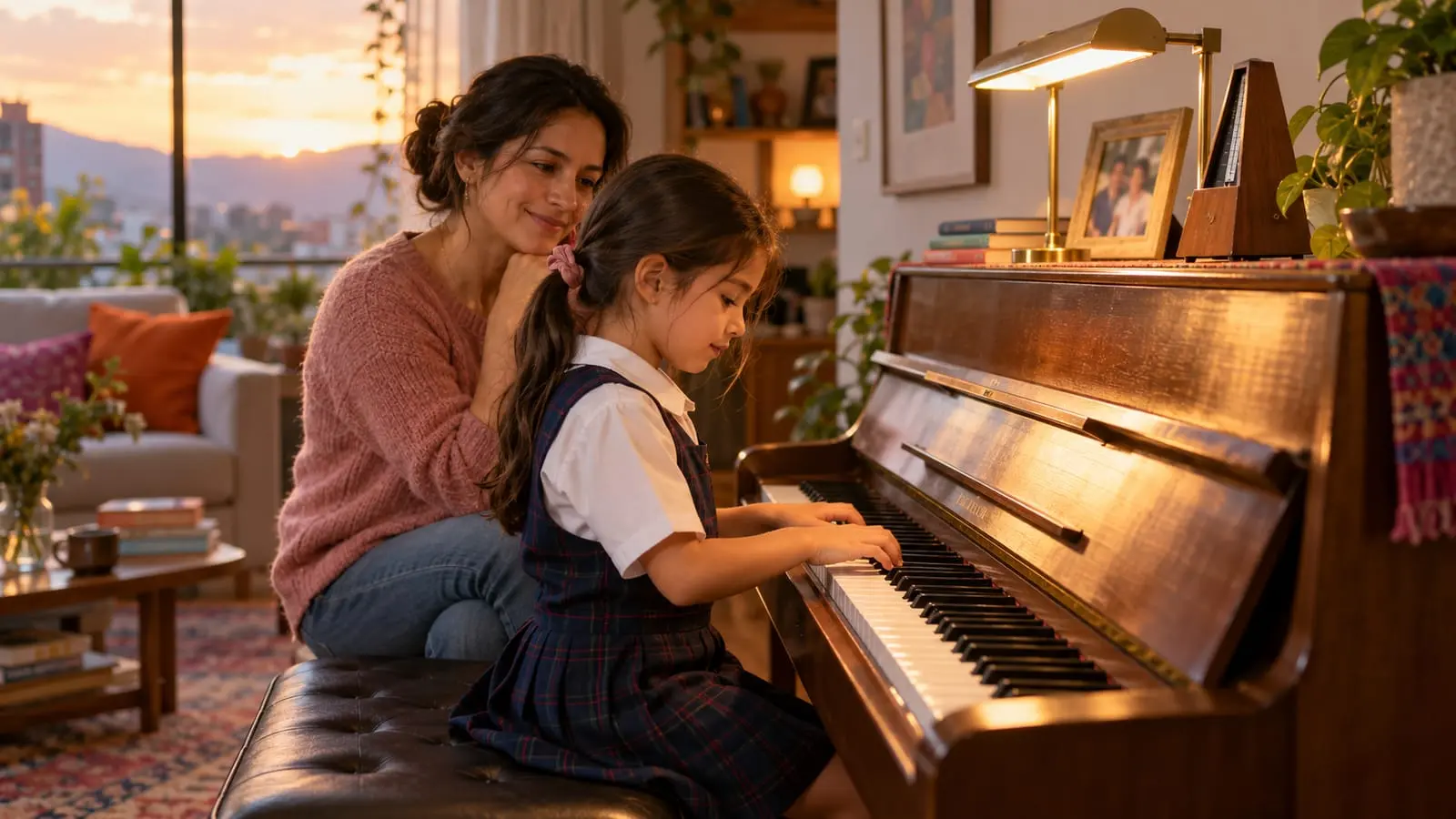
Many children are ready for piano lessons between ages 5 and 7, when they recognize numbers and letters, can stay with an activity for 20 or 30 minutes, and want to play. A keyboard with full-size, touch-sensitive keys is enough to start; an 88-key digital piano can wait a few months.
What matters most to your child's progress, though, is neither age nor the instrument: it is short, frequent practice at home and an adult who offers support without taking over as the teacher. This guide walks you through what to expect.
In short
- Many children are ready for piano between ages 5 and 7; before then, early music education lays the groundwork.
- A keyboard with full-size, touch-sensitive keys works for beginners; an 88-key digital piano with weighted keys is a medium-term goal.
- A bench at the right height and supported feet matter as much as the instrument.
- Children's methods combine reading, listening, and creativity; the teacher chooses and adapts them, so you do not have to.
- Ten or fifteen minutes on most days achieves more than an hour on Sunday.
At what age can a child start piano?
There is no magic age, but there are signs. A child is usually ready for piano lessons when they:
- Recognize the numbers 1 through 5 (the finger numbers used in piano) and some letters or colors.
- Can focus on a guided activity for 20 to 30 minutes.
- Move their fingers independently, for example by making each little finger “wave hello” one at a time.
- Ask to play, approach the keyboard on their own, or imitate melodies they hear.
If your child is 3 or 4 and loves music, early music education lessons develop rhythm, singing, and listening skills, making the transition to piano more natural. And if they are 9, 10, or 12, it is not too late: an older child understands music reading more easily and can make steady progress.
Which piano or keyboard to have at home
You do not need a grand piano to start, but you do need an instrument that makes things easier for your child. Here is a quick comparison:
| Option | Good for | Limitations |
|---|---|---|
| 61-key touch-sensitive keyboard | The first few months: finding notes, learning posture, and playing the first pieces. | Fewer keys and no piano-like weight to the action; you may outgrow it as the repertoire expands. |
| Digital piano with 88 weighted keys | Several years of study with a feel similar to an acoustic piano; supports headphones. | Takes up more space and costs more than a keyboard. |
| Upright acoustic piano | Authentic sound and feel; the full experience if space and budget allow. | Needs regular tuning by a technician and can be heard throughout the building. |
The essentials: full-size keys, touch sensitivity (a louder sound when your child plays harder), and a pedal input. Avoid toy keyboards with small keys. We compare the options in more detail in how to choose your first piano or keyboard.
The bench and the feet
When your child is seated, their elbows should be roughly level with the keyboard and their forearms almost horizontal. If a dining chair is too low, a firm cushion can help; if their feet dangle, a small stool or box underneath provides stability. It may seem like a detail, but the wrong height creates tension in the shoulders and wrists.
What the first piano lessons are like
In the first few weeks, a good teacher will not overwhelm your child with theory. Lessons usually cover:
- Finding your way around the keyboard. Locating C using the groups of two black keys, moving up and down, and distinguishing low and high notes.
- Posture and a rounded hand. As if holding a small ball, with curved fingers and a relaxed wrist.
- Finger numbers. The thumb is 1 and the little finger is 5 on both hands.
- First pieces using five notes. Melodies that stay in one hand position, first with each hand separately.
- Rhythm and singing. Clapping and singing the music before playing it.
- Room to create. For example, improvising using only the black keys, which always sound good together.
Music reading is introduced gradually, without getting in the way of the joy of playing. To find out what a teacher should look for in your child's posture, read correct hand position at the piano.
Piano methods for children: what to know
There are many books and approaches for teaching children piano, and teachers often combine several. They generally differ in how they introduce music reading:
- Starting from middle C. Both hands begin at middle C, and reading progresses one note at a time. This is very clear at first, although some children get used to reading only in the same area of the keyboard.
- Using intervals or different positions. Children learn to read the distances between notes (“up a step,” “skip a note”) and move around the whole keyboard early on.
- Playing by ear first. Approaches such as Suzuki emphasize plenty of listening and playing by ear before reading, with active parental involvement.
Rather than focusing on the method's name, look for three things: music your child enjoys, a balance of reading, playing by ear, and creating, and a small but clear step forward each week. If something is not working, the teacher can change books or approaches without losing the progress your child has made.
How much and how to practice piano at home
| Age | Daily time | How to organize it |
|---|---|---|
| 5 to 6 years | 5 to 10 minutes | Two short sessions a day, with play and singing. |
| 7 to 9 years | 10 to 15 minutes | One session with a warm-up, a piece, and some free playing at the end. |
| 10 to 12 years | 15 to 25 minutes | Hands separately, then together; use a metronome for difficult passages. |
- Put the piano somewhere you regularly pass through, rather than in an isolated room: an instrument in sight gets played more.
- Practice with hands separately first, then together; this is the step people skip most often, and the one that saves the most time.
- Once your child can play the piece slowly, the online metronome helps increase the tempo while keeping it steady.
- A notebook where the teacher writes assignments prevents the familiar “I don't know what I was supposed to practice.”
You can find a complete routine in how to practice music at home.
Your role as a parent (even if you do not know music)
You do not need to know how to play to provide good support. Here is what helps:
- Sit nearby during practice in the first few months, especially if your child is under 8.
- Ask your child to teach you what they learned: explaining is a way to review.
- Ask the teacher about the week's goal so you do not correct things they are not working on yet.
- Listen attentively and celebrate effort, not just perfectly played pieces.
- Arrange little concerts for the grandparents, in person or over a video call.
- If you have an acoustic piano, schedule tuning with a technician: an out-of-tune piano confuses the ear.
Signs that something needs adjusting
Raised shoulders or stiff wrists while playing, tears before practice, whole weeks stuck on the same piece, or “I don't like anything I play” are reasons to talk to the teacher. These issues can almost always be resolved by changing the repertoire, shortening practice, or adjusting posture. If you are looking for a teacher, piano lessons explains how to get started.
Frequently asked questions
Is it better to start with a piano or a keyboard?
For the first few months, a keyboard with full-size, touch-sensitive keys is enough. Once your child plays with both hands and starts using the pedal, it is worth moving to an 88-key digital piano with weighted keys or an acoustic piano.
Does my child need to read sheet music from the first lesson?
Not necessarily. Many teachers combine playing by ear with gradual music reading so children make music from the start without being held back by the score. Over time, reading becomes a natural part of lessons.
How many piano lessons a week does a child need?
One weekly lesson is the usual starting point, provided there is short practice on most days. A second lesson may make sense later, for example when preparing for a performance.
What if my child has small hands?
That is not a problem at first: the early pieces use five notes and do not require stretching the hand. The teacher chooses suitable repertoire and saves octaves and widely spaced chords for later.
Sources
We checked the facts in this article against these sources on October 22, 2026.