
Music lessons for children ages 3 to 5: what they’re like and where to start
At ages 3, 4, and 5, children learn music through play. Here’s what lessons are like at each age, when to move from early music education to an instrument, and how to support learning at home.
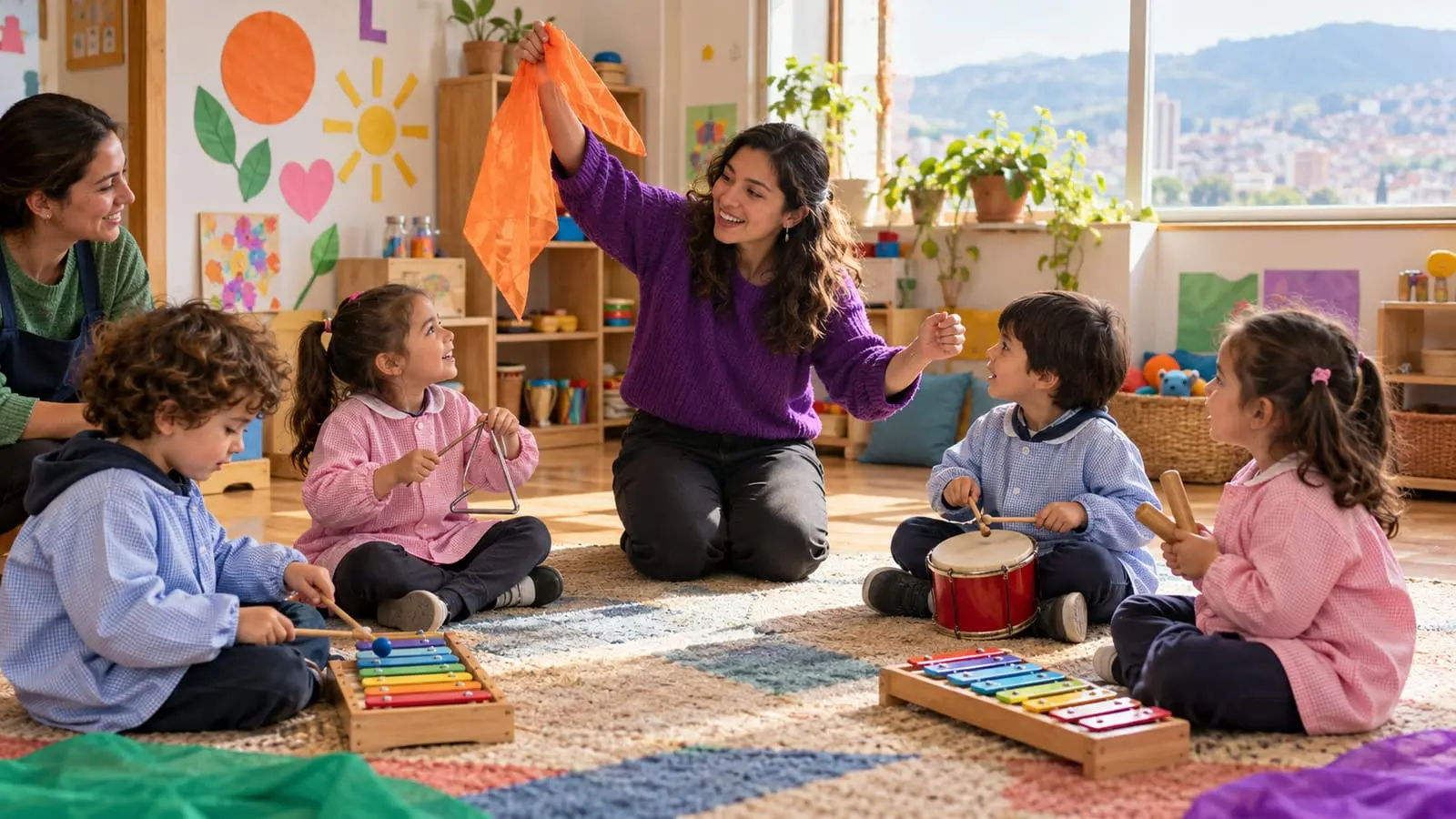
Yes: children between ages 3 and 5 can take music lessons. What changes with age is the lesson itself. At age 3, it’s all about early music education: songs, movement, play, and simple percussion. At ages 4 and 5, children encounter their first musical symbols and, if they’re ready, a first instrument, usually piano or violin, in short, playful sessions.
Age alone doesn’t decide. Look for specific signs: how long your child can focus on a guided activity, whether they can move their fingers somewhat independently, and whether their interest in the instrument is their own and lasts over time. Here’s what lessons are like at each age, what to expect, and how to help.
In short
- At age 3, lessons focus on early music education: play, singing, movement, and percussion. At ages 4 and 5, children can continue with early music education or start an instrument; neither option is inherently “better.”
- It’s normal for a 3-year-old to get distracted, lie on the floor, or simply watch: they’re still learning.
- Signs that your child is ready for an instrument include focus during guided activities, independent finger movement, a willingness to repeat things, and sustained interest.
- For young children, lessons are shorter and consist of brief activities that change frequently.
- Your role is to be a play partner, not to correct mistakes. Practice at home lasts 5 to 10 minutes, almost always with an adult alongside.
What children can do at ages 3, 4, and 5
Children make a big leap between ages 3 and 5, and lessons adapt along with them. Here’s what typically changes:
| Age | What children can typically do | What the lesson is like |
|---|---|---|
| Age 3 | Very short attention span for each activity. Moves, jumps, and imitates; sings snippets and repeats short phrases. | Early music education: songs with gestures, movement, echo games, and small percussion instruments. Activities change every few minutes. |
| Age 4 | Can focus for longer, follow a two-step instruction, and begin to keep a beat by clapping or walking. | More structured early music education: longer songs, contrasts (loud and soft, fast and slow), and sometimes a little time on a xylophone or keyboard. |
| Age 5 | Follows instructions with two or three steps, keeps a steady beat, is willing to repeat things, and enjoys “getting it right.” | First musical symbols (color-coded rhythm notes, cards, syllables such as “ta” and “ti-ti”) and, if ready, a first instrument taught through play. |
What you shouldn’t expect at any of these ages: fluent music reading or playing long songs. What you can expect: a child who sings at home what they learned in lessons, moves to the rhythm, and looks forward to lesson day.
What a lesson is like at age 3
At age 3, children learn music through movement and play. With one lesson a week and music at home, children practice moving to music, recognizing contrasts (loud and soft, high and low, sound and silence), singing snippets, stopping and starting on cue, exploring maracas, claves, tambourines, or a small drum, and, in group lessons, waiting their turn.
Every teacher has their own style, but a typical lesson starts with the same sung greeting, moves on to movement, songs with gestures, echo games, and instruments, includes a short story with sounds, and ends with the same goodbye song. Notice the repetition and the quick changes between activities. For the basics, read what early music education is.
What’s normal at age 3
Attention to any one activity is brief, and that’s typical for this age, not a problem with the lesson. It’s normal for children to watch without joining in for several lessons (many watch first and repeat things at home later), lie on the floor, ask for the same song over and over, or participate enthusiastically one day and not at all the next. Choose a time that doesn’t overlap with naps or meals; a consistent weekly lesson does more than several lessons packed into a single month.
At ages 4 and 5: early music education or an instrument
From age 4, there are three equally valid paths:
From age 4, your child can continue with early music education (more structured than at age 3), add some time on a xylophone or keyboard to play short melodies, or start a first instrument through play if they’ve been asking for months. None of these paths puts a child behind or ahead: children who stay in early music education until age 6 begin an instrument with a better ear and a steadier beat. Some approaches, such as Suzuki, start violin at a younger age with close family involvement; even so, early music education is a better fit for most 3-year-olds.
Signs your child is ready for an instrument
Rather than just wondering whether your child is old enough, watch them in everyday situations. These “at-home checks” offer useful clues:
- Guided attention: can your child do a puzzle or play a simple board game with you for 10 minutes without getting up?
- Independent fingers: can your child touch each finger to their thumb, one at a time, or lift one finger without moving the others?
- Beat: does your child march or clap along to a familiar song without constantly getting ahead?
- Repetition: is your child willing to try something several times to improve it, or do they give up at the first mistake?
- Their own interest: has your child been asking for the instrument for months, pretending to play it with toys or watching closely when someone plays it?
If you notice three or four of these signs, it’s worth a try. If the interest comes more from you than from your child, or if they get very frustrated whenever something doesn’t work, a few more months of early music education may help. Your teacher can also share their assessment after one or two lessons.
Piano or violin: getting started at age 4 or 5
Piano
It’s a very approachable first instrument: each key makes a sound when pressed, and children can see where each note is. The first piano lessons for children focus on posture at the bench (with a footrest so their feet don’t dangle), a rounded hand “as if there were a bubble inside,” groups of two and three black keys as a map of the keyboard, and songs with just a few notes, often learned by imitation.
You’ll need a keyboard or digital piano with full-size keys at home. It doesn’t have to be the best on the market, but your child should be able to rest a finger on the keys and control the sound. Check with your teacher before buying; you don’t need an acoustic piano.
Violin
Violins for children come in very small sizes (1/16, 1/10, 1/8), so a child aged 4 or 5 can have one that fits. The first few months focus on posture, holding the bow, and producing sound on open strings with fun rhythms; fingered melodies come gradually. With Suzuki-style approaches, families play a very active role: attending lessons, learning alongside the child, and guiding practice at home.
The teacher measures your child to recommend the right size. Buying a larger violin “so it lasts longer” is one of the most common mistakes and makes playing well very difficult; this guide to choosing your first violin and its size explains how to get it right.
What about other instruments?
Percussion can begin around age 5 with instruments that fit the child. Guitar and recorder usually wait a little longer, until age 6, and wind instruments such as saxophone or trumpet until permanent teeth have come in and the child has greater breath capacity.
What an instrument lesson is like at this age
For children this young, lessons are shorter than adult lessons, and they rarely spend many minutes in a row on the instrument. Lessons usually alternate between:
- Time on the instrument: posture, a new sound and a short song.
- A rhythm game away from the instrument: clapping, cards or walking to the beat.
- Returning to the instrument to apply what the game explored.
- A final song or challenge the child can show at home.
Children learn a lot by imitation: the teacher plays, and the child repeats. Formal music reading comes later; at this age, when introduced, it uses large notes, colors, and pictures. The exact length and price are tailored to each child; arrange this with the team on WhatsApp, and check the general lesson prices.
Your role as a parent
For children ages 3 to 5, an adult is usually present, especially in the first few weeks and during online lessons. Your role is to be a play partner, rather than a spectator or the teacher’s assistant.
- What helps: joining in and singing even if you feel shy, letting your child answer even if they make a mistake, waiting patiently if they only want to watch today, and telling the teacher which songs they ask for at home.
- What doesn’t help: looking at your phone, answering for your child or correcting them in every activity, insisting “do it like the teacher,” or comparing them with other children.
Practice at home: short, daily and playful
At age 3, “practice” means singing lesson songs in the car or at bath time, repeating games, and asking your child to show you what they did. With an instrument at ages 4 and 5, the adult is effectively the “teacher for the week.” You don’t need to know music, but you do need to be present. Some ideas that work:
- 5 to 10 minutes on most days is better than half an hour on Saturday.
- Practice at the same time each day, and stop while your child still wants more.
- An activity die: each number represents an activity from the lesson.
- Ask the teacher for practice tasks in writing or in a short voice message.
If practice is turning into an argument, try these ideas for motivating your child to practice.
In-home or online lessons at this age
At ages 3 and 4, in-person lessons usually work better: the teacher brings instruments, reads the child’s body language, sits on the floor with them, and adjusts the game on the spot. In-home music lessons in Bogotá have another advantage: children learn in a familiar space where they feel safe.
Online music lessons also work, with a few conditions: an actively involved adult, a camera positioned to show the child’s whole body, instruments ready before the lesson starts, and shorter sessions. They’re an option if you live outside Bogotá or in another country. At age 5, with an instrument and an adult alongside, online lessons work just as well. In-home and online lessons cost the same. If you’re deciding, this comparison of in-home and online lessons can help.
Another option that works very well is a small group with siblings, cousins or neighbors of similar ages: group play is motivating, and children imitate each other.
How to choose a teacher and tell if lessons are helping
For children this young, the teacher matters more than the instrument. At Gissi, lessons are one-on-one, and teachers go through an evaluation. Look for patience and experience with children this age, a plan with alternatives, the use of play and repetition, and an honest assessment of when your child is ready for the next step. If you’re looking for an early music education teacher, browse the profiles in our teacher directory and take your time choosing.
At this age, progress isn’t measured by the number of songs played. After a few weeks, see whether your child:
- Your child sings songs or parts of songs from the lesson at home, on their own.
- Your child asks about the teacher or gets excited when lesson day arrives.
- Your child repeats the games with toys or instruments.
- Your child moves more purposefully when music plays and responds to changes in speed or volume.
- Your child participates a little more each week, at their own pace.
If, after several weeks, your child cries before every lesson or refuses to participate at all, don’t force it: review the schedule, length, or format with the teacher. Sometimes a small change is enough.
Frequently asked questions
Can a 3-year-old start piano or violin?
Some approaches, such as Suzuki, can introduce violin at an early age, with plenty of play and close family involvement. Even so, early music education is a better fit for most 3-year-olds, and the move to an instrument tends to be smoother around ages 4 or 5.
Is piano or violin a better first instrument at age 5?
It depends more on the child than on the instrument. Piano shows visible results quickly, and your child doesn't have to tune it before playing; violin takes more patience with tone, but it's portable and comes in sizes to fit the child. If your child keeps asking for one of the two, that's usually your best clue.
What should I do if my child does not want to participate in lessons?
Give them time: at this age, watching is also a way of participating. Stay calm, join the games yourself so they can see that it is fun, and talk to the teacher, who can adapt activities to what interests them most.
What do I need at home for lessons?
For early music education, a clear space and a few percussion instruments, such as maracas or a tambourine. For piano, a keyboard or digital piano with full-size keys. Your teacher will guide you before you buy anything.
What if my child starts an instrument and struggles?
That is fine: your child can return to introductory music for a few months or try another instrument. What they have learned about rhythm, listening and posture is not lost. What matters is that trying does not become an experience of failure.
Sources
We checked the facts in this article against these sources on October 23, 2026.
- NAfME: early childhood music education (position statement)
- CDC: developmental milestones at age 3
- CDC: developmental milestones at age 5 (attention, rules, play)
- Suzuki Association of the Americas: the family’s role in learning
- The Canadian Encyclopedia: the Suzuki method (starting age and parental involvement)
- Violin Lounge: violin size chart by age and arm length
- John Packer: guide to instruments for children (wind instruments and permanent teeth)