
What size violin do you need? How to choose your first one
Violin size is chosen by measuring the arm, not by age. A size chart, how to confirm it with the violin in hand and what to check before you pay.
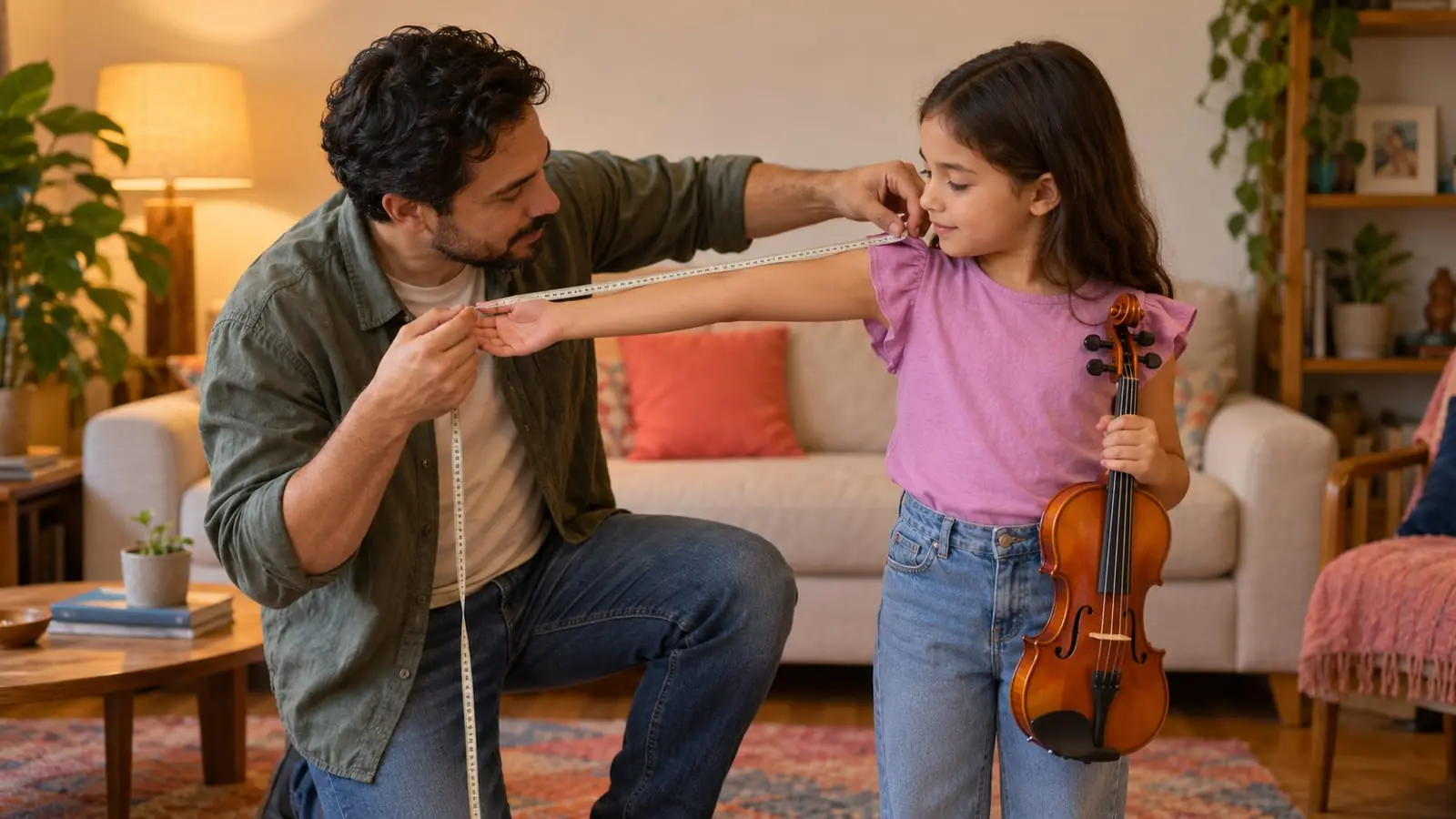
Choose a violin size by measuring the outstretched arm, rather than by age: with the left arm extended to the side, measure from the neck to the center of the palm, then find that measurement in the chart. If you fall between two sizes, choose the smaller one. Buying a large violin “so it will last” is the most common mistake and the one that holds children back the most.
Once you have the right size, focus on the setup: for a beginner, the bridge, pegs, strings, and a decent bow matter more than the wood or brand. Here is what to check.
In short
- Measure from the neck to the center of the palm with the arm extended; between two sizes, choose the smaller one.
- Adults and children from around 11 or 12 usually use a 4/4 violin.
- A student violin without a luthier's setup can be almost impossible to play, even for a teacher.
- The bow matters as much as the violin: it should be straight, have proper camber, even hair, and a working screw.
- A new bow will not produce sound without rosin: applying it is the first step before playing.
Violin size chart, from 1/16 to 4/4
| Size | Arm measurement | Approximate age | Body length |
|---|---|---|---|
| 1/16 | Less than 39 cm | 3 to 4 years | About 21 cm |
| 1/10 | 39 to 43 cm | 4 to 5 years | About 23,5 cm |
| 1/8 | 43 to 44,5 cm | 5 to 6 years | About 26 cm |
| 1/4 | 44,5 to 51 cm | 6 to 7 years | About 29 cm |
| 1/2 | 51 to 56 cm | 7 to 9 years | About 32 cm |
| 3/4 | 56 to 59,5 cm | 9 to 11 years | About 33 cm |
| 4/4 | 59,5 cm or more | From 11 or 12 years, and adults | About 35.5 cm |
There is also a 7/8 size, designed for teenagers or adults with short arms or small hands. If you are interested in the viola, its sizing system is different; we explain it in violin or viola.
How to measure and confirm the fit with the violin in hand
- Ask the student to extend their left arm to the side at shoulder height, palm facing up.
- Using a sewing tape measure, measure from the side of the neck, where the violin will rest, to the center of the palm.
- Find the measurement in the chart. If it falls on a boundary, choose the smaller size.
The final check is with the instrument itself. With the violin in playing position, resting on the shoulder and held with the jaw, the student extends the left arm underneath it. The scroll, the spiral at the end, should sit in the palm, with the fingers wrapped around it and the elbow slightly bent. If only the fingertips reach it, the violin is too large.
When should you move up a size?
When the elbow is bent too much and the hand feels cramped in first position, when the fingers bump into each other, or when the teacher notices a cramped posture. For children growing quickly, measure again at least once a year, or sooner if you notice the violin is getting too small. That's why many families buy used, rent, or swap smaller sizes.
What is a student violin, and what should it include?
A student violin is a mass-produced instrument for learners, usually sold as a kit with a violin, bow, case, and rosin. Two kits may look alike, but differ in their setup and the materials used for a few key parts.
| Part | What to look for | Warning sign |
|---|---|---|
| Top and back | Carved wood: spruce top, maple back | Pressed or laminated wood; poorly glued joints |
| Fingerboard | Ebony or another hardwood, smooth and unpainted | A black-painted fingerboard with peeling paint |
| Tuning pegs | Turn smoothly and stay in place | Slip, stick, or have play |
| Fine tuners | On all four strings, or a tailpiece with built-in fine tuners | Screws that rub against the top when lowered |
| Strings | New, with an even sound | Rusty, or harsh and metallic-sounding |
| Case | Hard case with bow holders and secure latches | A soft case that does not protect the bridge |
Always ask whether the violin has been set up by a luthier. Many leave the factory with an uncarved bridge, a poorly positioned soundpost, or strings that are too high, making a good sound almost impossible.
What the kit almost never includes
- A shoulder rest sized for the violin, tried on the student's shoulder.
- A tuner; you can also use our violin tuner.
- A music stand and a soft cloth to wipe off rosin after playing.
The bow and rosin
A poor bow makes even a good violin sound bad. Before accepting the one in the kit, check:
- Straightness: sight down the bow from the tip toward the frog. The stick should not bend sideways.
- Camber: with the hair loose, the stick curves toward the hair. If it is flat or bends away from the hair, it has lost its camber.
- Even hair: a uniform ribbon, with no gaps or many broken hairs.
- Screw and frog: the screw should tighten and loosen without sticking, and the frog, where the thumb rests, should have no play.
- Material: carbon fiber withstands knocks and drops, making it useful for children; brazilwood is the traditional student option. Very flexible fiberglass bows are hard to control.
Rosin
New bow hair will not produce sound: it needs rosin to grip the string. If the bow is new, apply rosin several times along the entire ribbon of hair before playing. A new cake is sometimes so smooth that it releases no powder; your teacher can show you how to lightly scratch the surface. After that, a few strokes before each practice session are enough.
Any reasonably good violin rosin will do for a beginner. Do not use double bass rosin, which is too soft. To hold the bow without tension, see how to hold a violin bow.
What to check before paying: bridge, pegs, and more
- Bridge: straight, perpendicular to the top, and aligned with the f-hole notches. Viewed from the side, it should not lean toward the fingerboard or be warped, and both feet should sit flush.
- String height: at the end of the fingerboard, the strings should not be so high that they are hard to press down, or so low that they rub against it.
- Pegs: turn each one a little. They should turn firmly and stay in place when released.
- Soundpost: a small wooden post inside the violin, near the bridge foot on the E-string side. If you hear something loose inside when gently moving the violin, it may have fallen: do not play the instrument, and take it to a luthier.
- Cracks and seams: check the top around the f-holes and along the edges. Gently tap around the perimeter with your knuckles: a buzz may indicate an open seam.
- Tailpiece and fine tuners: they should not touch the top, and the screws should turn.
- Sound: tune it and bow all four open strings. If something rattles or buzzes, find the cause before buying.
New, used, or rented
| Option | A good option when | Watch out for |
|---|---|---|
| New, with a luthier's setup | You are moving to a size you will use for several years, such as 4/4 | Kits without a setup that sound poor straight from the factory |
| Used | The child will need a larger size soon | Cracks, a crooked bridge, or a fallen soundpost: have it inspected |
| Rental or loan | You are finding out whether the child likes the instrument, or the child is growing quickly | Damage terms and the condition of the bow |
Whichever option you choose, a violin is best kept in its case, away from sunlight and windows. For daily care, follow our guide to cleaning and caring for a violin.
Frequently asked questions
What size violin does an adult use?
Most adults use a 4/4 violin. Some people with short arms or small hands find a 7/8 more comfortable. If you are unsure, try both in playing position with your teacher's help.
Can I buy a larger violin for my child to grow into?
That is not a good idea. A large violin forces the child to stretch their arm and fingers, creates tension, and makes intonation harder, which is already a challenge on a fretless instrument. It is better to change sizes when needed. Find more advice in violin for children: a guide for parents.
Why does my new violin make no sound?
It is almost always because the bow lacks rosin or the hair is too loose. Tighten the bow until the gap between the stick and hair at the center is about the thickness of a pencil, then apply rosin. If it still makes no sound, check that the bridge is in place.
Should a violin have fine tuners on all strings or only on the E string?
For a beginner, fine tuners on all four strings make daily tuning much easier. Over time, many violinists keep only the E-string fine tuner and tune the other strings with the pegs.
Sources
We checked the facts in this article against these sources on October 22, 2026.