
How to plan a music lesson: a step-by-step structure
A lesson structure that works for any instrument, with timings for 45- and 60-minute lessons, sample goals and homework that actually gets done.
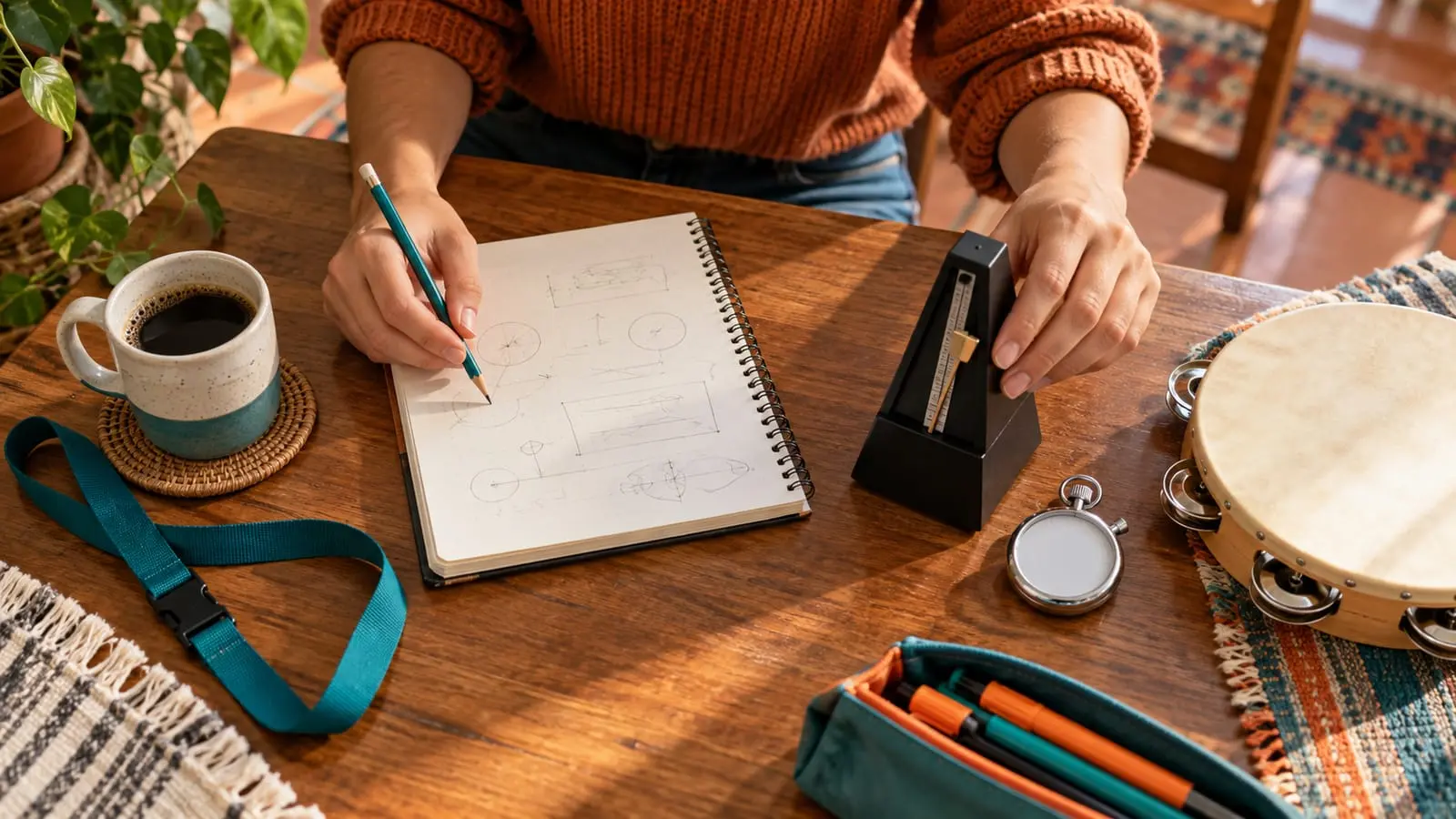
A well-prepared music lesson has five stages: warm-up, homework review, a new goal, repertoire, and a wrap-up with a clear practice assignment. Everything revolves around a single goal whose result you can see or hear at the end. If you don't know what should sound different by the end of the lesson, it isn't ready yet.
Here you'll find a structure with timings for 45- and 60-minute lessons, guidance on setting goals, a complete example, ways to adapt lessons for each age, and tips for setting assignments students will actually complete.
In short
- Basic structure: warm-up, review, a new goal, repertoire, and a wrap-up with a practice assignment.
- One goal per lesson, stated in observable terms: what the student will be able to play and at what tempo.
- For young children, three- to five-minute activities with plenty of movement; for adults, more context and explanation of why.
- The assignment should be short, specific, and written down: what to practice, how, at what tempo, and how many times.
- Always have a plan B: an easier version of the goal and a backup activity.
The structure of a lesson, stage by stage
| Moment | 45 min lesson | 60 min lesson | What it's for |
|---|---|---|---|
| 1. Warm-up | 5 min | 7 min | Prepare the body, ears, and instrument for the day's goal. |
| 2. Homework review | 5 min | 8 min | See what worked at home and make adjustments. |
| 3. New goal | 12 min | 15 min | Introduce and practice the day's skill. |
| 4. Repertoire | 17 min | 22 min | Apply the new skill in actual music. |
| 5. Wrap-up and assignment | 6 min | 8 min | Play something all the way through, summarize, and make the assignment clear. |
Warm-up
This isn't filler: it prepares the student for what's next. If the goal is a pasillo strumming pattern, warm up by clapping in three beats; if it's a fast scale, use long notes and relaxed fingers; if it's singing, use breathing exercises and gentle vocal warm-ups.
Homework review
Ask the student to play what they practiced before correcting anything. Listen to the whole performance, acknowledge what improved, and choose just one thing to adjust.
New goal
Introduce the day's skill with a short demonstration, break it into steps, and practice it outside the piece first: an isolated chord change, a difficult measure, or a clapped rhythm.
Repertoire and wrap-up
Apply the new skill in a song or piece; this is where the student plays a lot and you speak little. Finish with something they can play well all the way through, so they leave with a sense of achievement. Summarize what they learned in one sentence and set the assignment.
How to write an achievable goal
A good goal describes what the student will be able to do at the end of the lesson, rather than what you'll explain. Compare:
| Vague goal | Observable goal |
|---|---|
| Improve rhythm. | Play measures 1 to 8 with the metronome at 70, without stopping. |
| Learn chords. | Change from G to D on guitar in four beats, four times in a row. |
| Work on reading music. | Sight-read four measures in treble clef with quarter and eighth notes. |
| Practice intonation. | Sing the C major scale ascending and descending, in tune with the piano. |
| Cover dynamics. | Play the first phrase loudly and the answer softly, with a noticeable difference. |
If the goal isn't met by the end, it isn't a failure: it's information for your next plan. Perhaps the step was too big or the time too short. To track tempo progress, the online metronome lets you record a specific number each week.
Example: a 45-minute piano lesson for an 8-year-old
A student in their third month of piano. Goal: play the first two phrases of Oda a la alegría with both hands, with the left hand playing one note per measure.
- Warm-up (5 min): clap the piece's rhythm while saying the note names; then have all five fingers “walk” from C to G with each hand.
- Review (5 min): the student plays the right-hand part practiced at home; celebrate what went well and adjust just one thing, such as a collapsing wrist.
- New goal (12 min): left hand alone, one note per measure; then both hands together in the first measure, very slowly.
- Repertoire (17 min): hands together, phrase by phrase; between attempts, play a game where the teacher makes a deliberate mistake and the child spots it.
- Wrap-up (6 min): the student plays a familiar piece all the way through, you write down the assignment and its tempo, and tell the family what the student achieved.
How to adapt the lesson by age
| Age | Suggested duration for each activity | What works | What to avoid |
|---|---|---|---|
| Ages 3 to 5 | 3 to 5 minutes | Movement, songs, echo games, small percussion instruments | Long explanations and sitting still for too long |
| Ages 6 to 8 | 5 to 8 minutes | Short challenges, achievement markers, familiar songs | Correcting everything at once |
| Ages 9 to 12 | 8 to 12 minutes | Visible goals, music they enjoy, first performances | Children's music they no longer identify with |
| Teenagers | 10 to 15 minutes | Their music, freedom to choose, recording themselves | Treating them like children or ignoring their tastes |
| Adults | Longer blocks | Explaining why, connecting with their music, realistic goals | Assuming they understood without asking |
| Older adults | A gentle pace with breaks | Meaningful music, repetition, patience with motor skills | Rushing and information overload |
With very young children, the lesson feels more like guided play than an instrument lesson; if you work with this age group, review the principles of early music education.
Clear assignments: what to set for the week
What the student does at home depends largely on how clear the assignment is. A good assignment:
- Is short: two or three items, not ten.
- Says what, how, and how much: “measures 5 to 8, hands separately, at 60, three times in a row without mistakes.”
- Is written down, in the student's notebook or a message to the family.
- Includes something they enjoy, such as reviewing a piece they can already play or working out a song by ear.
- Provides a model: a short audio or video of you playing the passage at the right speed.
To share a guide to organizing daily practice with students and families, send them how to practice music at home.
Plan B: adjusting the lesson as you go
| Situation | Adjustment |
|---|---|
| The student didn't practice at home | Turn the review into guided practice: show the student how to work on that passage step by step. |
| The goal turned out to be too difficult | Make it a step easier: slower, a shorter passage, hands separately, or just the rhythm. |
| The student achieved it in ten minutes | Have the next step or a variation ready: another key, tempo, or dynamic. |
| The student arrives tired or distracted | Start with something active or a piece the student likes, and leave technique for later. |
| The student gets frustrated | Stop the exercise, have the student play something they do well, and return to the problem from another angle. |
A backup activity, such as a rhythm echo, improvising on two notes, or working out a phrase by ear, can rescue any lesson.
After the lesson: three minutes that save hours
Before moving on to the next student, note what you worked on and whether the goal was met, the exact assignment you set, one observation (something that worked, a question, or a warning sign), and a tentative goal for the next lesson. With those notes, planning the next lesson takes only a few minutes, and the student feels a connection between lessons.
At Gissi, we assess every teacher's musicianship, teaching skills, and personal qualities, and a well-prepared lesson is where all three are most visible. If you teach and would like to join us, see the opportunities on Work with us. For the practical side of teaching, such as the first lesson or agreements with families, read how to teach private music lessons.
Frequently asked questions
How long does it take to prepare a music lesson?
With a good record of the previous lesson, five to fifteen minutes is usually enough for an individual lesson. A first lesson with a new student and group lessons require more preparation.
Do I need to write a plan for every lesson?
You don't need a formal document. A few lines with the goal, activities, and planned assignment are enough; what matters is having it ready before you begin and reviewing it afterward.
How do I prepare a group music lesson?
Use the same structure, but choose activities everyone can take part in at once, rotate roles, and plan for different levels: an easier and a more challenging version of each exercise.
What if the student only wants to play music they like?
Use that to your advantage: draw the day's technical goal from their favorite song. Almost any song has a rhythm, chord change, or passage you can use to teach the skill they need.
Sources
We checked the facts in this article against these sources on October 22, 2026.