
Musical games for kids at home: ideas by age
Musical statues, clapping echoes, the conductor game and homemade instruments: simple games that develop rhythm and listening.
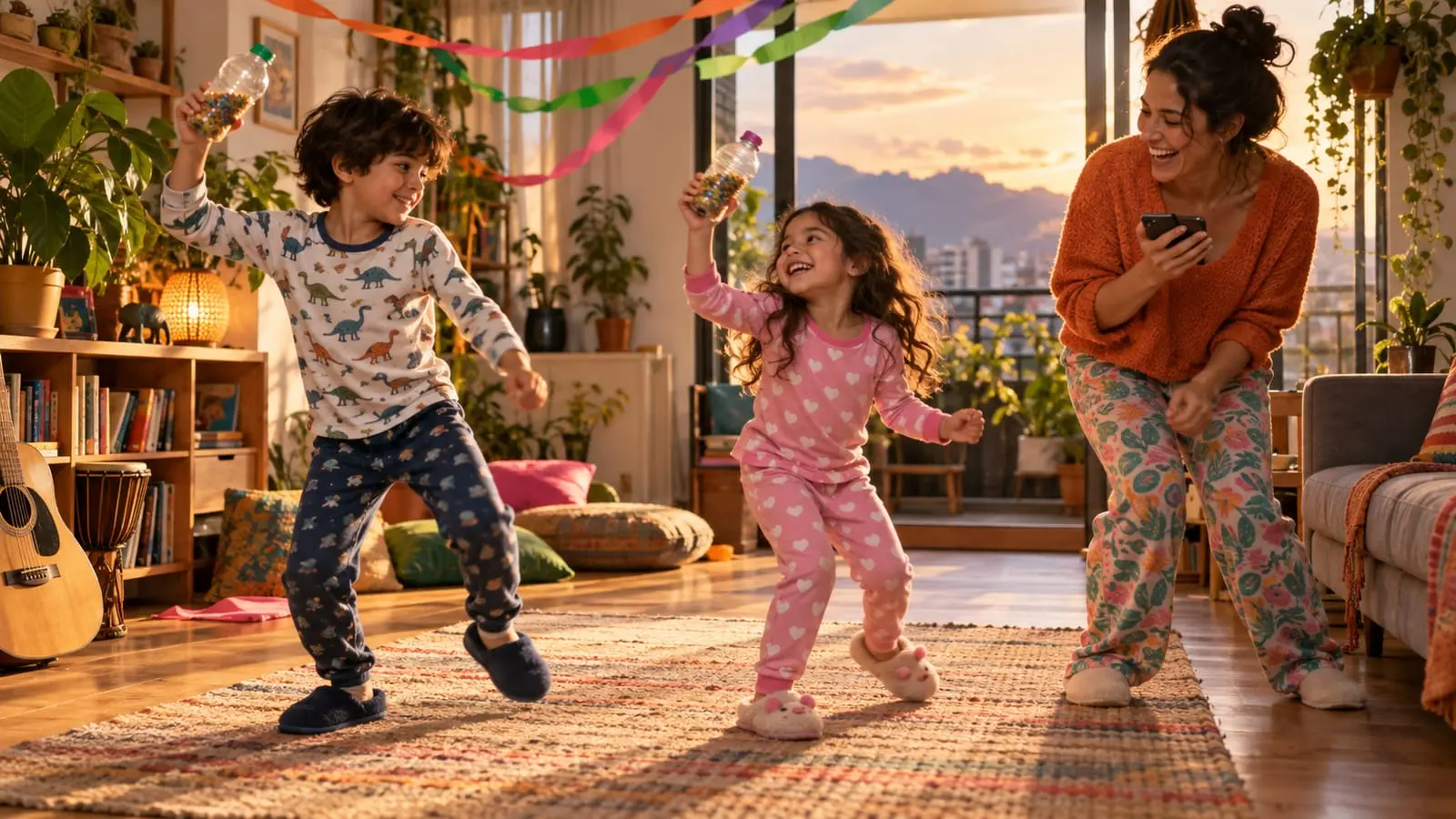
The best musical games to play at home get children moving, listening and responding: freeze dance, clapping echoes, playing conductor or guessing sounds with their eyes closed. You don't need instruments or musical knowledge; your voice, your hands and a couple of pots are enough.
Each game develops a specific skill: keeping a steady beat, listening, memory or coordination. Here you'll find instructions, ways to adapt them for ages 2 to 12, and tips for making safe homemade instruments.
In short
- Ten or fifteen minutes of musical play almost every day are worth more than one long session on the weekend.
- Freeze dance and walking to the beat develop listening skills and a sense of timing; clapping echoes build rhythmic memory.
- Younger children learn through movement; from age 6 or 7, games can include word rhythms, metronome challenges and first melodies.
- An adult who plays, sings and isn't afraid to make mistakes is the best role model.
- Homemade instruments must be securely sealed and used under supervision, especially if they contain seeds or small parts.
Before you start: four rules that make the games work
- Keep games short. Two to five minutes per game for younger children; switch before they get bored.
- Join in yourself. If you only give instructions, your child will lose interest. Sing, dance and make mistakes.
- Repeat what works. Children love playing the same game again, and they get better each time: that's learning.
- Let your child lead. Once they understand the game, let them take a turn inventing rules or playing the instrument.
You don't need a special occasion: these games work after an afternoon snack, on a rainy afternoon or while you're waiting for a meal.
Beat and movement games
Freeze dance (ages 2 and up)
Play some music or beat a drum; everyone dances and freezes when the music stops. This develops attentive listening and a response to silence. Make it harder for older children: they freeze in the pose shown on a card, or only if the music stops on a high-pitched sound.
Walking to the beat (ages 3 and up)
Keep a beat on a drum or by clapping, and ask the children to walk in time. When you play slowly, they walk like elephants; when you play quickly, like mice; when you stop, they stop. This lays the foundation for everything else: feeling the beat in your body before playing it on an instrument.
Playing conductor (ages 3 and up)
One person conducts with their arms while the others play or clap: arms wide apart mean loud, hands together mean soft, and fast arm movements mean fast. Then switch roles. This helps children understand dynamics and tempo without any theory.
Listening and ear-training games
What made that sound? (ages 2 or 3 and up)
With their eyes closed, your child guesses which object made a sound: keys, a spoon tapping a glass, crumpled paper or a door. For older children, make the sound in another room and ask them where it's coming from.
Up and down (ages 4 and up)
Sing or play a high note and your child stretches their arms upward; play a low note and they crouch down. Then gradually move higher or lower and have them follow with their body. This is an early way to understand high and low pitch, something that confuses even adults, who often say “higher” when they mean “louder.”
The hidden song (ages 5 and up)
Clap the rhythm of a song they know, without singing the melody, and have them guess the song. Then swap roles: they hide a song and you guess. This develops musical memory and rhythmic listening skills.
Rhythm games with clapping and words
The echo (ages 3 and up)
Clap a short, four-beat rhythm and have your child repeat it exactly. Start with evenly spaced claps, then mix faster and slower ones. For older children, alternate claps, thigh pats and foot taps, or try a singing echo: you sing a short phrase and they sing it back.
Food rhythms (ages 5 and up)
Every word has a rhythm: the Spanish word “pan” has one beat; “ta-mal,” two; “a-re-pa,” three; “em-pa-na-da,” four. Clap once per syllable as you say the names of foods, family members or animals, and combine them into rhythmic phrases. This is a natural introduction to the rhythm reading they'll later learn in lessons.
Call and response (ages 6 and up)
With two drums or two pots, one person “asks” with a short rhythm and the other “answers” with a different rhythm of the same length. It's a wordless conversation and an early form of improvisation.
The metronome challenge (ages 8 and up)
Set the online metronome to a slow tempo and clap right on the click until the claps “cover” the metronome's sound. Gradually increase the tempo. Who can keep going the longest without rushing ahead?
Homemade instruments (and how to make them safe)
| Instrument | Materials | What it teaches | Age |
|---|---|---|---|
| Maracas | Small bottles filled with rice, lentils or beans, with the caps taped shut | Beat and subdivision; comparing sounds made by different fillings | Ages 2 and up, with supervision |
| Pot drum | An upside-down pot and a wooden spoon | Beat, loud and soft | Ages 2 and up |
| Rainstick | A cardboard tube with crumpled aluminum foil inside, rice and securely sealed ends | Listening, sustained sounds and effects | Ages 3 and up, with supervision |
| Box guitar | A shoebox with a hole and rubber bands of different thicknesses | How tension and thickness change the sound | Ages 5 and up |
| Tuned bottles | Glass bottles or glasses with different water levels and a spoon | High and low pitch; building a scale | Ages 5 and up, with an adult |
The bottles offer a little experiment: when you tap them, the one with more water sounds lower; when you blow across the opening, the one with more water sounds higher. Using the tuner on your phone, you can adjust the water until you get C, D and E, then play a simple melody.
Which games to choose for each age
| Age | Games that work well | Time per game | Skills developed |
|---|---|---|---|
| Ages 2 and 3 | Freeze dance, what made that sound?, pot drum, maracas | 2 to 3 minutes | Listening, responding to silence, exploring sounds |
| Ages 4 and 5 | Walking to the beat, up and down, clapping echoes, playing conductor | 3 to 5 minutes | Beat, high and low pitch, loud and soft |
| Ages 6 to 8 | Food rhythms, call and response, the hidden song, tuned bottles | 5 to 10 minutes | Word rhythms, memory, first melodies |
| Ages 9 to 12 | Metronome challenge, body-percussion echoes, guessing intervals | 10 to 15 minutes | Rhythmic precision, ear training, teamwork |
For children ages 9 to 12, the ear-training game offers a good challenge: guessing the distance between two notes. In a family competition, the adults don't always win. If your child is under 2, things get even simpler; see these ideas for music for babies.
From play to music lessons
These games are much like what happens in an early music education lesson: children first experience the beat, sound and silence through their bodies, then learn their names. If your child asks for games by name, corrects adults when they lose the beat or invents their own rules, it may be a good time to introduce guided learning.
- Avoid correcting every mistake: at home, the goal is to enjoy and explore.
- Don't turn the game into a test or use it as a reward or punishment.
- Choose shared play over videos: playing instruments and moving together matter more than watching a screen.
- Alternate sound with quiet; background music all day makes children stop listening to it.
When the time comes, Gissi has early music education teachers for young children, with online or in-home lessons in Bogotá.
Frequently asked questions
What musical games can I play with a 3-year-old?
Games that use movement and silence: freeze dance, walking like elephants or mice to a drumbeat, guessing sounds with their eyes closed and playing a pot with a wooden spoon. Switch games every few minutes.
Do musical games replace music lessons?
No, but they prepare children for lessons and complement them. At home, the goal is to enjoy and explore; in lessons, a teacher turns that play into a learning process that progresses week by week.
Do I need to know music to play with my child?
No. You just need to clap a steady beat and give singing a try. If you sing out of tune, that's fine: your enthusiasm teaches your child more than perfectly in-tune singing would.
What if my child doesn't want to play?
Don't force them. Enjoy playing nearby and leave the invitation open; children often join in on their own after a while. Letting them choose the game or instrument also helps.
Sources
We checked the facts in this article against these sources on October 22, 2026.