
Musical gifts for kids: ideas by age
From maracas for the baby to a first real instrument: musical gift ideas by age, common mistakes and how to give lessons as a gift.
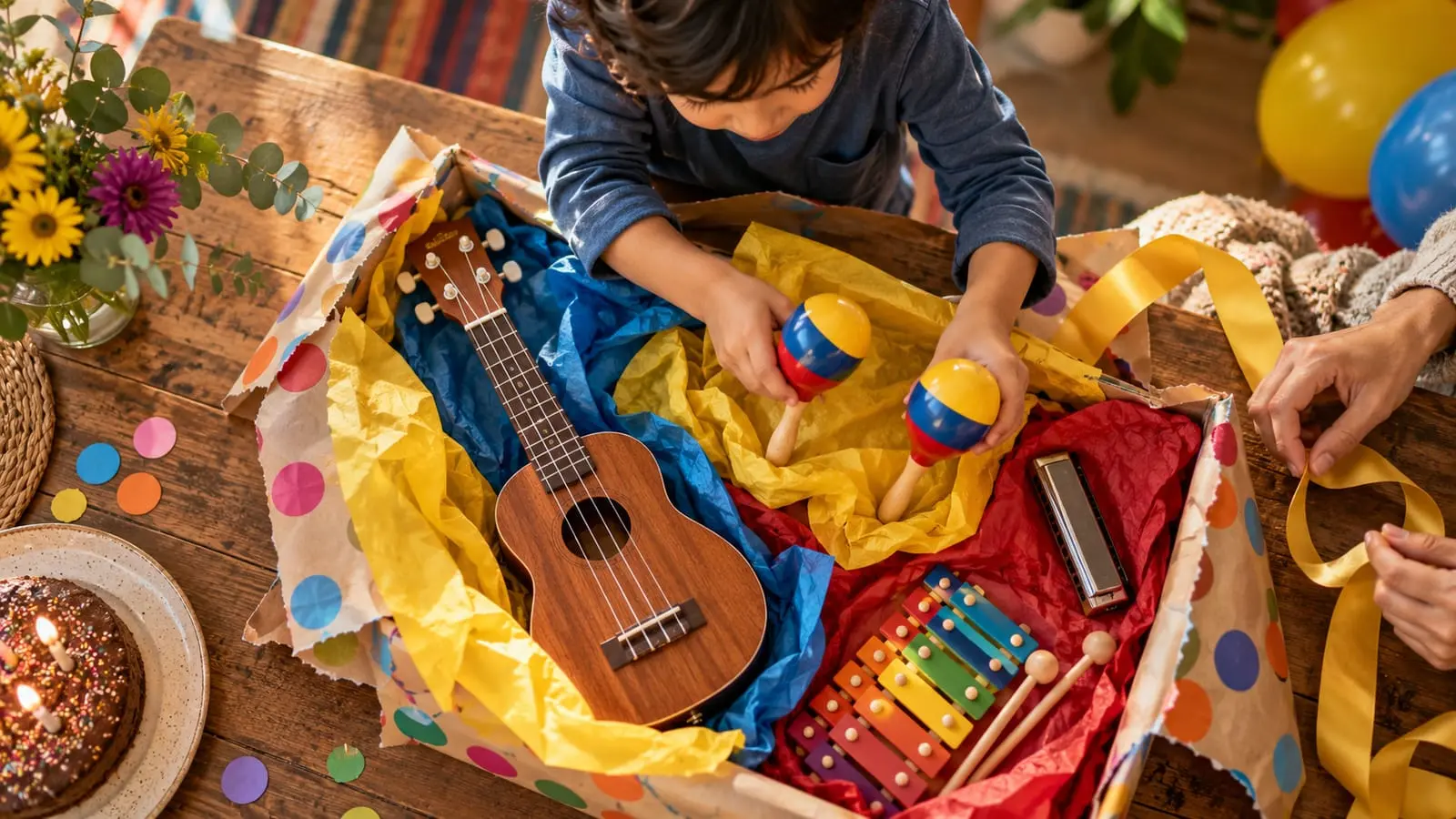
The best musical gift for a child suits their age and size, plays in tune, and is something they will actually use. For the youngest children, choose simple, safe percussion instruments; from age 6 or 7, a properly sized first instrument for lessons; and at any age, lessons that give everything else a purpose.
Here you’ll find ideas by age, ways to tell a toy from a real instrument, and common mistakes when giving musical gifts—especially in December, when Christmas novenas and carols make everyone want a tambourine.
In short
- Ages 0 to 2: simple percussion instruments with no small parts, and plenty of family singing.
- A toy instrument is useful for exploring; if your child will be taking lessons, they need one that can be tuned and stays in tune.
- Buy string instruments that fit your child, rather than oversized ones “to grow into.”
- Giving lessons makes any instrument useful and is a gift that grows with your child.
- Before giving a drum kit or a trumpet, talk to the family: the noise comes with it.
How to choose a musical gift that will get used
Before browsing the shops, answer four questions:
- How old and how big is the child? An instrument that is too large or heavy causes frustration and gets abandoned.
- What do they enjoy? Singing all day, tapping on every surface, or watching the school band: these clues matter more than any list.
- Where do they live? In an apartment, a very loud instrument may end up put away.
- Who will support them? Without someone to teach or encourage them, an instrument often stays in the closet.
If the gift is for another family’s child, ask the parents first. An instrument means a commitment of space, noise, and time, and they know whether one is already waiting at home or the child has been asking for another for months.
Musical gift ideas by age
| Age | Gift ideas | Keep in mind |
|---|---|---|
| Ages 0 to 2 | Egg shakers, rattles, a hand drum with a soft drumhead, books with songs. | No small parts that could be swallowed; sturdy materials that are easy to clean. |
| Ages 3 to 5 | A tuned metallophone, tambourine, claves, maracas, a small drum, introductory music lessons. | Look for pleasant, in-tune sounds; at this age, exploring matters more than “learning an instrument.” |
| Ages 6 to 8 | A good-quality recorder, a keyboard with full-size keys, a 1/2 or 3/4 guitar with nylon strings, a violin that fits. | This is a common age to start formal instrument lessons; ideally, the gift should include lessons. |
| Ages 9 to 12 | The instrument your child asks for, in the right size, plus accessories: a music stand, tuner, metronome, songbook. | School bands and personal tastes come into the picture; ask your child first. |
| Teenagers | An electric guitar with a small amplifier, a microphone for practice, an electronic drum kit, lessons in the style they enjoy. | A surprise gift that doesn’t fit their music often ends up put away. |
For the youngest children, music for babies explains how to use these instruments at home. If you’re unsure which instrument would suit your child, read choosing an instrument for your child.
Toy instrument or real instrument?
Toy instruments have their place: for a two- or three-year-old, a colorful xylophone or a little plastic guitar is a way to explore sound. The problem comes when the child is ready for lessons and the instrument cannot be tuned.
| Aspect | Toy instrument | Student instrument |
|---|---|---|
| Tuning | Often out of tune, with no way to adjust it. | Can be tuned and stays in tune. |
| Size | One-size-fits-all, sometimes with miniature keys or frets. | Full-size or fractional sizes, depending on age. |
| What it's for | Exploring, playing, and enjoying making noise. | Learning in lessons and practicing at home. |
| Duration | Short. | Years, with basic care. |
A tip before you buy
If you’re giving a metallophone or xylophone, check that the bars have note names and test them on your phone with the online tuner. If the bar labeled C doesn’t register as C, keep looking. For guitars and keyboards, avoid strings that are impossible to tune or keys smaller than a piano’s: ears and hands get used to what they play.
Giving music lessons as a gift
An instrument without lessons is like a ball without a playing field. Giving lessons puts what’s already at home to use, and the gift grows with your child: the teacher adapts the pace and repertoire to their age and interests.
- Make it tangible. Wrap a handmade card naming the instrument together with drumsticks, a flute, or a music manuscript notebook.
- Choose the format with the family. Lessons can be in-home in Bogotá and the surrounding area, or online from any city.
- Think about continuity. One lesson is an experience; several consecutive weeks give the child time to make progress.
- Keep the choice open if you’re unsure. For young children, introductory music lessons don’t require choosing an instrument yet.
Lesson prices depend on the format, length, and frequency. If you’d like to give them as a gift, message us on WhatsApp and we’ll tell you about the available options.
Last-minute musical gifts that don't need sizing
If it's already December and you're short on time, choose gifts that don't depend on size or tuning: small percussion instruments, accessories and books. You can buy them in a single trip, and they're almost always used from the novena onward.
- Maracas, a tambourine, claves or a triangle to accompany Christmas carols.
- A songbook or a book of children's songs with sheet music.
- A music manuscript notebook and colored pencils to write down what your child learns.
- A folding music stand or a metronome for someone who already plays.
- A handmade card announcing lessons starting in January.
Giving lessons that start after the holidays
You can give the lessons as a gift on December 24 and have them start in January, when routines resume. The card announces the gift, and the teacher and family agree on the date and time of the first lesson afterward.
If your child is on school break and you want them to make the most of their free time, take a look at the school-break music courses. And for Christmas carols for the novena, you'll find ideas in easy Christmas carols to learn to play at Christmas.
Small gifts for children who already play
If your child already studies an instrument, accessories are useful, less expensive gifts. Ask the teacher what they need first:
- Recorder: a better-quality recorder with the fingering system the school requires, a case, and a songbook. Learn how to choose one in how to choose a recorder.
- Guitar: spare strings of the type they use, a clip-on tuner, a capo, a padded gig bag.
- Piano or keyboard: an adjustable bench, closed-back headphones, a book of pieces at their level.
- Violin: rosin, a practice mute, a microfiber cloth for cleaning the strings.
- Percussion: new drumsticks, a practice pad, hearing protection for musicians.
- For any instrument: a folding music stand, a music manuscript notebook, or concert tickets.
Common mistakes when giving an instrument
- Buying an oversized guitar or violin “to grow into”: an instrument that doesn’t fit is uncomfortable, sounds bad, and discourages the child.
- Choosing the cheapest option without checking whether it can be tuned; an instrument that sounds bad convinces the child they’re “no good at music.”
- Giving an acoustic drum kit without consulting the family or considering the neighbors.
- Giving an instrument without a plan for lessons or practice.
- Choosing what you would have liked to play instead of what interests the child.
- Buying a keyboard with small keys for a child who will study piano: choose full-size keys and, if possible, touch sensitivity.
If you’ve already bought the gift and it’s the wrong size, don’t worry: ask the store about an exchange or have the teacher check it at the first lesson. Often, adjusting the strings or bridge makes it playable.
Frequently asked questions
What instrument can I give a 3-year-old?
Simple, sturdy percussion instruments: maracas, a tambourine, claves, a small drum, or a tuned metallophone. At that age, the focus is on exploring sounds, singing, and moving to music, rather than learning technique.
Is a keyboard a good gift for a child?
Yes, as long as it has full-size keys and, ideally, touch sensitivity. Toy keyboards with small keys are fine for play, but not for studying piano.
Can I give online music lessons to a child in another city?
Yes. Online lessons let children study with a teacher from anywhere. Coordinate the schedule, instrument, and who will support the child during the lesson with the family.
What musical gift works for a teenager?
The best approach is to ask them. Many teenagers value an accessory for their instrument, a microphone for recording themselves, or lessons in the style they enjoy more than a new instrument they didn’t choose.
When should I buy the Christmas instrument?
Several weeks ahead, rather than in the last days of December. That way you can check the size and tuning, ask about exchanges and have time to make any necessary adjustments before the 24th.
What musical gift works well if I buy it at the last minute?
Gifts that don't depend on size: maracas, a tambourine, claves, a songbook or accessories such as a music stand or tuner. You can also give a handmade card announcing lessons starting in January.
Sources
We checked the facts in this article against these sources on October 22, 2026.