
How to motivate your child to practice their instrument without fights
Motivation to practice doesn't just appear: it's built with routine, small goals and recognition of effort. Here are ideas and phrases that actually work.
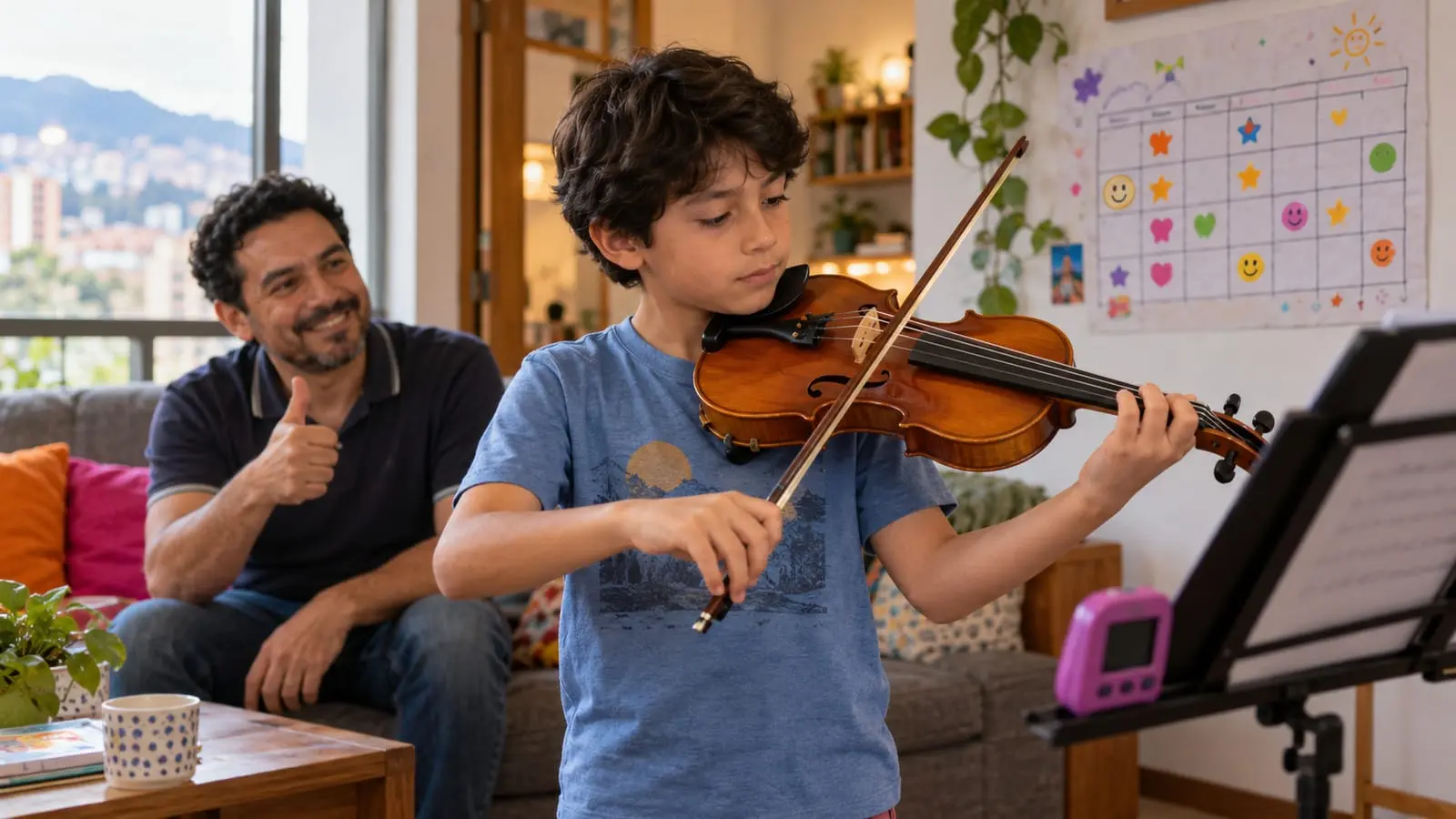
Motivation to practice rarely comes on its own: you build it. What works best is a fixed routine that isn't renegotiated every day, goals small enough to reach today, recognition of effort rather than talent, and music your child enjoys. Punishments and lectures tend to make things worse.
It also helps to know that ups and downs are normal. Some weeks your child will be eager to play; other weeks the instrument will stay in its case. Your job is to keep those weeks from turning into daily arguments.
In short
- A set practice time, linked to another daily routine, avoids daily negotiations.
- Replace “practice for 15 minutes” with specific goals: “today, play these four measures three times in a row.”
- Recognize effort and progress rather than talent: “I noticed you kept repeating that part until you got it.”
- Don't use practice as a punishment or skip it as a reward.
- The teacher plays a key role: clear assignments, engaging music, and goals within reach, such as a mini concert.
Why children find it hard to practice
Before looking for solutions, it helps to understand what's happening. Lessons are fun and guided; practicing at home is a solitary activity with no immediate reward. The most common reasons are:
- They don't know what to practice. They sit down with the instrument without a clear idea of what to do.
- It's too difficult. The piece is beyond their level, and every attempt ends in a mistake.
- It's too long. Twenty minutes feels like forever to a 6-year-old.
- It competes with something more appealing: a tablet, TV, or going outside to play.
- They feel judged. Someone corrects them every time they play.
Each cause calls for a different solution. If your child doesn't know what to practice, the assignment needs attention; if they feel judged, the way you support them does.
A fixed routine that isn't renegotiated every day
Asking “are you going to practice today?” invites a no. It works much better to give practice a fixed place in the day, just like brushing teeth: after the afternoon snack, before tablet time, or right after school.
| Age | Duration | How to support your child |
|---|---|---|
| 4 to 5 years | 5 to 10 minutes | An adult stays beside the child throughout, and practice feels almost like a game. |
| Ages 6 to 8 | 10 to 15 minutes | An adult stays nearby, helps the child get started, and listens at the end. |
| Ages 9 to 12 | 20 to 25 minutes | The child practices independently with their notebook; an adult checks that practice happens. |
| Teenagers | 30 minutes or more | They organize their own practice; you help by providing space and time. |
Other helpful details: keep the instrument visible and ready to play (rather than at the back of a closet), aim for five days a week instead of seven, and stop while your child still wants to play. For a way to organize that time, use this home practice routine.
Small, visible goals
“Practice for 15 minutes” is a time-based goal, and children can experience it as a punishment. A task-based goal is much more motivating: “today we'll get measures 5 to 8 right three times in a row.” Once the goal is met, practice is over, even if only 8 minutes have passed.
Some games that turn repetition into a challenge:
- The five counters: place five counters or chickpeas on one side of the music stand. Each time the passage goes well, move one to the other side; if it goes wrong, move one back. The goal is to move all five across.
- The task die: assign an activity to each number (a scale, a familiar song, a new passage, a rhythm exercise). Your child rolls the die to decide the order.
- The calendar: a check mark or sticker for each practice day, and something special at the end of a full week.
- The metronome challenge: play a passage cleanly with the metronome and increase the tempo by two beats per minute each day.
Examples by instrument: on piano, “left hand alone, three clean repetitions”; on violin, “four long bow strokes on the A string without a scratchy sound”; on guitar, “switch from C to G ten times without looking at your hand.”
How to recognize effort (and which phrases to avoid)
What you say while your child practices carries a lot of weight. In general, describing what you noticed works better than passing judgment:
| Better to say | Better to avoid |
|---|---|
| “I noticed you kept repeating that part until you got it.” | “You're a genius!” (when something goes wrong, they feel they've stopped being one). |
| “That part sounded more even than yesterday.” | “That's wrong. Again.” |
| “Will you play what you learned today for me?” | “Did you practice or not?” |
| “Which part is giving you the most trouble?” | “Your cousin played much better at your age.” |
| “I love listening to you play.” | “After all we're paying for those lessons…” |
About rewards: occasional recognition is fine, especially if it relates to music, such as choosing the next song, going to a concert, or organizing a mini recital for the grandparents. What you want to avoid is putting a price on every practice session, because motivation research suggests that material rewards can weaken a child's own interest in the activity.
Why punishment doesn't help with practice
“You misbehaved, so you'll practice for an extra half hour today” and “you behaved well, so you don't have to practice today” sound like opposites, but they send the same message: playing the instrument is unpleasant. Over time, your child associates music with punishment and practices less and less.
That doesn't mean everything is optional. Practice can be a family commitment, like school homework, and it's fine to uphold it. The difference lies in your tone: practice is part of learning, rather than a consequence of something else.
The teacher's role: clear assignments and engaging music
Motivation at home depends a lot on what happens in lessons. A good teacher:
- Sets specific, achievable assignments, written in the notebook or explained in a short audio recording.
- Includes music your child enjoys: a song from a movie, something on the radio, or a piece they requested.
- Sets goals within reach: a mini concert, a video for the family, or an end-of-semester performance.
- Celebrates the week's achievements before offering corrections.
- Stays in touch with the family and adjusts the plan if practice isn't working.
Don't hesitate to tell the teacher what's happening at home: arguments, a piece your child dislikes, or too much homework. That's exactly what weekly follow-up is for. If motivation has disappeared and your child is talking about quitting, read what to do when your child wants to stop playing their instrument.
Frequently asked questions
Should I make my child practice?
Rather than forcing practice, uphold an agreement: practice is part of taking lessons, just as homework is part of school. If that agreement breaks down every day, look at the causes (length, difficulty, repertoire) before making the rules stricter.
Do rewards for practicing help?
Occasional recognition, especially when it relates to music, can help. Paying for every practice session with screen time, candy, or money usually works only briefly and can weaken a child's own interest in music.
What if my child practices but doesn't improve?
They may be practicing without a clear focus: playing everything from beginning to end or going too fast. Ask the teacher for a more specific assignment and help your child work on short passages slowly. Recording themselves once a week also helps them notice real progress.
Do I need to be there while my child practices?
It depends on age. Up to age 6 or 7, usually yes. Between 8 and 12, staying nearby, helping them get started, and listening for a moment is enough. With teenagers, it's best to give them space and show interest without supervising every minute.
Sources
We checked the facts in this article against these sources on October 22, 2026.