
How to teach private music lessons: a guide for teachers
From the first message with the family to the tenth lesson: how to assess, plan, communicate and stay organized so your students make progress.
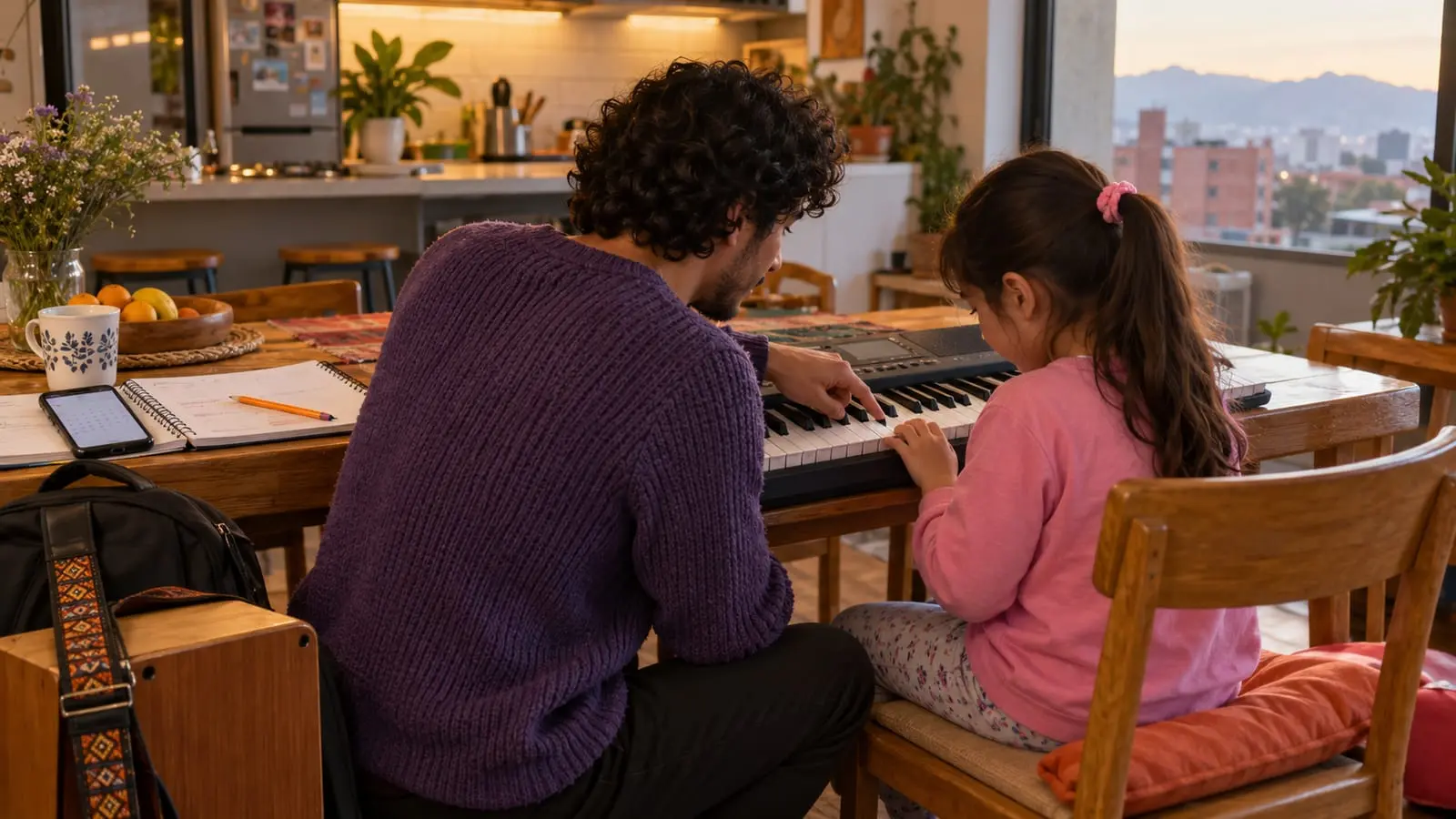
Good private music lessons rest on four things: an honest assessment in the first lesson, a plan with monthly goals, clear agreements with the student or their family, and punctuality that holds up even in heavy traffic. Musical skill is the starting point; what keeps a student coming back is seeing their own progress.
This guide is for teachers who are starting out or want to organize their work: what to do before and during the first lesson, how to plan, how to communicate, and what changes between online and in-home lessons.
In short
- Before the first lesson, ask about the student's goals, previous experience, the condition of their instrument, and who will be there with them.
- The first lesson is an assessment, not a test: observe the student's sense of pulse, ear, posture, and reading skills, and make sure they finish by playing something new.
- Plan around monthly goals and review them with the student or their family; prepare each lesson individually with those goals in mind.
- Put your agreements on scheduling, cancellations, and makeup lessons in writing before you start.
- For online lessons, pay attention to audio and camera setup; for in-home lessons, allow extra travel time and maintain professional boundaries.
Before the first lesson: the initial conversation
A ten-minute call or exchange of messages saves you from going into the first lesson blind. Ask:
- How old is the student, and what experience do they have with music?
- Why do they want to learn? Playing in the school band, accompanying songs, auditioning for a music degree, and simply enjoying music are different goals.
- Do they have an instrument, and what condition is it in? A guitar with very high string action or a keyboard with small keys affects everything.
- What music do they like to listen to?
- Which days and times work for them, and will the lessons be online or at home?
- If the student is a minor, which adult will be at home, and who will be your point of contact?
With those answers, you can arrive with materials chosen for that person instead of a generic lesson.
The first lesson: assessment without a test
The first lesson has two goals: understand where the student is now and leave them wanting to come back. Skip intimidating tests; assess them through games and playing music.
| What to watch for | How to do it | What it tells you |
|---|---|---|
| Beat | Play something and ask them to keep the pulse by clapping or tapping a foot. | Whether they can work with a metronome or need to develop a steady pulse first. |
| Ear training | Sing or play a short phrase and ask them to repeat it. | How readily they will pick out melodies and correct themselves. |
| Posture and body | Watch them hold and play the instrument without correcting them immediately. | Which tensions or habits need attention first. |
| Reading | Show them a few simple measures, without putting them under pressure. | Whether to start by ear, with chord symbols, or with sheet music. |
| Motivation | Ask what they would like to be playing in a few months. | Which repertoire will keep them motivated to put in the work. |
Save the last few minutes for playing something new, however simple: a rhythm, two chords, a phrase. Leaving the first lesson able to play something they couldn't play before is the best reason to keep going.
Plan around goals, not just one lesson at a time
Use your assessment to set goals for the next four to eight weeks. A good goal is something you can see and hear: “play the first section of the waltz with both hands at a slow tempo” says much more than “get better at piano.” Combine three types:
- A technique goal: a scale, a chord change, a bow stroke, a fingering.
- A repertoire goal: a complete piece or song, chosen with the student.
- A reading or ear training goal, based on what the assessment showed.
Review the goals every month with the student or their family. If they weren't met, ask yourself whether they were realistic, whether the student practiced at home, or whether the plan needs a different approach. We explain how to turn those goals into a specific lesson in how to prepare a music lesson.
Keep brief notes after each lesson, too: what you did, what worked, and what to cover next time. With several students a week, memory alone isn't enough.
Agreements and communication with families and students
Most misunderstandings in private lessons come from expectations that were never discussed. Before you start, put these in writing:
- The day, time, and length of the lesson.
- How much notice is needed to cancel and how makeup lessons work.
- What happens if you are the one who cancels.
- How much home practice you expect and how it will be recorded.
- Which communication channel you use and when you reply.
With children and teenagers
Spend two minutes at the end of the lesson telling the family what you worked on and what needs practice. Talk about specific progress, not generalities. If there's a problem, such as a lack of practice or frustration, discuss it privately with the adult and bring a proposed solution, not just a complaint.
Always communicate with the responsible adults rather than through private chats with the child, and try to ensure an adult is home during the lesson. These boundaries protect both the student and you.
With adults
Adult students often have little time and high expectations. Adapt the goals to their actual schedules, explain the purpose of each exercise, and give them repertoire they enjoy from the start.
Punctuality and professionalism
In Bogotá, a traffic jam can eat up half a lesson. Allow extra time when planning your routes, group students by area when possible, and let them know as soon as you realize you'll be late, not after you're already late.
- Start and finish at the agreed time; if the student is late, the lesson doesn't run longer unless you've agreed otherwise.
- Have your materials ready before you arrive or connect.
- Keep your phone silent and out of sight, except when using it as a metronome or to record.
- Ask permission before touching a student to adjust their posture; often, demonstrating with your own body is enough.
- Pay attention to your appearance and language, including in online lessons.
Online or in-home lessons: what changes
| Aspect | Online lesson | In-home lesson |
|---|---|---|
| Sound | Latency prevents you from playing together at the same time: take turns or provide tracks for the student to play along with. | You can play duets and accompany the student live. |
| Corrections | Ask for a side view or a second camera so you can see their hands and posture. | You can see the whole body and the instrument up close. |
| Material | PDF sheet music, screen sharing, and recordings sent after the lesson. | Printed sheet music, a folding music stand, and whatever fits in your bag. |
| Logistics | A stable connection, headphones, and a backup plan if the call drops. | Travel time, a buffer for traffic, and a suitable space in the home. |
| With young children | An adult nearby to help with the instrument and camera. | An adult at home and a space without distractions. |
For online lessons, enable your platform's music audio mode if it has one, and check your own equipment; you'll find our recommendations in equipment for online music lessons.
If you'd like to teach in both formats as part of a network, Gissi is looking for teachers for online and in-home lessons in Bogotá and the surrounding area. We assess each teacher's musical skills, teaching skills, and personal qualities before their first lesson. You can apply to teach and, if you're still figuring out your path, read how to become a music teacher in Colombia.
Common mistakes new teachers make
- Talking more than the student plays: the instrument should be in their hands for most of the lesson.
- Correcting everything at once instead of choosing one correction for each passage.
- Always using the same method without repertoire the student enjoys.
- Giving vague assignments, such as “practice the song.”
- Failing to record progress and forgetting what you did the previous week.
- Accepting back-to-back lessons at opposite ends of the city, with no time allowed for traffic.
- Putting off difficult conversations with the family until the problem has grown.
Frequently asked questions
How long should a private music lesson last?
It depends on age and skill level. For young children, 30 to 45 minutes is usually enough; for teenagers and adults, 45 to 60 minutes works well. More than the length, what matters is that every minute has a purpose.
What should I do if a student doesn't practice between lessons?
First, find out why: a lack of time, unclear assignments, or repertoire they don't enjoy. Make the assignment short and specific, and use part of the lesson to work together on how to practice at home.
How do I handle lessons the student cancels?
Set your policy before you start and put it in writing: how much notice is required, what happens with last-minute cancellations, and how makeup lessons work. What matters is that it's clear and you apply it consistently to everyone.
Is it worth offering a trial lesson?
It's up to each teacher. If you offer one, treat it as a real first lesson, with an assessment and something new learned, and explain from the start how things will work if they decide to continue.
Sources
We checked the facts in this article against these sources on October 22, 2026.
- Suzuki Association of the Americas: code of ethics for teachers (conduct and working with families)
- Suzuki Association of the Americas: Suzuki method principles (family support, listening, and a positive environment)
- Zoom: “Original sound for musicians” for online music lessons
- Wikipedia: networked music performance (why latency prevents playing together in real time)