
How to choose your first piano or keyboard: a buying guide
Acoustic, digital or keyboard: which specs really matter for learning piano, what to test in the store and what to check if you buy used.
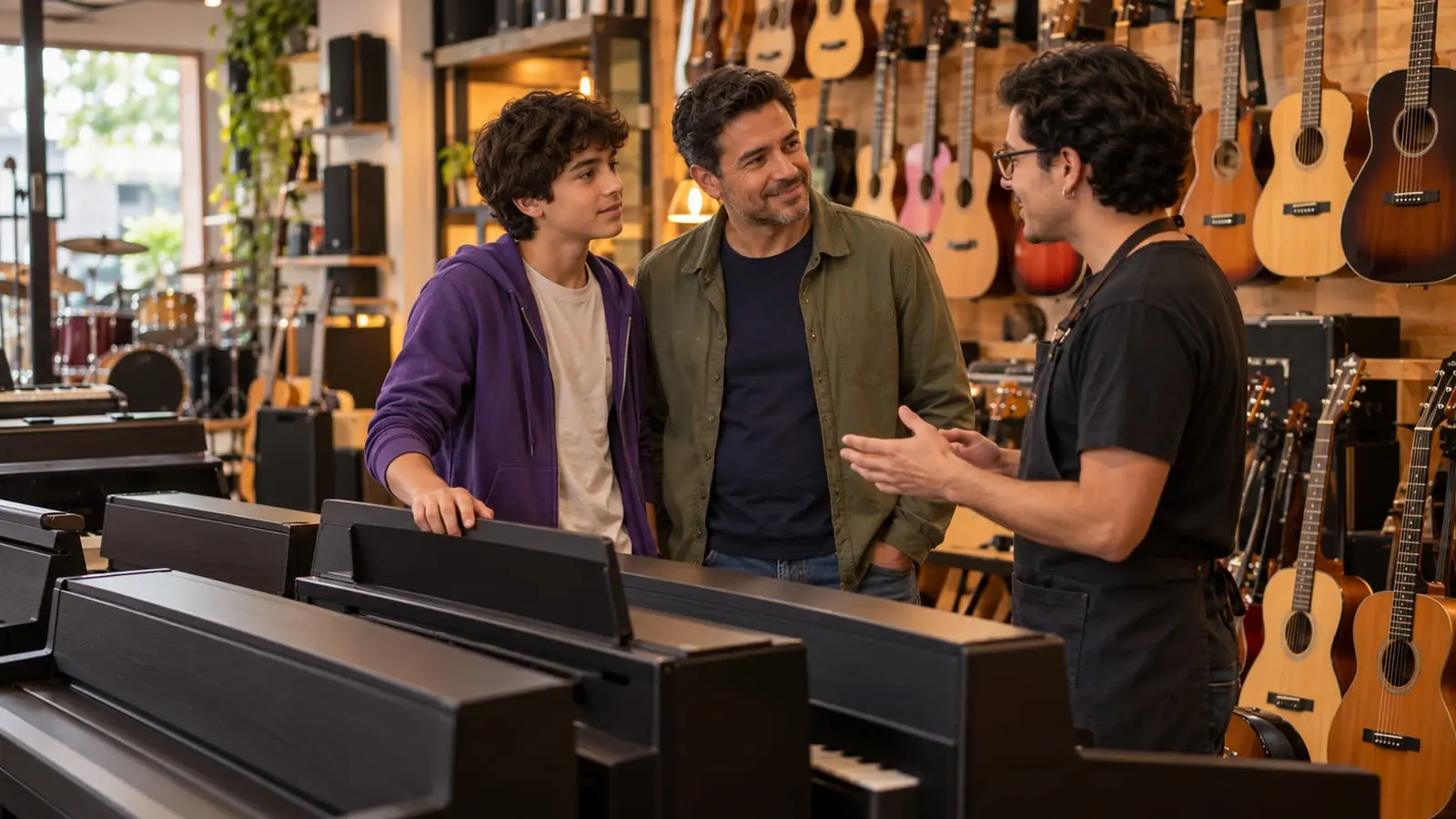
If you're serious about studying piano, the most practical starting point is a digital piano with 88 weighted, touch-sensitive keys and a proper sustain pedal. An acoustic piano offers the best experience if you have the space, a good relationship with your neighbors, and someone to tune it. A 61-key keyboard is useful for exploring or introducing young children to music, but you'll outgrow it within a few months.
Here's what matters when comparing instruments, what to try in the store, and what to check if you're buying used. We're looking at features, not brands: the right instrument meets these requirements and fits in your home.
In short
- For learning piano, look for 88 full-size, weighted, touch-sensitive keys.
- A keyboard with light keys is useful for exploring, but it doesn't develop the finger strength or control that piano requires.
- In an apartment, a digital piano with headphones takes care of airborne noise; the impact of the keys and pedal still travels through the floor.
- Only pay for a used acoustic piano after a technician checks the pinblock, hammers, soundboard, and tuning.
- Ask your teacher to try the instrument, or watch a video of it, before you pay.
Acoustic piano, digital piano, or keyboard: what really changes
All three have black and white keys, but they don't respond the same way. The differences lie in the key mechanism, the sound, and what they require of your home.
| Upright acoustic piano | Digital piano | Portable keyboard | |
|---|---|---|---|
| Keys | 88, with a real hammer mechanism | 88, weighted in models designed for study | Usually 61 or 76, with light keys |
| Feel | The benchmark: the mechanism's weight and response | Imitates piano key weight; varies widely between models | Light; doesn't develop finger strength |
| Sound | Real vibrating strings and wood | Recorded piano samples; depends on the speakers | Many sounds and rhythms; the piano sound is less realistic |
| Volume | Can't be muted; some have a practice mute pedal | Adjustable volume and headphone output | Adjustable volume and headphones |
| Maintenance | Regular tuning by a technician | Almost none | Almost none |
| Space | Heavy and kept against a wall | Compact cabinet or stand | Can be stored in a closet |
| Who it is for | Students with space and long-term plans | Most beginners, children and adults | Introduction to music, exploration, popular keyboard playing, or production |
If you're specifically deciding between a digital piano and a keyboard, digital piano or keyboard: differences compares them in depth. Here, we focus on making your choice and checking the instrument before buying.
The specifications that matter for a beginner
Spec sheets list dozens of details. For learning piano, check these and leave the rest for later:
| Specification | What to look for | Why it matters |
|---|---|---|
| Number of keys | 88, standard size | The repertoire soon uses the low and high ends of the keyboard |
| Action | “Weighted” or “hammer action,” preferably graded | Low keys feel heavier, as on an acoustic piano |
| Touch sensitivity | Several levels, enabled by default | Without it, you can't play forte or piano, or shape the expression |
| Pedal | A piano-style pedal; ideally supports half-pedaling | The small square plastic pedal slides around and doesn't allow graduated control |
| Polyphony | The more voices, the better; for solo playing, it matters less than the feel of the keys | With the sustain pedal, notes build up, and if polyphony is low, the earliest notes cut off |
| Connections | Headphone output (two is better) and USB | Practice at night and use apps or take online lessons |
Watch out for “semi-weighted”: these keys offer a little more resistance than a keyboard's, but not the weight or return of a piano action. And be wary of children's keyboards with narrower-than-standard keys: they encourage poor hand habits.
The stand and bench matter, too
An X-style stand that moves when you play loudly is uncomfortable and unsafe. Look for a sturdy stand or cabinet base, and a height-adjustable bench: seat height affects hand posture more than you might think.
Space, apartments, and neighbors
Before you fall in love with an instrument, measure the space where it will live. A console digital piano takes up about as much space as a narrow desk. An acoustic upright is deeper, usually weighs between 200 and 300 kilos, and needs an interior wall, away from windows with direct sunlight and the kitchen.
- Airborne noise: an acoustic piano can be heard in neighboring apartments even when you play softly. Some uprights have a middle practice mute pedal that greatly reduces the volume for practice.
- Impact noise: even with headphones, key and pedal impacts travel through the floor slab. A thick rug or an anti-vibration pad under the stand helps, especially on upper floors.
- Practice times: agree on a time window with your family and neighbors for playing through speakers, and use headphones at night.
- Moving: an acoustic piano won't fit up every staircase or into every elevator. Check access to the building and hire specialist movers; it will need tuning after the move.
- Climate: in hot regions, humidity can make keys stick and strings rust; in Bogotá, temperature changes near windows also affect it. We explain how to manage this in how to care for and clean a piano.
What to try in the store, step by step
You don't need to know how to play to do these tests. Bring your own headphones if you have them, so you can listen without the store noise.
- Play the same key very softly, then very loudly. Both the volume and tone color should change.
- Compare a key at the low end with one at the high end: with graded action, the low key feels a little heavier.
- Repeat a note quickly several times. The key should return promptly without odd noises.
- Press the pedal, play a chord, and lift your hands: the sound should sustain and stop when you lift your foot. Try lifting the pedal halfway, too.
- Turn the volume down and listen to the mechanism: loud thumping or uneven clicking becomes very annoying over the months.
- Plug in headphones and check that the speakers turn off and there's no hum.
- Sit on the bench you'll use: your forearms should be roughly parallel to the floor.
- Ask what's included: stand, pedal, power adapter, music rest, and bench. Sometimes they're sold separately.
Warning signs
- Narrow keys or keys without touch sensitivity, advertised as “ideal for learning piano.”
- Keys that stay down, sound different from neighboring keys, or make no sound.
- Speakers that rattle or crackle at medium volume.
- A stand that wobbles when you play forcefully.
New or used?
A used digital piano can be a good buy if you check it carefully. So can a used acoustic piano, but the risk is greater because serious problems aren't visible at first glance.
| What to check | Used digital piano | Used acoustic piano |
|---|---|---|
| Keys | All 88, one by one, softly and loudly | No keys should stick or return slowly |
| Pedals | Sustain should work without unwanted noise | Each pedal should perform its function |
| Sound | Speakers and headphones without hum | Overall tuning; dull or buzzing notes |
| Structure | Secure connectors and the original adapter | Pinblock, soundboard, hammers, and felts: assessed by a technician |
| Climate and pests | Not applicable | Moths in the felts, rusty strings, cracked wood |
If an acoustic piano won't hold its tuning because the tuning pins are loose in the pinblock, repairs can cost more than the instrument. That's why you should pay only after a piano technician has inspected it. For other instruments, see our guide to new or used instruments.
What to choose based on age and goals
| Situation | Reasonable option | Why |
|---|---|---|
| Child aged 4 to 6 being introduced to music | Keyboard with 61 standard-size, touch-sensitive keys | At this stage, learning involves games with pulse, singing, and exploration |
| Child aged 6 or 7 and up taking piano lessons | Digital piano with 88 weighted keys | Develops finger strength and control from the start |
| Adult beginner | Digital piano with 88 weighted keys, or acoustic if there's space | Avoids having to replace the instrument after a year |
| Popular keyboard playing, accompaniment, or production | Keyboard or controller with good touch sensitivity | Sounds and connections matter more than key weight |
| Preparing for an admissions audition | Digital piano designed for study, or acoustic piano, plus more practice time on an acoustic | The audition is usually on an acoustic piano, and the difference in touch is noticeable |
If the last row applies to you, take a look at our music university preparation program, too. And if you're starting piano lessons, ask your teacher before buying: they know what your level needs now and a year from now.
Frequently asked questions
Can you learn piano on a 61-key keyboard?
For the first few months, yes, especially for young children or for exploring. Problems arise when pieces call for notes outside that range and when your fingers get used to light keys: controlling volume becomes difficult when you move to a piano. If you already know you'll study piano, start with 88 weighted keys.
Can you study classical piano on a digital piano?
Yes, as long as it has hammer action, good touch sensitivity, and a proper pedal. Many students progress for years on one. Ideally, play an acoustic piano occasionally, in lessons or a rehearsal room, to experience the differences in touch and sound.
How high should a piano bench be?
High enough for your forearms to be roughly parallel to the floor, your wrists level with the keys, and your feet supported. For children, an adjustable bench and a footrest solve the problem as they grow.
Is a keyboard with light-up keys or learning features worth it?
They can be motivating, especially for children, but they don't replace the essentials: 88 keys, weight, and touch sensitivity. If you have to choose, prioritize the feel of the keys over extra features, and use apps to complement lessons rather than replace them.
Sources
We checked the facts in this article against these sources on October 22, 2026.