
How to read bass clef: notes, tricks and exercises
Lines G-B-D-F-A, spaces A-C-E-G and three landmark notes so you don't have to count up from the bottom. Everything you need to read bass clef, with exercises by instrument.
In the fourth-line F clef used today, the symbol's two dots surround the 4th line of the staff, identifying it as F. From there, the lines from bottom to top are G-B-D-F-A, and the spaces are A-C-E-G. Middle C sits on the first ledger line above the staff.
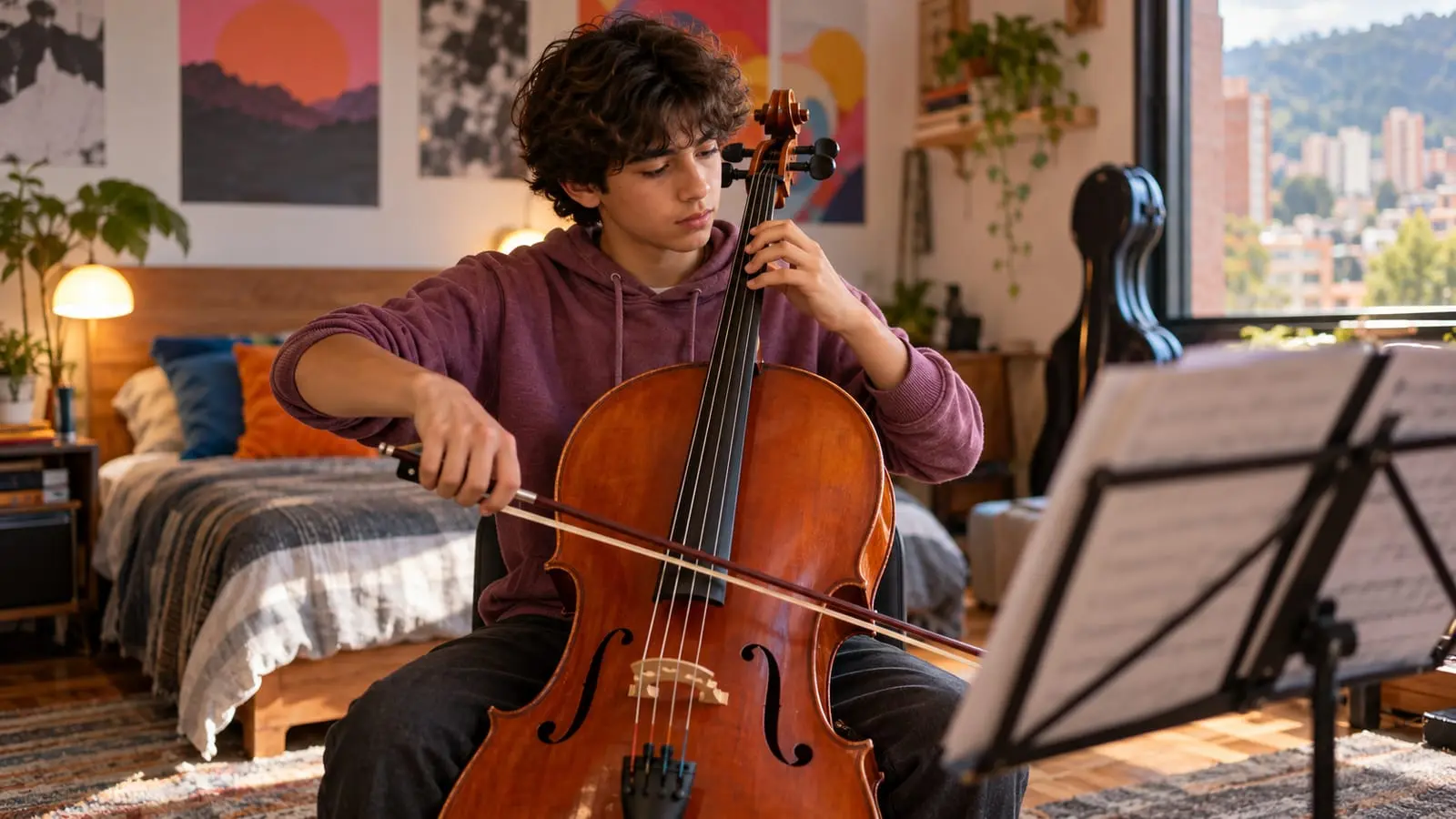
It's used for the piano's left hand, electric bass, double bass, cello, trombone, bassoon, and tuba. Here's how to locate any note without counting from the bottom, avoid confusing it with treble clef, learn each instrument's key reference notes, and build a practice routine. If you're not yet familiar with the staff or note values, start with our guide to reading sheet music.
In short
- In bass clef, the lines are G-B-D-F-A and the spaces A-C-E-G, from bottom to top.
- Three landmark notes are enough to find your way: G on the 1st line, F on the 4th (between the dots), and middle C on the ledger line above.
- The same note name sits one line or one space lower in bass clef than in treble clef, and sounds two octaves lower.
- If you read the position as though it were treble clef, move two note names up: E becomes G, F becomes A.
- Writing the name above every note slows your reading; landmark notes and intervals are a better approach.
What bass clef is and who uses it
A clef is the symbol at the beginning of the staff that tells you which note belongs on each line. The F clef evolved from a stylized letter F, which is why its two dots mark the F line. Today you'll almost always see it on the 4th line, hence its full name, fourth-line F clef. Older music also uses a third-line F clef, but it's very rare in modern sheet music. You'll find a brief definition in the music glossary.
| Instrument | Use | Something to keep in mind |
|---|---|---|
| Piano | Usually the left hand | The clef may change partway through a piece; check the symbol at the start of each system |
| Cello | Almost always | In the upper register, it also uses tenor and treble clefs |
| Electric bass and double bass | Always | They sound one octave lower than written |
| Trombone | Almost always | Advanced repertoire uses tenor clef; some bands use parts written in treble clef |
| Bassoon, tuba, and timpani | Almost always | Bassoon also uses C clef in its upper register |
| Low voices | Bass and baritone parts in choral scores | Tenors usually read treble clef, sounding an octave lower |
Notes on lines, spaces, and ledger lines
| Position | Note |
|---|---|
| 2nd ledger line above | E (E4) |
| Space above the 1st ledger line | D (D4) |
| 1st ledger line above | Middle C (C4) |
| Space above the 5th line | B (B3) |
| 5th line | A (A3) |
| 4th space | G (G3) |
| 4th line (between the dots) | F (F3) |
| 3rd space | E (E3) |
| 3rd line | D (D3) |
| 2nd space | C (C3) |
| 2nd line | B (B2) |
| 1st space | A (A2) |
| 1st line | G (G2) |
| Space below the 1st line | F (F2) |
| 1st ledger line below | E (E2) |
| Space below the 1st ledger line | D (D2) |
| 2nd ledger line below | C (C2) |
Two memory phrases
- Lines (G-B-D-F-A): “Good Boys Deserve Fun Always”.
- Spaces (A-C-E-G): “All Cows Eat Grass”.
Notice the pattern, too: from one line to the next, you always skip a note. From G to B, you skip A, in the space between; from B to D, you skip C. Lines and spaces therefore alternate in note order, so if you know a line, you know the space above it.
Landmark notes: finding your way without counting from the bottom
Counting “G, A, B…” from the 1st line every time works for the first week, then becomes slow. Experienced readers use a few notes they recognize instantly and work out nearby notes from those.
| Landmark note | Where it is | How to remember it |
|---|---|---|
| F (F3) | 4th line | The line between the clef's two dots |
| G (G2) | 1st line | G on the ground floor of the staff |
| C (C3) | 2nd space | The C one octave below middle C |
| Middle C (C4) | 1st ledger line above | The note shared by treble and bass clefs |
| Low C (C2) | 2nd ledger line below | Two lines below, two octaves below middle C |
Use landmark notes as anchors and read by intervals: a line to the neighboring space is a second (one step), a line to the next line is a third, and so on. If a note is in the space just above F on the 4th line, it's G, with no further counting needed.
How to avoid confusing it with treble clef
The most common mistake among people who learned treble clef first is reading bass clef with treble-clef note names. Three ways to avoid this:
- Move two names up. If you instinctively read a position in treble clef, move two note names up: the 1st line would be E in treble, so it's G in bass; the 1st space would be F, so it's A.
- One position lower. The same note name sits one line or one space lower in bass clef: G is on the 2nd line in treble and the 1st in bass; A is in the 2nd space in treble and the 1st in bass. They sound two octaves apart.
- The lines look similar. Treble-clef lines are E-G-B-D-F and bass-clef lines G-B-D-F-A: they share G, B, D, and F, shifted by one place. The spaces follow the same pattern: F-A-C-E in treble, A-C-E-G in bass.
One clue to spot the mistake while playing: if your left hand on piano lands two white keys below where it should, or its notes don't fit the right hand's harmony, you're probably reading as though it were treble clef.
Bass clef on your instrument
Piano
In left-hand C position, finger 5 goes on C in the 2nd space and the thumb on G in the 4th space: C, D, E, F, and G, alternating spaces and lines. In middle C position, your left thumb plays C on the ledger line, and finger 5 reaches F on the 4th line. Learning to read both clefs together is part of piano lessons from the first year.
Electric bass and double bass
The open strings are written as follows: E on the 1st ledger line below, A in the 1st space, D on the 3rd line, and G in the 4th space. They sound one octave lower than written, but that doesn't change how you read them. Many bassists start with tablature; reading sheet music opens the door to big bands, orchestras, and recording sessions. We work on this in electric bass lessons.
Cello
A memory trick: all four open strings fall on lines. C on the 2nd ledger line below, G on the 1st line, D on the 3rd, and A on the 5th.
Trombone
Three first-position notes you'll read all the time: B flat on the 2nd line, F on the 4th line, and B flat in the space above the 5th line.
Exercises for fluent reading
- Flashcards. Make cards for the notes from low C to middle C. Practice five minutes daily, saying the names aloud. Once you're quick, time yourself.
- Landmark notes first. In a score, find and mark only the Fs, the Gs on the 1st line, and the Cs. Then use them to read the rest.
- Read by intervals. Without naming notes, say whether each one moves up or down, and whether it's a step or a leap.
- Write. Play or sing a note and write it on the staff. Writing reinforces its location more than reading does.
- Spoken solfège. Read the bass line by saying the note names in rhythm, as we explain in what is solfège.
- Sight-reading. Four new measures a day, with a slow metronome and without stopping to correct mistakes.
If you'd like to strengthen your reading in any clef alongside rhythm and harmony, music theory lessons offer a structured way to do it.
Frequently asked questions
Why is bass clef also called F clef?
Because it marks the location of F, the note between its two dots. The symbol comes from a letter F that gradually became stylized over the centuries into its current form.
Where is middle C in bass clef?
On the first ledger line above the staff. It's the same note written on the first ledger line below the staff in treble clef, and it's where the piano's two hands meet.
Is bass clef harder than treble clef?
It isn't inherently harder; it feels that way because most of us learn treble clef first and practice it more. With a few minutes of reading each day, bass clef becomes just as natural.
Does electric bass use bass clef?
Yes. It's written in bass clef and sounds one octave lower than written, just like double bass. Many bassists use tablature, but reading sheet music is very useful for ensemble playing and recording sessions.
Sources
We checked the facts in this article against these sources on October 22, 2026.