
How to memorize a piece of music: the four types of memory
Repeating a piece until your fingers know it isn't enough. Solid memory combines four layers and a section-by-section method with restart points in case you get lost.
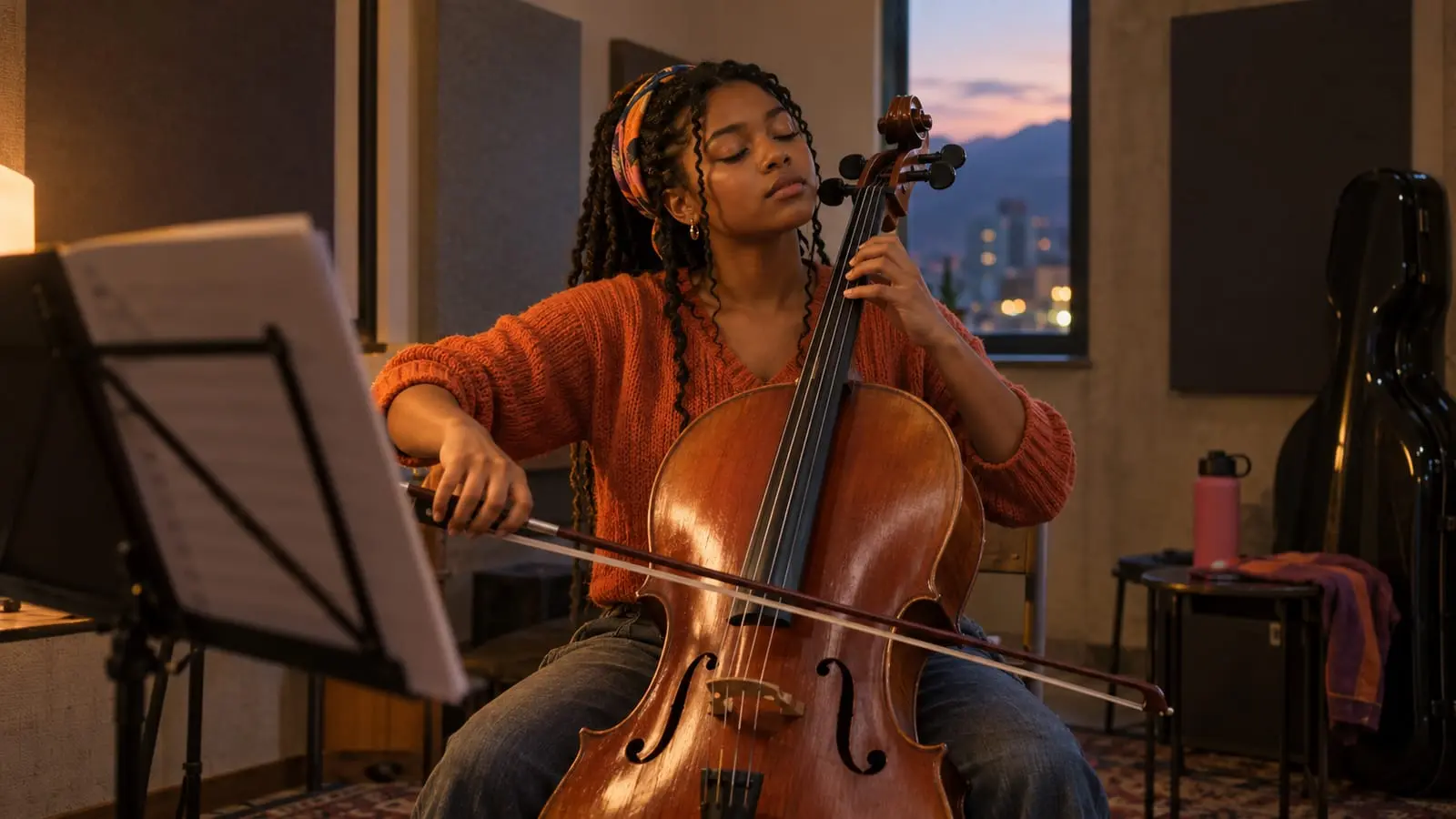
Memorizing a piece well takes more than repeating it until your fingers "know it." Reliable memory combines four layers: aural (you know how the next passage sounds), visual (you picture the sheet music or keyboard in your mind), motor (your hands know the way), and analytical (you understand the form, chords, and phrases).
Motor memory develops naturally through repetition, which is why many players rely on it alone. The problem is that it's the first to fail under nerves or distraction. The method below develops all four types, section by section, with anchor points you can return to if you lose your place.
In short
- Your fingers learn quickly, but their memory is fragile; strengthen it with aural, visual, and analytical memory.
- Before memorizing, understand the piece's form: its sections, repetitions, and how they differ.
- Memorize short sections and connect them with a one-measure overlap.
- Prepare anchor points and practice starting from any of them.
- If you can only play it fast and from the beginning, you haven't fully memorized it yet: try playing slowly and starting in the middle.
The four types of musical memory
Each type of memory fails differently. Recognizing what each lapse feels like tells you what you need to strengthen:
| Memory | What it is | Signs of a lapse | How to strengthen it |
|---|---|---|---|
| Motor | Automatic movements of the hands, arms, and breathing | If you stop, you can't resume without going back to the beginning | Play very slowly, paying attention to every movement |
| Aural | Hear what's coming next in your mind | You don't know which note comes next, even with your hand in the right position | Sing the melody, hum the accompaniment, and listen to recordings |
| Visual | Remember the page, keyboard, or fingerboard | You don't know where you are in the piece | Study the sheet music carefully and visualize positions with your eyes closed |
| Analytical | Understand form, harmony, and patterns | You go to the wrong section or repeat the wrong passage | Name chords, mark sections, and notice differences between repetitions |
Before memorizing: understand the piece
Ten minutes of analysis can save you hours of repetition. With a pencil and the sheet music in hand:
- Divide the piece into sections and label them: A, B, A', coda. In a song, identify the intro, verse, chorus, and bridge.
- Mark repeated material. Many pieces have less to learn than they seem to, because they return to the same material.
- Circle the differences between repetitions. A classic trap is a section that returns with a different ending the second time.
- Write down the chords or key of each section, even in a simple way.
- Mark where each phrase ends and where you breathe or change position.
If you still struggle to read sheet music fluently, start there: memory builds on accurate reading, and a wrong note you've memorized is hard to correct later.
A section-by-section method, step by step
- Choose a short section of four to eight measures.
- Play it slowly from the sheet music several times, paying attention to the notes, fingering, and sound.
- Look away or turn the page over and play from memory.
- Check against the sheet music. If you made a mistake, correct it and repeat until you can play it correctly several times in a row.
- Away from the instrument, sing the section or rehearse it mentally without playing.
- Connect it to the next section by playing the last measure of one and the first measure of the other.
A tip many teachers recommend: memorize from the end backward. Starting with the last section makes the ending the most practiced part, rather than the weakest, as often happens.
Anchor points: your safety net
An anchor point is a place in the piece where you can start without hesitation: the beginning of a section, the start of the chorus, or a key change. Mark and number them in the sheet music.
Then practice starting from any of them in random order. Write the numbers on slips of paper and draw one at random, or ask someone to tell you where to start. If you lose your place in a performance, don't try to recall the exact note you forgot: jump to the next anchor point and keep the beat going.
Tips for your instrument
Piano
Memorize each hand separately, especially the left, which tends to be less secure because practice often focuses on the melody. Say the accompaniment chords aloud. In piano lessons, it's common to work on remembering keyboard positions as well as the notes.
Violin
Along with the notes, memorize shifts, fingerings, and bowings: up-bow or down-bow, which part of the bow to use, and how many notes are slurred together. Sing the piece using note names, and learn where the accompanying piano comes in. In violin lessons, your teacher helps you settle these choices before memorizing, so you don't learn something you'll later need to change.
Guitar
In the classical guitar repertoire, memorize right-hand fingering (p, i, m, a) as carefully as left-hand fingering. For songs, learn the chord progression by scale degree as well as chord names: if you know the chorus moves from the first degree to the fourth and fifth, you can play it in any key and are less likely to lose your place. If you sing and play, memorize lyrics and chords together, syllable by syllable wherever the harmony changes.
How to check that you really know it
- Play it slowly from beginning to end without stopping.
- Start from three randomly chosen anchor points.
- Rehearse it mentally from beginning to end, on the bus or TransMilenio, for example, hearing each note in your mind.
- Write the chords or structure on paper without looking at the sheet music.
- Play it after a day without practicing it, without warming up first.
- Play with a distraction: someone talking, the TV on, or a person watching you.
Keep checking the sheet music occasionally, even once you know the piece: small changes in rhythm or notes can creep in over time without you noticing. If you'll be performing in public, continue with our guide to preparing for your first recital.
Frequently asked questions
How long does it take to memorize a piece?
It depends on the length, difficulty, and your experience with memorization. The important thing is to start early: rushing to memorize during the week of a performance leaves you with fragile memory that often fails under nerves.
Should I memorize from the start or wait until I can play it from the sheet music?
It's best to memorize once the notes, rhythm, and fingering are correct, so you don't cement mistakes. From there, you can memorize section by section while continuing to polish the piece.
Why do I forget the piece just when I'm playing in front of others?
Because nerves first affect motor memory, which runs on autopilot. If you also have aural, visual and analytical memory, plus prepared reference points, you have something to rely on. For managing nerves, read how to overcome stage fright.
Does listening to the piece many times help me memorize it?
It helps aural memory, but doesn't replace work at the instrument. Listen to recordings with the sheet music in front of you, following the sections you've marked, rather than just using them as background music.
Sources
We checked the facts in this article against these sources on October 22, 2026.
- Psychological Science: Practicing perfection, piano performance as expert memory (Chaffin and Imreh, 2002)
- Frontiers in Psychology: recording thoughts while memorizing music, a case study (Lisboa, Chaffin, and Demos, 2014)
- Berklee College of Music (PULSE): silent practice, audiation, and memorization techniques