
Digital piano or keyboard? Differences and which to choose
They look alike from the outside, but they don't play the same. We explain what changes in the keys, the pedal and the polyphony, and when a keyboard is enough to learn on.
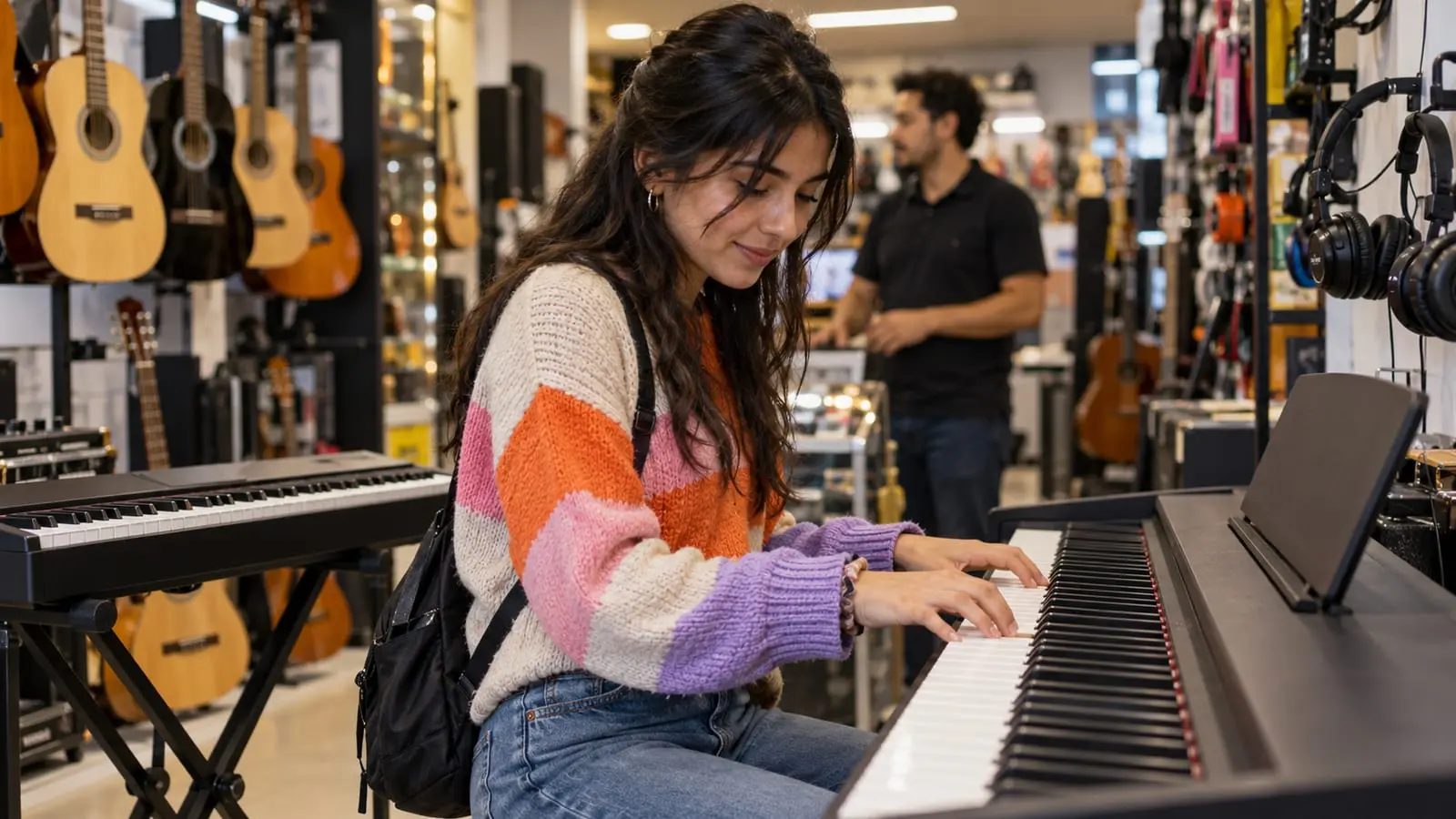
It depends on how seriously you plan to study piano. If you want to develop technique, dynamics, and repertoire, choose a digital piano: 88 weighted, touch-sensitive keys and a proper pedal. If you want to explore, accompany songs with chords, or provide an instrument for a young child learning through play, a touch-sensitive 61-key keyboard is enough to start.
The difference is less about the sound coming from the speakers than about what your fingers feel. That determines whether the instrument helps you or holds you back after a few months.
In short
- A digital piano imitates the feel of an acoustic piano: 88 weighted keys that respond to how firmly you play them.
- A keyboard usually has 61 light keys, hundreds of sounds, and accompaniment rhythms; it works for exploring and playing popular music.
- Unweighted keys don't develop the finger strength or control required by piano repertoire.
- Polyphony is the number of notes that can sound at once; using the pedal quickly reaches the limit on basic instruments.
- Moving from a keyboard to a digital piano is a normal step once practice becomes consistent.
Digital piano vs. keyboard: comparison table
| Feature | Digital piano | Keyboard |
|---|---|---|
| Number of keys | 88: the piano's full range, just over seven octaves. | Usually 61 (five octaves); 49- and 76-key models are also available. |
| Key weight | Weighted, with hammer action; many have graded weighting, heavier in the bass. | Light, organ-style keys; some models are semi-weighted. |
| Touch sensitivity | Always: volume and tone color change according to how firmly you play. | On most current models, but not all: check before buying. |
| Pedal | Piano-style sustain pedal; console models have three pedals. | Pedal input; a small switch-style pedal is sometimes included, or sold separately. |
| Polyphony | High: sustains passages with pedal without cutting notes off. | Lower: with pedal and many notes, some stop sounding too soon. |
| Sounds and features | A few carefully developed sounds: several pianos, organs, and strings. | Hundreds of sounds, accompaniment rhythms, and learning features. |
| Size and portability | Heavy; console models stay in place, and portable models need a stand. | Light; some run on batteries. |
| Relative cost | Larger investment. | Much more affordable. |
| What it's suitable for | Formal piano study, classical repertoire, and audition preparation. | Introductory learning, song accompaniment, popular music, and the first few months of exploration. |
The four differences that matter when learning
Weighted keys: the feel
On a piano, each key moves a hammer, giving it weight and resistance. Weighted keys imitate this. On a light-action keyboard, fingers don't develop strength or control, and students discover this when they play a real piano: the notes sound uneven and the hand tires. Remember: “touch-sensitive” isn't the same as “weighted.” The first means volume changes with how firmly you play; the second means the key has weight.
Number of keys: is 61 enough?
For the first year, almost always. Beginner repertoire fits within five octaves. The problem comes with intermediate pieces that use low and high notes a 61-key keyboard doesn't have. As the student progresses, the limitation becomes clear.
The pedal
The sustain pedal is part of piano technique, not an accessory. A small switch-style pedal slides around on the floor and only works as on or off. A piano-style pedal is more stable and, on many digital pianos, supports half-pedaling.
Polyphony
This is the number of notes an instrument can sound at the same time. It may seem like plenty, but notes accumulate when you hold the pedal down, and low polyphony causes the instrument to start cutting off the earliest notes. In a slow piece with pedal, you hear sounds suddenly disappear.
Choose a digital piano if… / choose a keyboard if…
Choose a digital piano if…
- You plan to take piano lessons regularly and want to develop proper technique.
- You're drawn to classical music, jazz, or ballads with pronounced dynamic contrasts.
- You plan to take auditions, exams, or an admission test later on.
- You have a permanent spot at home for the instrument.
Choose a keyboard if…
- It's for a young child who's exploring and hasn't decided whether to continue.
- You want to accompany songs with chords, sing, or play at church or with friends.
- You need something light to move between homes or take to rehearsals.
- You want to experiment with sounds and rhythms, or produce music.
If you choose a keyboard, look for at least 61 full-size, touch-sensitive keys. Anything less starts to get in the way. Our guide to choosing your first piano or keyboard explains what to check before buying.
For children and adults: a few distinctions
For children aged 5 or 6, a good keyboard makes it possible to start without a large investment while their interest becomes clearer. But a child who already practices consistently shouldn't spend months on light keys: their fingers get used to not applying force, and that is harder to correct later. If you're at this stage, read the piano guide for parents.
Adults usually notice the difference in feel much sooner, and many get frustrated with light-action keyboards because they can't play softly. If you already know you want to learn piano, going straight to a digital piano saves you an upgrade.
There's a third option worth mentioning: a controller keyboard, which has no built-in sounds and needs a computer or tablet. It's useful for music production, but adds more complications than benefits when you're learning piano from scratch.
When and how to move from a keyboard to a digital piano
These signs suggest you've outgrown your keyboard:
- The piece your teacher assigned goes beyond the available keys.
- You can't play pianissimo or fortissimo, even when you try.
- The pedal slips or notes cut off when you use it.
- In lessons on a real piano, your hands tire or your playing sounds uneven.
When you switch, the keys will feel heavy for the first few weeks. That's normal. Practice scales and exercises slowly, using arm weight and a relaxed wrist, as explained in proper hand position at the piano, and adjust the bench height so your forearms are parallel to the keyboard. Your old keyboard still has a use: as a portable instrument or for experimenting with sounds.
In piano lessons, your teacher will tell you honestly whether your current instrument is holding you back or will still serve you for several months.
Frequently asked questions
Can you learn piano on a 61-key keyboard?
Yes, to start with. What matters is that the keys are full-size and touch-sensitive. When the repertoire needs a wider range, or you need better dynamic control, it's time to consider a digital piano.
What's the difference between touch-sensitive and weighted keys?
Touch-sensitive means the volume changes according to how firmly you play. Weighted means the key has weight and resistance, like a piano key. A keyboard can be touch-sensitive without being weighted.
How much polyphony do I need to study piano?
The higher, the better: the most basic models start at around 32 notes, while the best exceed 200. With a low note limit, some notes may cut off early in pieces that use the pedal.
Can a digital piano replace an acoustic piano?
For the vast majority of students, yes, for years. If you're preparing for auditions or admission tests, look for opportunities to practice on an acoustic piano too, because its response has nuances that no digital piano fully reproduces.
Sources
We checked the facts in this article against these sources on October 22, 2026.