
How long does it take to learn to play drums?
A basic rock beat can come together in weeks; real hand-and-foot independence takes one to three years. This is how drummers actually progress.
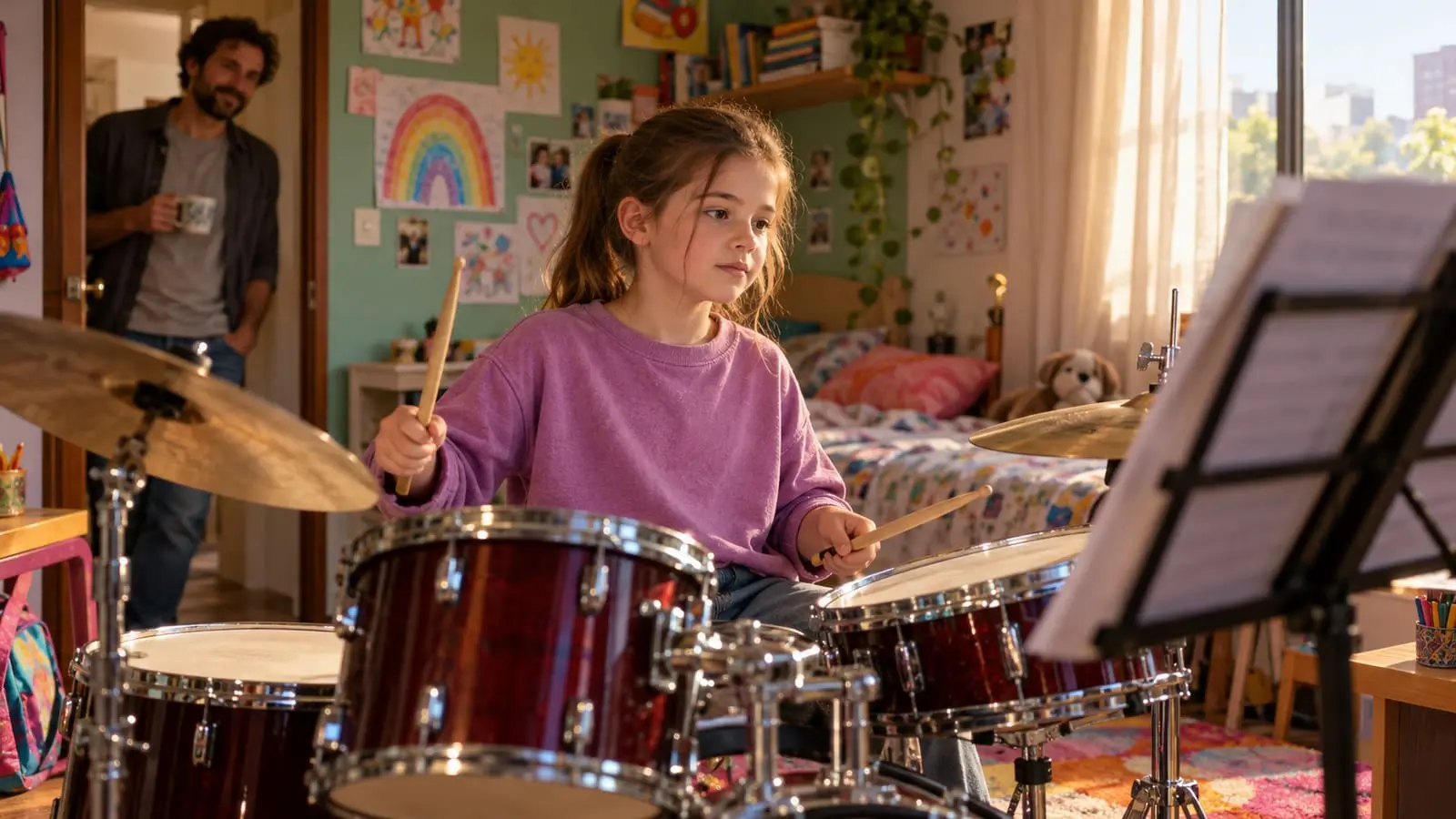
With regular practice—20 to 30 minutes almost every day, divided between a drum kit and a practice pad—you can hold a basic rock beat in two to six weeks. In three to nine months, you can play simple songs all the way through, with section changes and short fills. True independence, where each hand and foot does something different without conscious effort, along with clean rudiments, takes one to three years.
These are rough timelines. Much depends on how much time you can spend at an actual drum kit, your age, your sense of rhythm, and the style you want to play: simple rock calls for different skills than jazz or salsa.
In short
- A basic rock beat usually comes together in the first few weeks; playing full songs takes three to nine months.
- Hand and foot independence is the big challenge: you build it by adding one limb at a time, slowly and with a metronome.
- Ten minutes of rudiments on a pad every day can noticeably improve speed and control within a few months.
- A drummer's main job is to keep time; flashy fills come later.
- Not having a drum kit at home slows foot coordination, but a pad and an electronic kit make up for much of that.
The stages of learning drums and how long they take
Drums are one of the few instruments you play with all four limbs at once. Your first beats come quickly because they repeat; what takes time is getting your body to do different things while keeping the pulse steady.
| Stage | What you achieve | Approximate time with regular practice |
|---|---|---|
| Pulse and grip | Stick grip, relaxed strokes with rebound, counting aloud, and a basic eighth-note rock beat. | 2 to 6 weeks |
| First beats and fills | Kick drum variations, one-measure fills, and returning to the beat without losing time. | 1 to 4 months |
| Playing along with songs | Full songs with verses, choruses, and bridges, keeping time with the recording. | 3 to 9 months |
| Rudiments and independence | Single- and double-stroke rolls, paradiddles, flams, ghost notes, and foot-operated hi-hat. | 6 months to 2 years |
| Styles | Shuffle, funk, bossa nova, and Latin and Colombian rhythms adapted to the drum kit. | 1 to 3 years |
| Intermediate or advanced level | Fluent reading, irregular time signatures, subtle dynamics, and improvising fills in a band. | 2 to 4 years or more |
As an external benchmark, Trinity College London estimates about 60 total hours (lessons plus independent study) to prepare for its Grade 1 drum kit exam, about 180 for Grade 5, and about 320 for Grade 8, and clarifies that these are averages that vary with each person’s experience.
Independence: the defining challenge of drumming
At first, when the kick pattern changes, your hi-hat hand stops or speeds up. It's the classic sign of limited independence, and it happens to everyone. You solve it by taking the beat apart and rebuilding it layer by layer, rather than playing faster:
- Play eighth notes on the hi-hat alone until they feel automatic, even while you're talking.
- Add the snare on beats 2 and 4.
- Add the kick on 1 and 3, then change its placement one variation at a time.
- Once all three parts are steady, add the hi-hat with your left foot.
- Use a metronome for all of this, at a tempo you can play without mistakes, even if it feels far too slow.
Counting aloud as you play helps more than you might think: it makes your brain maintain the pulse and reveals exactly where your timing drifts.
Rudiments: a workout for your hands
Rudiments are sticking patterns used in every style. They may not be exciting, but they make the difference between a clean fill and a rushed, uneven one. These are usually the first ones you work on (D means right hand, I means left hand):
| Rudiment | How it is played | What it's for |
|---|---|---|
| Single-stroke roll | Alternating hands: D I D I. | Speed and balanced control in both hands. |
| Double-stroke roll | Two strokes per hand: D D I I. | Learning to use stick rebound instead of force. |
| Paradiddle | R L R R, L R L L. | Combining single and double strokes; very useful for grooves and fills. |
| Flam | A soft grace note just before the main stroke. | Adding body and color to accents. |
Ten minutes a day on a practice pad, with a metronome at a comfortable speed, usually makes a noticeable difference within a few months. Our guide to using a metronome for practice explains how to increase the tempo while keeping your playing clean.
Playing along with songs: when and how to start
You don't need to master technique before playing along with music. It's worth starting in the first few months because it trains your ear, stamina, and sense of song form.
- Choose songs with a steady tempo and a repeating beat, as in many rock and pop tracks.
- Before playing, listen to the song and count how many measures each section lasts.
- Use closed-back headphones to hear the track over the drums.
- Focus on keeping the beat from start to finish; if a fill throws off your timing, simplify it.
- Record yourself and compare: are you locked in with the recording, or do you rush in the choruses?
Later come band rehearsals, where there's no recording to keep you on track: you're the one keeping time for everyone else.
What if you don't have a drum kit at home?
This is very common, especially in apartments. It affects your timeline, but less than you might think if you organize your practice well:
- Practice pad: quiet and affordable; keeps your hands and rudiments progressing.
- Electronic drum kit: lets you work on full coordination with headphones, without disturbing the neighbors.
- Foot practice without a kit: you can practice kick and hi-hat patterns by tapping your feet on the floor, seated at the right height.
- Time on an acoustic kit: if possible, book a rehearsal room now and then to get used to the volume and actual rebound of drumheads.
If you're still deciding what to buy, how to choose a drum kit or cajón to get started compares the options.
What helps or slows your progress
| Speeds up progress | Slows progress |
|---|---|
| Practicing with a metronome or track almost every time. | Playing without a timing reference and speeding up without noticing. |
| Starting slowly and staying relaxed, using the rebound. | Always playing loudly and fast, with tense wrists. |
| Working on groove before fills. | Spending practice sessions on fills and solos without holding a beat. |
| A teacher who checks your grip, posture, and seat height. | Keeping a grip that later causes discomfort or limits your speed. |
| Recording yourself and listening back. | Never listening to your playing from an outside perspective. |
Frequently asked questions
Can you learn drums without reading music?
Yes. At first, much of your learning comes from listening and imitation. Still, basic rhythm reading saves time: it lets you write down beats, understand exercises, and communicate with other musicians. Most teachers introduce it gradually in the first few months.
At what age can you start playing drums?
Many children start around age 6 or 7, once they can reach the pedals with the seat adjusted and stay focused during a lesson. Volume and hearing protection need attention. We explain this in drums for children.
Is learning drums the same as learning Latin percussion?
Both involve rhythm and coordination, but congas, timbales, and cajón each have their own technique. In our percussion lessons, you can focus on one or combine both; drums or Latin percussion helps you choose.
How much time should I practice drums each day?
To start, 20 to 30 minutes almost every day works well: a few minutes of rudiments on the pad, a new beat, and a song. If your time at the kit is limited, use it for foot coordination and practice your hands on the pad.
Sources
We checked the facts in this article against these sources on October 22, 2026.
- Trinity College London: drum kit and percussion exam syllabus (estimated study hours by grade)
- Percussive Arts Society: international drum rudiments
- NIOSH (CDC): occupational noise and the recommended exposure limit of 85 dBA
- NIOSH (CDC): hearing protection, types of earplugs, and earplugs for musicians