
Music lessons and ADHD: how to support your child's learning
Teaching adaptations that help a child with ADHD enjoy and progress in music lessons, and what a music lesson doesn't replace.
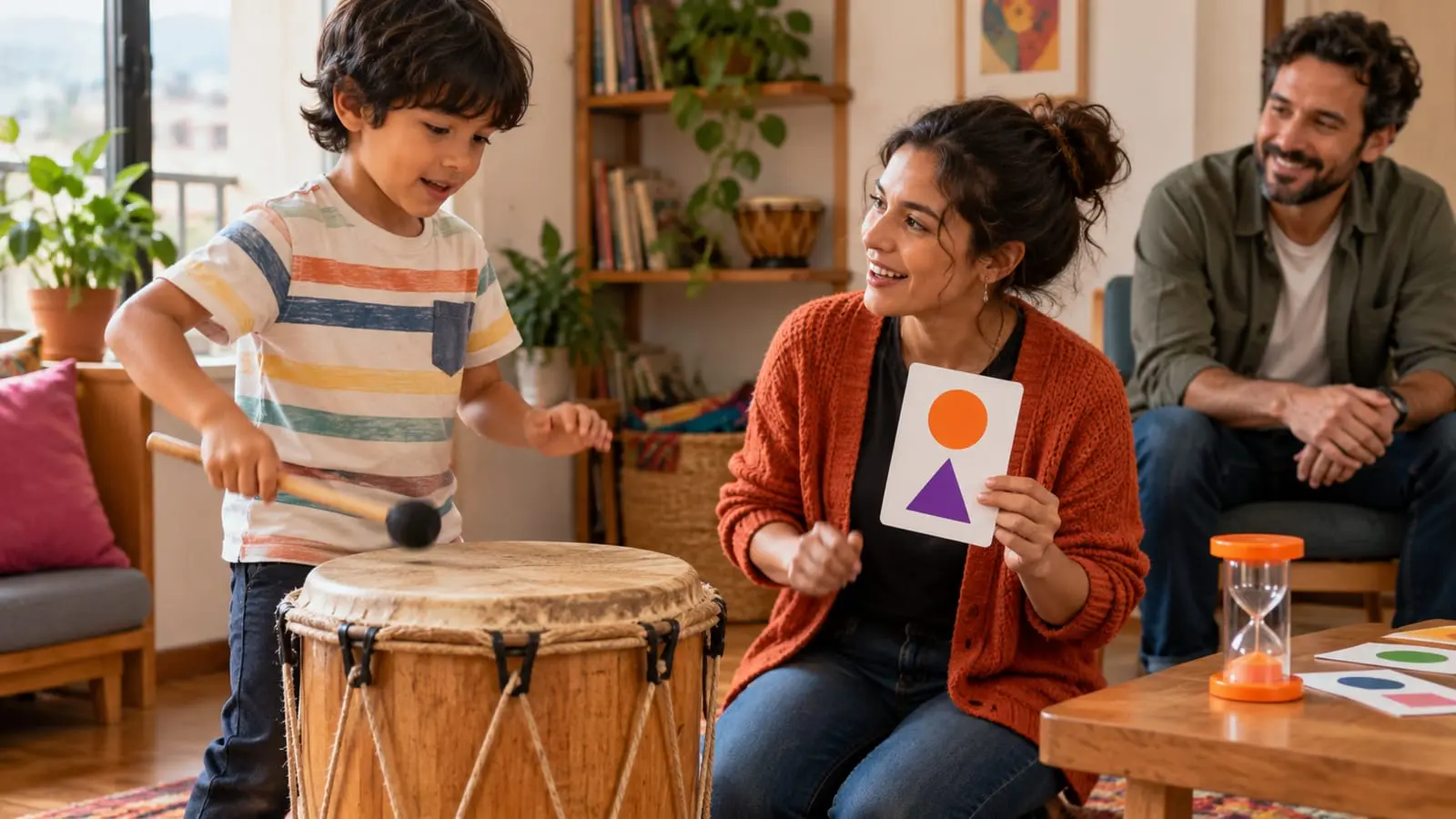
A child with ADHD can learn and enjoy music, and often the difference lies in how the lesson is organized rather than in the instrument: short blocks, a structure repeated each week, freedom to move, one instruction at a time, and small goals worth celebrating.
Before we continue, an important point: a music lesson is not therapy and does not replace diagnosis, treatment or support from the health professionals who know your child. A good teacher can, however, adapt their teaching approach. That is what this guide is about.
In short
- A music lesson is a place to learn music; it isn't therapy and doesn't replace the professional care your child may need.
- Structure helps: the same sequence each week, short blocks, and a clear ending.
- Movement can be part of the lesson: feeling the beat with the body, playing standing up, or switching instruments between blocks.
- Short instructions, one at a time, and demonstrations instead of long explanations.
- Telling the teacher what works at home and at school is one of the most useful ways to adapt lessons.
First things first: what a music lesson is and isn't
When a family looks for music lessons for a child with ADHD, there's often an underlying question: will this help? The honest answer is that a music lesson has a musical goal: learning to play, sing, keep time, listen, and enjoy music. It can be a valuable space for your child, but it isn't designed to treat ADHD.
- It isn't therapy. A music teacher teaches music; they don't assess, diagnose, or provide clinical interventions.
- It isn't music therapy. Music therapy is a separate profession practiced by people with specific training who work toward therapeutic goals. If you're interested, discuss it with your child's healthcare team.
- It doesn't replace anything. That includes treatment, school support, and recommendations from your child's doctor, psychologist, or other professionals.
- It is a place to learn in their own way. A skilled teacher adjusts the pace, duration, and activities to each student, whether or not they have a diagnosis.
A lesson with a clear structure and short blocks
Knowing what's coming next and how much time is left reduces uncertainty. It helps to keep a consistent lesson structure, with brief activities that change before boredom sets in, rather than afterward.
| Block | Approximate duration | What happens |
|---|---|---|
| Opening routine | 3 minutes | The same greeting or song each week, followed by a quick look at what you'll be doing. |
| Body rhythm | 5 minutes | Clapping, steps, or body percussion to start with energy and find the beat. |
| Instrument, part 1 | 10 minutes | One goal: a scale, a rhythm, or the first notes of a piece. |
| Movement break | 3 minutes | Stand up, stretch, play a rhythm echo game, or move to another spot. |
| Instrument, part 2 | 12 minutes | The week's song or piece, practiced in sections. |
| Musical game | 7 minutes | Improvise, guess songs, or play a duet with the teacher. |
| Closing | 5 minutes | Sum up what was learned in one sentence and write down the practice assignment. |
To begin with, a 30-minute lesson may work better than a full hour; it can get longer once your child feels comfortable. A visual schedule, such as a list with pictures or a small whiteboard where each block is crossed off, shows how much is left and turns the end of each activity into a small achievement.
Movement as part of the lesson
Asking a child to sit still at an instrument for 45 minutes often leaves everyone frustrated. Music has an advantage: movement can be part of it. Here are some ideas a teacher can use:
- Feel the beat by walking, jumping, or clapping before playing it on the instrument.
- Play standing up when possible: a drum, a keyboard at the right height, or singing.
- Alternate instruments during the lesson, such as piano and percussion, to change position and stimulation.
- Pass a ball or scarf from hand to hand to the beat.
- Echo games: the teacher plays a short rhythm and the child repeats it, in quick rounds.
Is one instrument better than another?
There is no instrument “for ADHD.” Percussion gives immediate feedback and plenty of movement; the piano presents notes visually; introductory music activities combine singing, rhythm, and play for younger children. But your child's interest matters most: a child who dreams of playing guitar will stay more engaged with a guitar than with an instrument someone else decided was “ideal.”
Short instructions and small goals
How instructions are given makes a big difference to a lesson. These simple adjustments are within any attentive teacher's reach:
- One instruction at a time. “Put your hand on C,” then wait; next, “now play with finger 1.” Don't put both instructions in the same sentence.
- Show before you explain. A ten-second demonstration says more than a minute of explanation.
- Visual supports. Colors or stickers on the keys, tape on the fingerboard, and sheet music with few elements per page.
- Goals that fit one block. “Play these four measures three times in a row” instead of “learn the song.”
- Specific, immediate feedback. “You counted before coming in, so you started on time” teaches more than a generic “very good.”
- Redirect without scolding. If your child gets distracted, bringing them back with a musical prompt (“let's see who can repeat this rhythm”) works better than reprimanding them.
A metronome you can see as well as hear, such as the site's online metronome, also helps your child follow the beat visually.
Home practice in small doses
At home, the difference between a realistic plan and an unrealistic one becomes especially clear. These guidelines often work well:
- Sessions of 5 to 10 minutes, once or twice a day, rather than half an hour straight.
- The same set time each day, so you don't have to negotiate it every time.
- A card with no more than three tasks, written or drawn by the teacher. Your child can choose the order.
- A visible timer: knowing there are three minutes left makes it easier to finish.
- Keep the instrument visible and ready to play, without having to take it out of its case and set it up each time.
- Always finish with something your child enjoys playing, even if it's a song from a month ago.
Avoid making practice a punishment or a condition for other activities: that often turns it into a daily battle. For more ideas, see how to motivate your child to practice.
What to tell the teacher (and what to ask)
You don't have to share more health information than you want to. What helps the teacher is practical information: what does and doesn't work for your child. Before the first lesson, tell them:
- What music your child likes and what motivates them.
- When your child is usually most receptive: after a long school day isn't the same as a Saturday morning.
- Which strategies work at school or at home, so the teacher can use the same language.
- What frustrates your child and how you can tell when they're reaching their limit.
Ask the teacher how they organize lessons, whether they've used short blocks, and how they'll keep you informed about progress. A good teacher welcomes suggested adjustments; they need that information to teach better.
If your child is on the autism spectrum, music lessons for autistic children explains how to adapt the routine, the advance notice and the sensory input of each lesson.
Online or at home?
It depends on the child. In an online lesson, the screen competes for attention and the teacher can't move alongside your child; in an in-home lesson, the teacher has more freedom to change activities and locations. One option is to begin in person and alternate with online lessons once a routine is established.
Realistic expectations: progress at your child's pace
Progress in music is rarely a straight line, and every child has good weeks and weeks when nothing seems to move forward. Compare your child's progress with their own starting point, not with a sibling, cousin, or school friend.
- Celebrate effort and consistency, not just results.
- Check in with the teacher from time to time about what needs adjusting: lesson length, schedule, repertoire, or activities.
- If lessons become a source of distress, it's okay to take a break or change the format.
- If you're concerned about your child's attention, mood, or behavior, talk with their doctor or the professionals supporting them; the music teacher isn't the right person to make those decisions.
At Gissi, every teacher is assessed for musicianship, teaching skills, and interpersonal qualities before their first lesson. In the teacher directory, you can explore their profiles and find someone whose teaching approach suits your child.
Frequently asked questions
Which instrument is best for a child with ADHD?
There is no instrument recommended on the basis of a diagnosis. What helps most is that your child likes the instrument and the lesson is well organized. Percussion and piano are easy to start because they produce sound immediately, but a child eager to play violin or guitar can learn those instruments just as well.
Does music improve ADHD symptoms?
We can't promise that, and it's wise to be wary of anyone who does. A music lesson aims to help your child learn music and enjoy doing it. Decisions about ADHD belong with the healthcare professionals supporting your child.
Should I tell the teacher my child has ADHD?
It's your decision. You don't have to share the diagnosis, but practical details help: how long your child stays with an activity, what motivates them, and which strategies are used at school or at home. That information helps the teacher plan.
How long should a music lesson for a child with ADHD last?
There is no fixed length. To start, 30 minutes divided into several short blocks is a good trial. If your child finishes with energy and wants more, the lesson can gradually get longer.
Are music therapy and music lessons the same thing?
No. Music therapy is a separate profession with specific training and therapeutic goals. Music lessons have musical goals. They can coexist, but neither replaces the other.
Sources
We checked the facts in this article against these sources on October 22, 2026.