
Instruments of Colombian Caribbean music: cumbia, porro and vallenato
Which instruments you hear in cumbia, porro and vallenato, the role each one plays and which ones you can study with a teacher if Colombian Caribbean music moves you.
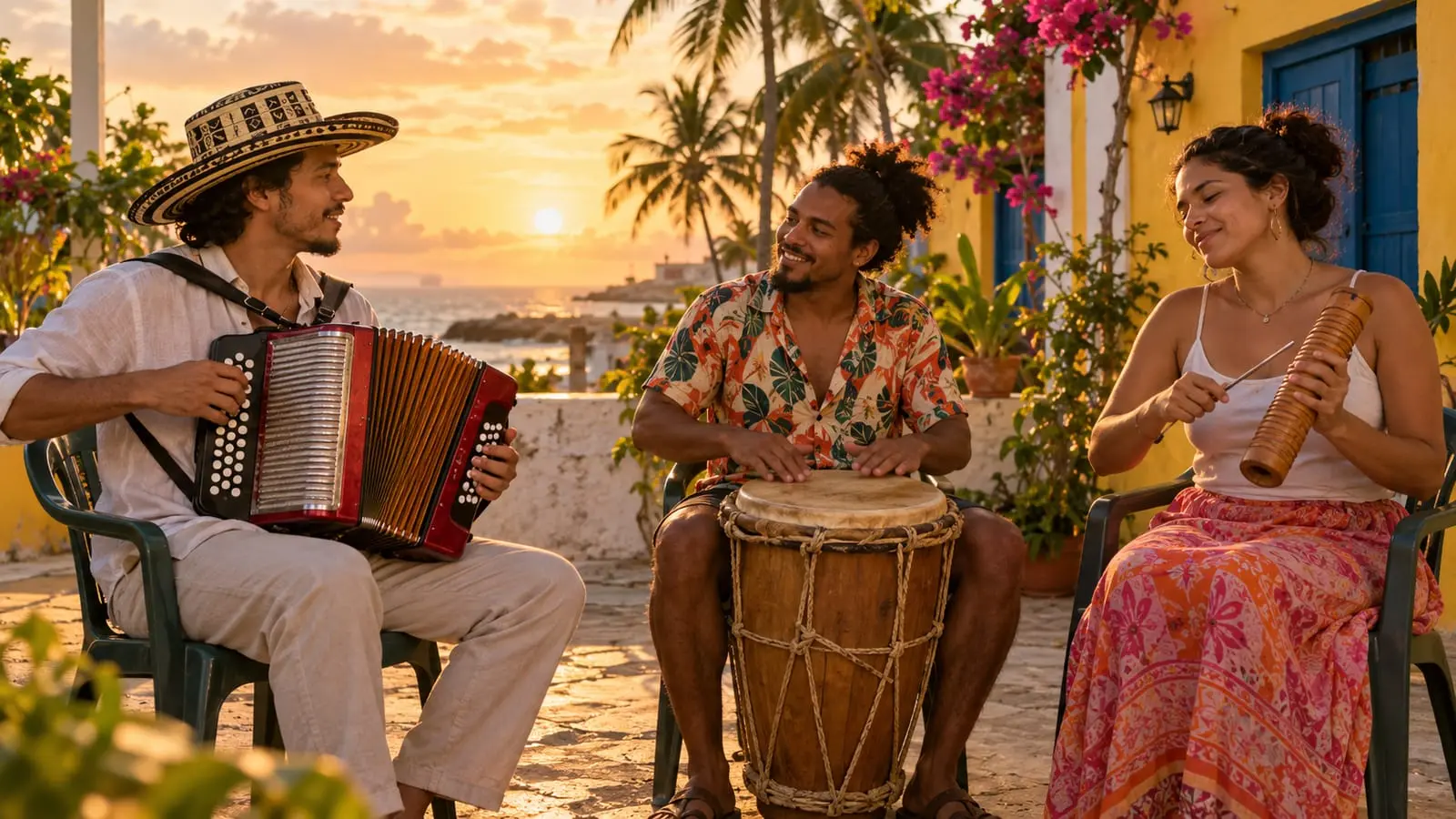
Cumbia instruments include three drums, the tambor alegre, llamador, and tambora, plus maracas or guache, and a melodic voice: gaitas (hembra and macho) or caña de millo. Orchestral cumbia adds clarinets, trumpets, saxophones, and bass.
The music of Colombia's Caribbean region is built around three main instrument groups: drums and small percussion (tambor alegre, llamador, tambora, maracas, guache, and guacharaca), traditional flutes (gaitas and flauta de millo), and, in vallenato and wind bands, instruments of European origin such as accordion, clarinet, trumpet, and trombone.
Here you will discover the instruments in each ensemble, what each one does, and where to start if you want to play cumbias, porros, or vallenatos.
In short
- Cumbia instruments: tambor alegre, llamador, tambora, and maracas or guache for percussion, and gaitas or caña de millo for the melody.
- Cumbia and vallenato are Caribbean musical styles, but they use different instruments: cumbia uses drums and gaitas or millo; vallenato uses accordion, caja, and guacharaca.
- In cumbia and gaita music, the tambor alegre improvises, the llamador keeps a steady pattern, and the tambora provides the low-end weight.
- The gaita hembra and the flauta de millo carry the melody in traditional ensembles; the gaita macho accompanies.
- Traditional vallenato uses accordion, caja, and guacharaca, and is usually divided into four styles: paseo, son, merengue, and puya.
- Porro and fandango make up the repertoire of the sabanera wind bands, with clarinets, trumpets, trombones, euphonium, and percussion.
- Percussion, clarinet, trumpet, trombone, and saxophone are good starting points for learning Caribbean music with a teacher.
Cumbia instruments
Cumbia instruments include tambor alegre, llamador, and tambora for percussion, maracas or guache as rattles, and gaitas or caña de millo for the melody. This is the traditional ensemble of Colombia's Caribbean region.
| Instrument | Family | Role in cumbia |
|---|---|---|
| Tambor alegre | Percussion (membranophone) | Improvises and plays flourishes, interacting with the melody and the dancing |
| Llamador | Percussion (membranophone) | Repeats a steady stroke that keeps the ensemble's pulse |
| Tambora | Percussion (membranophone) | Provides bass tones and drive, played with sticks |
| Maracas or guache | Small percussion (rattles) | Maintain a continuous sound that sustains the movement |
| Gaita hembra | Wind (flute) | Carries the main melody |
| Gaita macho | Wind (flute) | Provides accompaniment with a more repetitive pattern |
| Caña de millo | Wind (reed pipe) | Carries the melody in millo ensembles |
| Clarinets, trumpets, saxophones, and bass | Winds and strings | Used in orchestral and wind band cumbia, but not in traditional cumbia |
To feel the beat, practice with the cumbia metronome, which marks the llamador’s pulse. And to understand how it is written and felt, read bambuco, pasillo, and cumbia explained.
Ensembles: who plays what
In the Caribbean, instruments form ensembles with recognizable combinations rather than simply playing on their own. Knowing which sound you enjoy is the first step in choosing what to learn.
| Format | Instruments | Typical repertoire |
|---|---|---|
| Gaita ensemble | Gaita hembra, gaita macho with maraca, tambor alegre, llamador, tambora | Cumbias, gaitas, and puyas |
| Millo ensemble | Flauta de millo, tambor alegre, llamador, tambora, maracas or guache | Cumbias, puyas, and carnival rhythms |
| Vallenato ensemble | Accordion, caja, guacharaca; today also electric bass, congas, and backing vocals | Paseo, son, merengue, and puya |
| Pelayera or sabanera wind band | Clarinets, trumpets, trombones, euphoniums, tuba, bass drum, snare drum, and cymbals | Porros and fandangos |
Tropical dance orchestras also brought cumbia and porro to dance halls with saxophones, trumpets, piano, and upright or electric bass. To see how the Caribbean fits into the country's musical landscape, explore Colombia's traditional instruments by region.
Drums: the heart of cumbia
Tambor alegre
A single-headed drum played with the hands. Its role is to improvise: it plays flourishes, responds to the melody, and interacts with the dancers. It is the percussion soloist, calling for a good ear, creativity, and a strong command of the pulse.
Llamador
Smaller, it repeats a steady, fixed stroke throughout the piece. It seems simple, but it anchors the group: if the llamador falters, everything loses its footing. It is an excellent first drum for developing consistency.
Tambora
A double-headed drum played with sticks, alternating strokes on the head and the wood or rim. It provides the bass tones and drive you feel in your body.
Maracas, guache, and guacharaca
Maracas and guache (a tube filled with seeds) fill the space with a continuous sound that keeps the music moving. Guacharaca, a cane scraper played with a fork-like tool called a trinche, is essential to vallenato.
In percussion lessons, you develop the pulse, coordination, limb independence, and rhythmic reading needed for any of these instruments. For a specific traditional drum's technique, such as alegre strokes, work with someone who knows the style. If you are weighing your options, read drum kit or Latin percussion.
Gaitas and flauta de millo: melodies with Indigenous roots
Gaitas are long flutes of Indigenous origin, traditionally made from the stem of the cardón cactus, with a head of beeswax mixed with charcoal and a feather-quill mouthpiece. They are played in pairs: the gaita hembra carries the melody, while the gaita macho, with fewer finger holes, accompanies it as its player shakes a maraca with the free hand.
The flauta de millo is a thin cane played sideways, producing sound through a reed cut into the cane itself. Its tone is high and piercing, and many players add a vocal buzz as they blow. It is inseparable from carnival and ensemble cumbia.
Both traditions are passed down mainly by ear, from teachers to learners, in traditional music schools and cultural centers. If you already play another wind instrument, breath control and ear training help, but each has its own technique, best learned in its cultural context.
Vallenato: accordion, caja, and guacharaca
Traditional vallenato rests on three instruments, often described as representing three roots: the diatonic button accordion, brought from Europe, carries melody and harmony; the caja, a small hand-played drum, evokes African heritage; and the guacharaca is associated with Indigenous scrapers.
Its four traditional styles are paseo, son, merengue, and puya. Each has its own tempo and character: puya is among the fastest and most demanding, while son is among the slowest. Modern vallenato commonly adds electric bass, congas, backing vocals, and other instruments.
Vallenato accordion is a highly specialized path, usually learned with accordionists rooted in the tradition. If you want to join a modern vallenato ensemble, bass, percussion, or singing are practical starting points.
Cumbia and vallenato: differences
The main difference between cumbia and vallenato is the instruments: cumbia is played with drums and gaitas or caña de millo, while vallenato uses accordion, caja, and guacharaca. Both are musical styles from Colombia's Caribbean region, but they come from different traditions.
| Aspect | Cumbia | Vallenato |
|---|---|---|
| Traditional instruments | Tambor alegre, llamador, tambora, maracas or guache, and gaitas or caña de millo | Accordion, caja, and guacharaca |
| Melodic voice | Gaitas or caña de millo | Accordion and singing |
| Meter and rhythm | Duple meter; the llamador keeps the beat | Four styles with distinct rhythms: paseo, son, merengue, and puya |
| Region of origin | Colombian Caribbean, in ensembles of gaitas, drums, and millo | Colombian Caribbean, in the Magdalena Grande region, linked to the Sierra Nevada de Santa Marta |
| How it is danced and sung | Danced in pairs or groups, with drums marking the rhythm | Centers on songs: the lyrics tell stories, and it is also danced in pairs |
For a closer look at vallenato, read vallenato instruments. To practice the pulse of each style, use the vallenato metronome.
Porro and fandango: the sabanera wind bands
In the savannas of Córdoba and Sucre, wind bands play porros and fandangos at festivities and celebrations. They are called pelayeras after San Pelayo in Córdoba; similar ensembles in other parts of the country are known as papayeras. Each instrument has a clear role:
- Clarinets: agile melodies, ornaments, and exchanges with the brass.
- Trumpets: power, brilliance, and answering phrases.
- Trombones: countermelodies and the band's harmonic foundation.
- Euphonium and tuba: countermelodies in the low-to-middle register and bass lines.
- Bass drum, snare drum, and cymbals: the rhythmic engine that gets everyone dancing.
Playing in this kind of band requires a powerful but controlled sound, endurance, good reading skills, and an ear for section playing. Clarinet lessons and trumpet lessons build that foundation; wind bands in Colombia: how to get started explains how to join one.
Porro instruments
Porro is played in two ensemble formats: band porro (or pelayero), with clarinets, trumpets, trombones, euphonium, tuba, bass drum, snare drum, and cymbals, and gaita porro, with gaitas and drums. The band version is the best known today.
| Format | Instruments | Where you hear it |
|---|---|---|
| Porro pelayero or wind band porro | Clarinets, trumpets, trombones, euphonium, tuba, bass drum, snare drum, and cymbals | Wind bands from the savannas of Córdoba and Sucre |
| Porro de gaita | Gaita hembra, gaita macho, tambor alegre, llamador, and tambora | Caribbean gaita ensembles |
San Pelayo, in Córdoba, is the town that gives the pelayera tradition its name and hosts the Festival Nacional del Porro. Porro later became part of the repertoire of tropical dance orchestras.
If you want to play in a band, start with wind bands in Colombia. To feel the pulse, use the porro metronome.
Which instrument should you learn if you enjoy Caribbean music?
| If you enjoy… | Start with… | What you will work on |
|---|---|---|
| Cumbia drums | Percussion | Pulse, independence, hand strokes, and rhythmic reading. |
| Wind band melodies | Clarinet | Embouchure, agile fingering, and ornaments. |
| The energy of brass | Trumpet or trombone | Lip vibration, endurance, and section sound. |
| The sound of tropical dance orchestras | Saxophone | Tone, phrasing, and section playing. |
| Modern vallenato | Electric bass or singing | Groove, accompaniment, and voice. |
| Gaitas, millo, or accordion | Teachers rooted in the tradition | Instrument-specific technique and learning by ear. |
At Gissi, you can include cumbias, porros, and fandangos in your percussion or wind instrument lessons, online or at home in Bogotá, alongside the technique you need to sound good in any style.
Frequently asked questions
What instruments are used in cumbia?
Traditional cumbia uses tambor alegre, llamador, and tambora, with maracas or guache, and gaita hembra and gaita macho or caña de millo for the melody. Orchestral cumbia adds clarinets, trumpets, saxophones, and bass.
What’s the difference between cumbia and vallenato?
Cumbia is played with drums and gaitas or caña de millo; vallenato uses accordion, caja, and guacharaca. Both come from Colombia's Caribbean region, but they have different origins, instruments, and repertoires.
What is the difference between gaita hembra and gaita macho?
Gaita hembra has more finger holes and carries the main melody. Gaita macho has fewer holes, plays a more repetitive accompaniment, and is played with one hand while the other shakes a maraca.
What is the difference between cumbia and porro?
Both come from Colombia's Caribbean region and share many features, but they are associated with different ensembles: cumbia originated in drum ensembles with gaitas or flauta de millo, while porro is the signature repertoire of sabanera wind bands. Both later moved into orchestras.
What is a banda pelayera?
It is a wind band from the savanna tradition of the Colombian Caribbean, named after San Pelayo in Córdoba. It plays porros and fandangos with clarinets, trumpets, trombones, euphonium, tuba, bass drum, snare drum, and cymbals.
Can you learn tambor alegre in Bogotá?
Yes. Bogotá has collectives, traditional music schools, and teachers who teach Caribbean drums. A percussion foundation with a steady pulse and good coordination makes that learning much faster.
Sources
We checked the facts in this article against these sources on October 22, 2026.
- Banco de la República (Boletín Cultural y Bibliográfico): Gaitas y tambores, by Manuel Zapata Olivella
- Universidad de Córdoba: the saxophone in the sound world of pelayera bands (San Pelayo, Córdoba)
- Universidad de Córdoba: improvisation in porro, the instrumental lineup of the pelayera band
- UNESCO: traditional vallenato music of Magdalena Grande
- El Universal: gaitas and drums, the sound of a community