
How to practice with a metronome: a step-by-step guide
The metronome isn't there to pressure you: it's a mirror of your pulse. Here's how to pick a starting tempo, work on subdivisions and speed up without rushing.
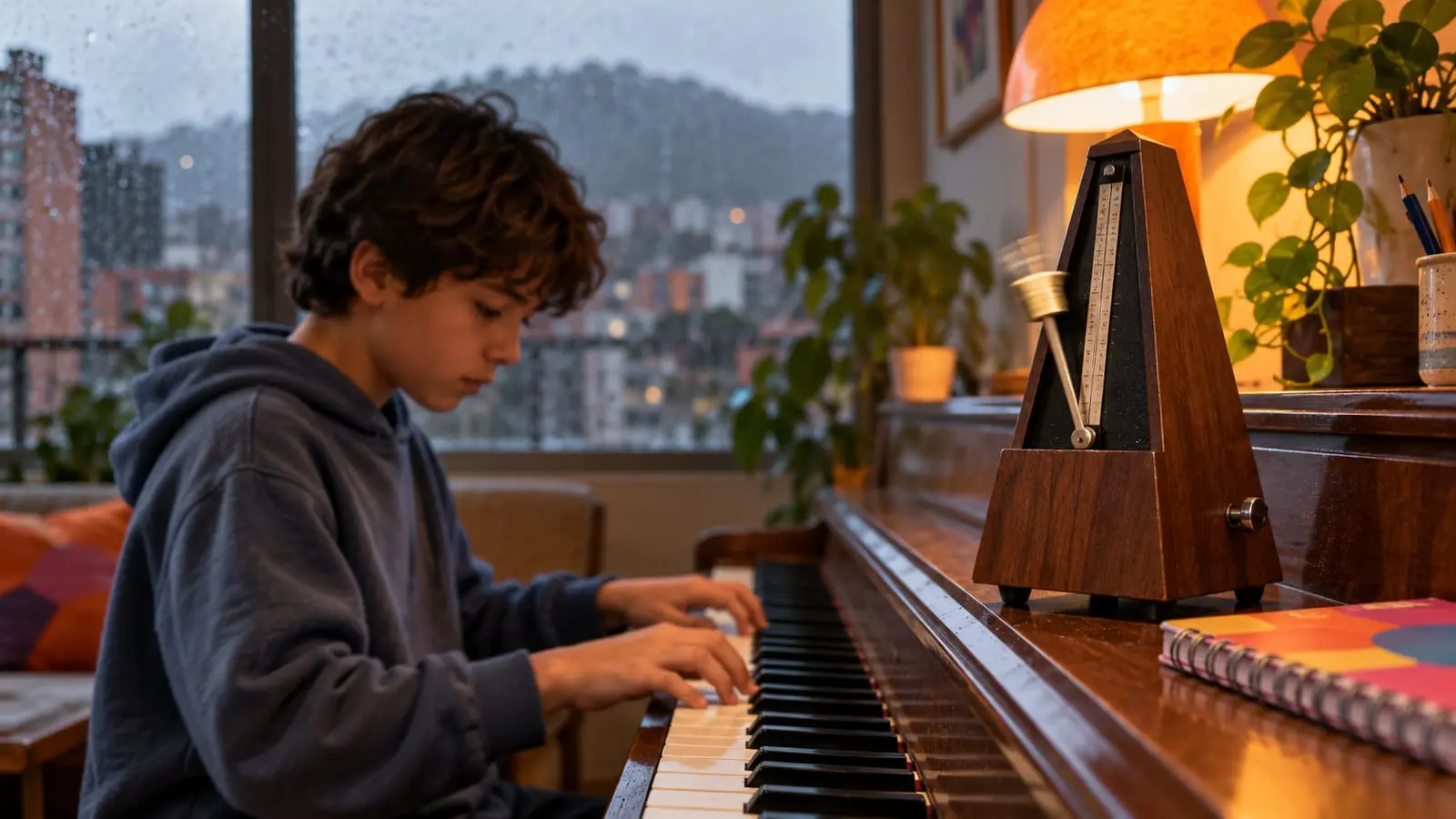
To practice with a metronome, start at a tempo slow enough to play the passage without mistakes or tension. Count subdivisions out loud and raise the speed a few beats at a time, only after you've played the passage cleanly several times in a row. The metronome isn't there to rush you: it's a mirror that shows where your beat speeds up or slows down.
This method works for any instrument and for singing. You can follow this guide with the website's free online metronome or any app.
In short
- Your starting tempo is the fastest speed at which you can play the passage cleanly and comfortably, not the speed of the recording.
- Increase by 2 to 5 beats per minute (BPM) at a time, and only after three consecutive error-free repetitions.
- Counting subdivisions (“1 and 2 and”) is the habit that does the most to improve rhythmic accuracy.
- If you lose control, lower the tempo: stepping back is part of the method, not a failure.
- Alternate playing with and without the click so the beat comes from you, not the device.
What tempo is and what BPM means
A metronome measures tempo in BPM, beats per minute. At 60 BPM, you hear one click per second; at 120 BPM, two per second. In sheet music, tempo appears as a number next to a note value (for example, quarter note = 80) or as an Italian term. These terms are guidelines, interpreted somewhat differently across periods and by different editors:
| Term | Character | Approximate range |
|---|---|---|
| Largo / Lento | Very slow | 40–60 BPM |
| Adagio | Slow and calm | 66–76 BPM |
| Andante | At a walking pace | 76–108 BPM |
| Moderato | Moderate | 108–120 BPM |
| Allegro | Fast and lively | 120–168 BPM |
| Presto | Very fast | 168 BPM or more |
A metronome marks beats; measures group them. If your metronome can accent the first beat, set it to match the piece's time signature: two beats for 2/4, three for 3/4, four for 4/4. In meters such as 6/8, the beat is usually felt in two groups of three eighth notes, so you can start with a click on each eighth note and later switch to each dotted quarter note. If these numbers still confuse you, review our guide to reading sheet music.
Step by step: finding your starting tempo
- Choose a short passage of two to four measures, rather than the whole piece.
- Set the metronome to roughly half the final tempo. If the piece is at 120, start around 60.
- Listen to four clicks before playing and count them out loud.
- Play the passage. If every note lines up with the click, without mistakes or tension in your shoulders or hands, that's your tempo.
- If it didn't work, lower the tempo by 8 or 10 BPM and repeat. Keep lowering it until you can play cleanly.
- Write the number in pencil on your sheet music or in your practice notebook. Tomorrow, you'll know where to start.
Slow doesn't mean easy. At 50 BPM, you can hear if a note ends too soon, a position shift is late, or a breath breaks the phrase. That magnifying effect is exactly what makes the metronome useful.
Subdivisions: the secret to accuracy
Rhythmic mistakes almost never happen on the click itself, but in the space between clicks. Subdividing means counting what happens within each beat, and it keeps eighth notes even and rests from getting cut short.
| Note value within each beat | Notes per click | How to count them |
|---|---|---|
| Quarter notes | 1 | “1, 2, 3, 4” |
| Eighth notes | 2 | “1 and 2 and 3 and 4 and” |
| Eighth-note triplets | 3 | Three evenly spaced syllables per beat, such as “ta-ta-ta” |
| Sixteenth notes | 4 | Four syllables per beat, such as “ta-ka-ta-ka,” or the pattern your teacher uses |
Subdivision exercise (5 minutes)
- Set the metronome to 60 BPM.
- Clap quarter notes for eight clicks, counting out loud.
- Without stopping, switch to eighth notes for eight clicks, then triplets, then sixteenth notes.
- Work back in reverse order to quarter notes.
- Repeat the exercise on your instrument with a scale or a repeated note.
For difficult passages, many metronomes can sound the subdivisions as well as the main beat. Use that support for a few days, then turn it off: the goal is to hear the subdivisions in your head.
How to build speed without losing accuracy
The small-increment method
Once you've played the passage cleanly three times in a row, increase by 2 to 5 BPM. If you make mistakes twice at the new tempo, return to the previous one. It may seem slow, but this lets your body learn the correct movement instead of practicing mistakes faster.
Two steps forward, one back
Another option is a staircase approach: move up two increments and back one to consolidate. A session might look like this:
| Step | Tempo | What you do |
|---|---|---|
| 1 | 60 BPM | Three clean repetitions |
| 2 | 64 BPM | Three clean repetitions |
| 3 | 68 BPM | A mistake appears: repeat with care |
| 4 | 64 BPM | Step back and consolidate |
| 5 | 68 BPM | Now you can play it cleanly |
| 6 | 72 BPM | End the session here |
The next day, it's normal to start a little below where you finished, for example at 66. You're not going backward: your body needs to warm up again. Over the days, your starting point will naturally rise.
Exercises to develop your own internal beat
Once the passage is up to tempo, the challenge changes: instead of following the click, you work toward not needing it.
- Click on 2 and 4: in pop, jazz, or funk, set the metronome to half the tempo and feel each click as beat 2 or 4 of the measure. You supply beats 1 and 3. It's a staple of percussion and drum lessons.
- Click only on 1: in 4/4, set the metronome to a quarter of the tempo so it sounds once per measure. You have to keep the other three beats steady yourself.
- Silent measures: play two measures with the click and two without it, or turn the volume down periodically. If you're still lined up when the click returns, your internal beat is steady.
- Separate hands on piano: work on each hand with the metronome before putting them together; on piano, it's the quickest way to spot which hand is dragging.
- Record yourself with the click: listening back reveals whether you rush easy passages or slow down in difficult ones.
Common metronome mistakes
| Error | What happens | Solution |
|---|---|---|
| Starting at the final tempo | You repeat the mistake until it becomes automatic | Start at half speed and increase in steps |
| Chasing the click | You react to the click and always arrive late | Count out loud and anticipate the beat |
| Speeding up when it's “almost” right | The passage never becomes completely clean | Require three consecutive clean repetitions |
| Not counting | Rests and long notes get cut short | Count subdivisions out loud, even quietly |
| Poor volume setting | You can't hear it, or it's overwhelming | Turn it up until you can hear it easily over your instrument |
| Always using it for the entire piece | The music sounds mechanical | Use it for technique and passages, then play expressively |
To fit metronome work into a full session, see our routine for practicing music at home. If you want to build rhythmic reading skills from the ground up, music theory lessons cover beat, meter, and subdivision through progressive exercises.
Frequently asked questions
At what speed should a beginner practice?
There's no single number: it depends on the passage and instrument. A good starting point is half the marked tempo, going slower if needed. If you're playing without mistakes or tension, you're on track, even if the number seems very low.
Is it bad to rely on a metronome?
Only if you never turn it off. A metronome helps build your sense of beat; afterward, you need to check that you can maintain it without the device. Alternate sections with and without the click, and in expressive pieces, allow room for the rubato your teacher recommends.
Mechanical metronome, digital metronome, or app?
Any of them works if you can hear it clearly and set it accurately. Digital metronomes and apps usually offer accents and subdivisions; mechanical ones have the advantage of a visible pendulum. To get started, an online metronome on your phone or computer is enough.
How do I use a metronome in 6/8?
At first, set a click for every eighth note so you can count all six. Once you feel confident, switch to one click per dotted quarter note, or two per measure. This takes you from counting notes to feeling the two-beat sway of 6/8.
Sources
We checked the facts in this article against these sources on October 22, 2026.