
Drums or Latin percussion? How to choose
One is played with sticks and all four limbs; the other, almost always with your hands. We compare genres, technique, space and noise to help you decide.
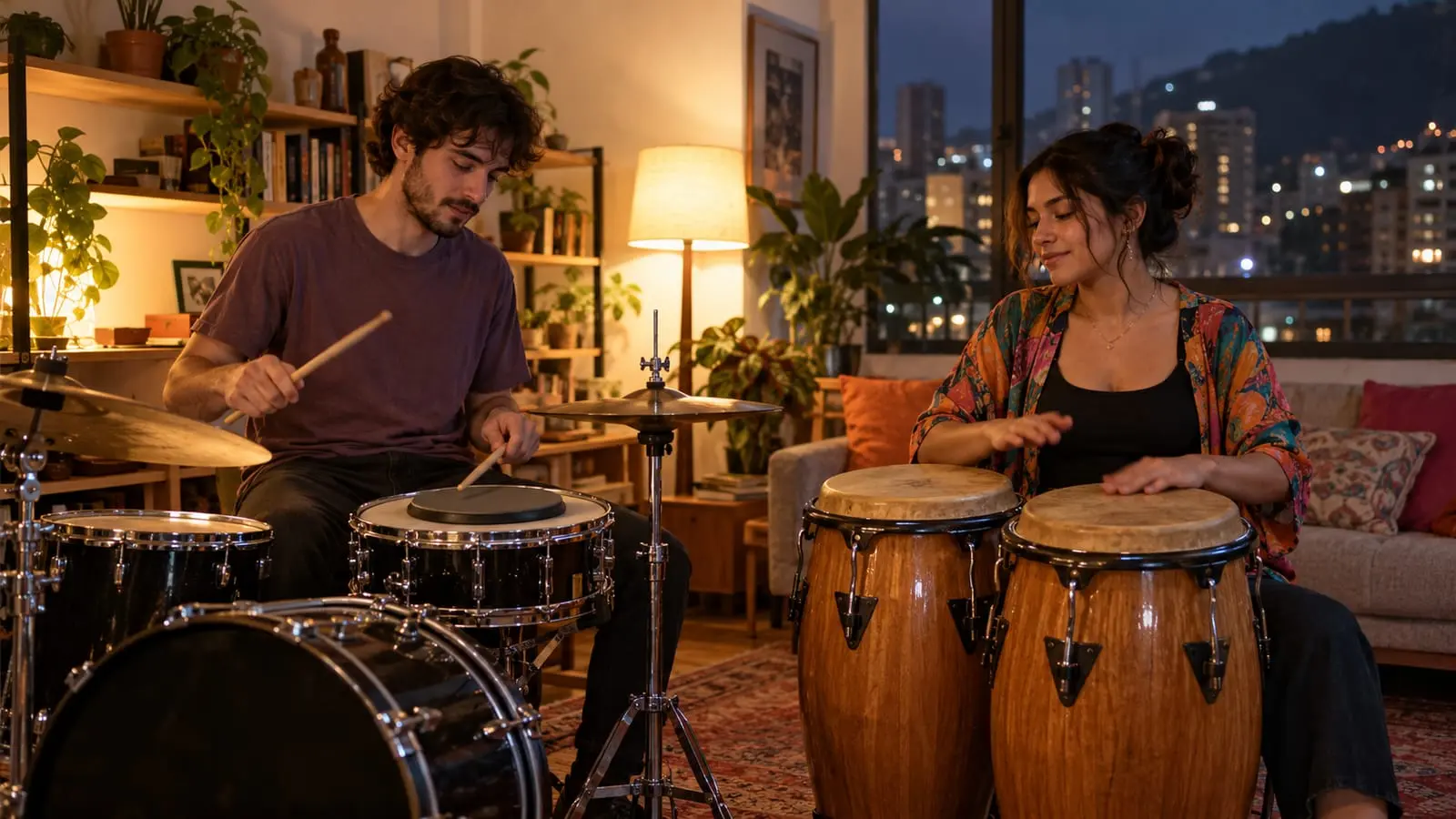
It depends on the music that moves you and the space you have. If you dream of playing rock, pop, funk, or metal in a band and have room for a kit or can practice on electronic drums, choose the drum kit. If salsa, cumbia, son, or Afro-Colombian music speaks to you, or you live in an apartment where noise is a concern, choose Latin percussion: congas, bongos, timbales, or cajón.
Both can be learned in percussion lessons and share the essentials: a steady beat, rhythm reading, and an ear for playing with others. What changes is how you use your body. On a drum kit, you coordinate hands and feet while using sticks; in hand percussion, your hands are the instrument.
In short
- A drum kit is played by one person using hands and feet; Latin percussion distributes the rhythm among several instruments and musicians.
- Drumming requires independence of all four limbs; congas and bongos require hand technique with several types of strokes.
- An acoustic drum kit needs a permanent space and is very loud; a cajón or bongos fit in any corner.
- Small percussion instruments are often the starting point for young children, from around age 5; drums usually come around age 6 or 7, depending on the child's height and whether they can reach the pedals.
- Skills carry over: many drummers play percussion, and many percussionists eventually take up drums.
Drum kit vs. Latin percussion: a comparison
| Aspect | Drums | Latin percussion |
|---|---|---|
| What you play | A kit: bass drum, snare drum, toms, hi-hat, and cymbals. | Separate instruments: congas and bongos played with your hands, timbales with sticks and hands, and cajón while sitting on it. |
| Coordination | Four limbs doing different things at the same time. | Mostly both hands, producing a wide variety of strokes and sounds. |
| Core technique | Sticks: rebound, rudiments, independence. | Hand strokes: open, muted, slap, and bass tones; on timbales, cáscara and cowbell. |
| Genres | Rock, pop, funk, jazz, metal, ballads, and fusion. | Salsa, son, cumbia, merengue, Latin jazz, Afro-Peruvian music, and fusion. |
| Role in the group | One person holds down the entire groove. | Several people weave the rhythm together, each with their own part. |
| Space | A spacious, permanent corner. | A cajón or bongos fit almost anywhere; congas need a little more space. |
| Noise | Very loud on an acoustic kit; electronic drums with headphones reduce the noise considerably. | Congas and timbales are loud; cajón is more moderate. |
| Transport | Difficult; rehearsals usually use the kit at the venue. | Cajón and bongos are easy to carry. |
| Relative cost | A full kit with cymbals is a substantial investment. | Cajón is one of the more affordable options; a pair of congas costs more. |
| Suggested starting age | Around age 6 or 7, depending on the child's height and whether they can reach the pedals. | Small percussion instruments from around age 5. |
How you learn each one
Drums
Your first lessons focus on sitting posture, holding the sticks, and rebound: letting the stick bounce back instead of forcing it upward. Next come rudiments such as single strokes, double strokes, and paradiddles, along with your first rock beat: eighth notes on the hi-hat, bass drum on one and three, snare on two and four. It sounds simple until you try to stop your right foot from copying your hand.
Latin percussion
Here, everything revolves around clave, the five-stroke pattern that organizes salsa and son. On congas, you learn tumbao and how to produce different sounds depending on where and how your hand lands; on bongos, martillo; on timbales, cáscara on the shell and ending fills. Cajón works like a minimal drum kit: the center produces the bass tone and the edge the high tone.
In Colombia, Latin percussion overlaps with traditional percussion: alegre, llamador, tambora, maracas, and guache. Read more in instruments of Colombia's Caribbean music.
Space and noise: the practical question
In many Bogotá apartments, an acoustic drum kit would cause problems with the neighbors. Before deciding, consider these options:
- Practice pad: almost silent, ideal for rudiments and stick technique.
- Electronic drums with headphones: they address the sound, though bass drum pedal impacts travel through the floor. A thick rug or platform can help.
- Cajón: much quieter than a drum kit and lets you practice complete rhythms.
- Congas and timbales: they're loud, so agree on practice times.
If you live in a house or have an isolated space, an acoustic kit offers the best experience. Otherwise, starting with hand percussion or electronic drums is a valid way to learn. To compare specific instruments, read how to choose a drum kit or cajón for beginners.
Choose drums if… / choose Latin percussion if…
Choose drums if…
- Your favorite songs are rock, pop, funk, or metal.
- You enjoy the challenge of coordinating hands and feet.
- You want to provide a band's rhythmic foundation on your own.
- You have space or can use electronic drums.
Choose Latin percussion if…
- Salsa, cumbia, son, or Latin jazz moves you.
- You enjoy playing with your hands and feeling the drumhead.
- You live in an apartment and need something more manageable, such as a cajón.
- You enjoy playing in a group where each instrument contributes its own part.
- It's for a child of 5 or 6 who can't reach the pedals yet.
Our percussion lessons cover drum kit and hand percussion; your teacher guides you based on your music and available space.
How to combine them or switch later
These aren't separate worlds. Many drummers learn Latin rhythms such as cumbia or songo on the kit and play congas or cajón in acoustic groups. Many percussionists also come to drums with a steady beat and a feel for groove that's evident from day one.
- From drums to Latin percussion: the new skills are hand technique and understanding clave. You already have rhythm reading and a steady beat.
- From percussion to drums: the new skills are footwork and independence. Start slowly with the metronome, and practice hands and feet separately before combining them.
- For children: starting with small percussion instruments and moving to drums when they can reach the pedals is a natural progression. Find more details in the drums for children guide.
Frequently asked questions
Which is harder, drums or congas?
They present different challenges. Drums require coordinating four limbs at once; congas require precise hand technique to produce different sounds and a strong understanding of rhythm within a group.
Can you learn drums in an apartment?
Yes, with adjustments: a practice pad for technique, electronic drums with headphones, and something to cushion bass drum impacts. Many students practice this way and use an acoustic kit only in lessons or rehearsals.
Can a cajón help you learn drums?
It helps develop a steady beat, rhythm, and low and high tones, but it doesn't replace the foot coordination needed for drums. It's a good introduction to percussion.
At what age can a child start learning drums?
As a guideline, around age 6 or 7, when the child can reach the pedals and better coordinate hands and feet. Before that, small percussion instruments are excellent preparation.
Sources
We checked the facts in this article against these sources on October 22, 2026.
- Wikipedia: clave (rhythm), a five-stroke pattern over two measures
- Banco de la República (Enciclopedia): Petrona Martínez and the instruments in her ensemble
- Colombia.co: cumbia and the ensemble's instruments (llamador, guache, maracas)
- NIOSH (CDC): hearing protection for musicians and uniform-attenuation earplugs