
Acoustic drums, electronic drums or a cajón to start with?
Before the drum kit, a practice pad and a good pair of sticks. We help you choose between an acoustic kit, an electronic kit or a cajón for your home.
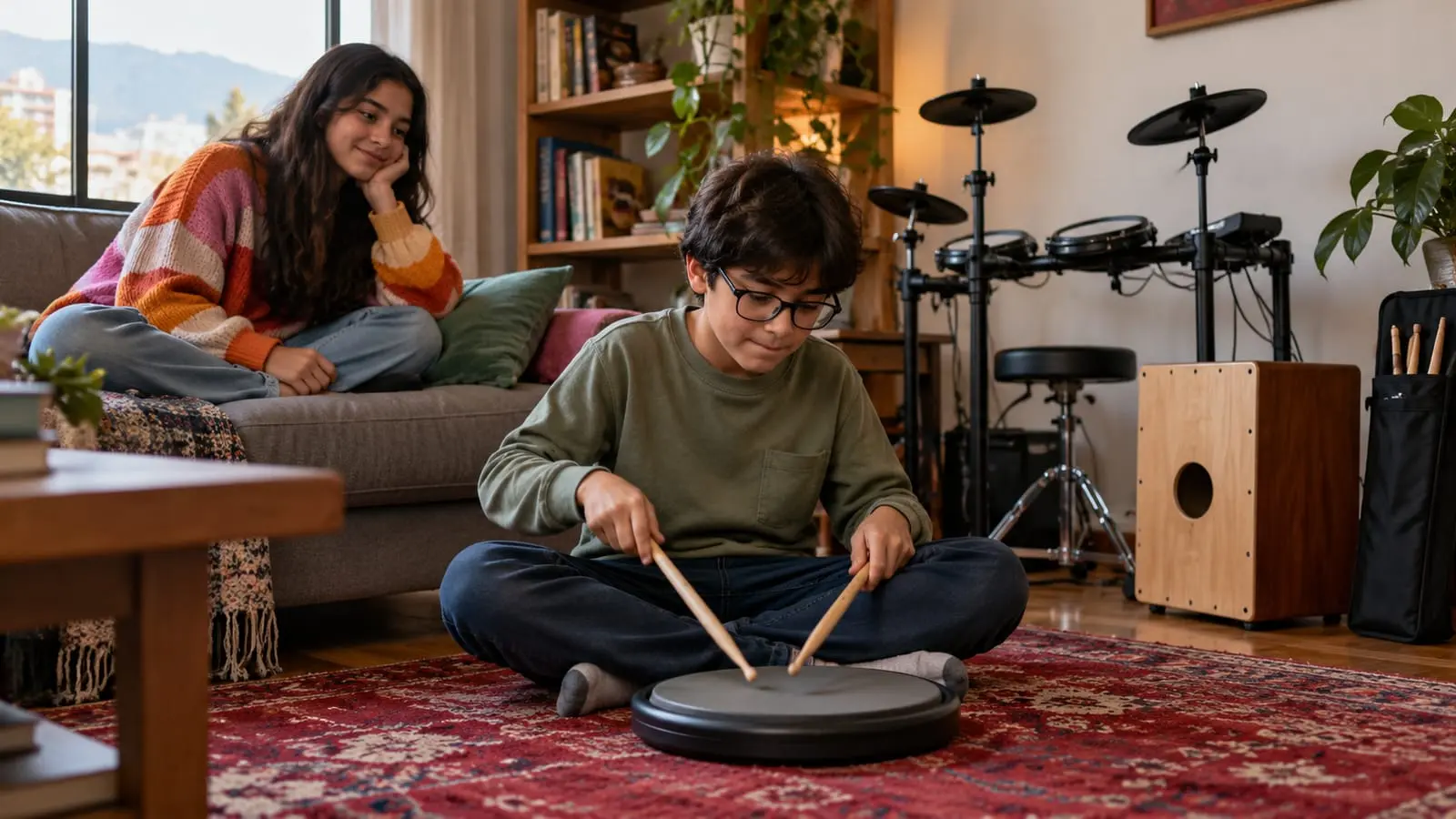
You do not need to buy a drum kit on your first day of learning: a practice pad and a pair of drumsticks let you work on hand technique and the rudiments you will always use. When the time comes, choosing acoustic drums, electronic drums, or cajón depends mainly on your space, your neighbors, and the music you want to play.
In an apartment, electronic drums are usually the most realistic option; in a house with space and flexible practice hours, acoustic drums offer the fullest experience; and cajón is ideal for acoustic music, small spaces, and children.
In short
- A practice pad and 5A or 7A drumsticks are almost every drummer’s first purchase.
- Electronic drums let you practice with headphones, but bass drum pedal impacts travel through the floor.
- For an electronic kit, look for mesh heads, a responsive snare, and a hi-hat pedal with continuous control.
- The cajón is compact and versatile, but it is not silent.
- Use hearing protection from the start, especially with acoustic drums.
First: a practice pad and drumsticks
A practice pad is a rubber surface that mimics a drumhead’s rebound. You can place it on your lap, on a table, or on a snare stand, and it is much quieter than a drum. Use it to work on your grip, single and double strokes, rolls, and rhythm reading—the foundations of everything else.
- Choose a medium-sized pad that lets you strike the center with both sticks without squeezing your arms inward.
- Look for even rebound and a base that will not slip.
- Use it with the metronome: ten minutes of daily hand practice with a steady pulse go a long way.
Even after you get a drum kit, the pad remains an everyday practice tool and lets you practice at times when playing a drum would not be possible.
Acoustic or electronic drums
| Aspect | Acoustic | Electronic |
|---|---|---|
| Volume | Very loud; audible throughout the building | Low with headphones, though striking the pads and pedal still makes noise |
| Neighbors | Requires agreed practice hours and often sound isolation | Easier to manage; a platform or thick mat under the bass drum helps |
| Space | Takes up considerable space and is not easy to move | More compact; many kits fold up |
| Feel | The actual response of drumheads and cymbals | Depends on the pads; mesh heads feel more natural |
| Extras | Only needs tuning and eventual head replacement | Metronome, sounds, recording, and computer connection for online lessons |
| Maintenance | Heads and hardware adjustments | Cables, module, and sensors; harder to repair at home |
If you choose acoustic drums
- A basic five-piece setup—bass drum, snare, two rack toms, and a floor tom—plus a hi-hat and one cymbal is enough to learn.
- Junior-sized kits are available for children. Being able to reach the pedals with their feet securely supported matters more than the number of pieces.
- Check that the throne is stable and height-adjustable, the hardware tightens without slipping, and the bass drum pedal returns evenly.
- Cymbals in beginner kits tend to be limited; you can replace them later. Low-volume cymbals and heads are also available for home practice.
If you choose electronic drums
- Prefer mesh heads: they are quieter and rebound more like a real drumhead.
- A dual-zone snare, with head and rim zones, lets you practice strokes you will later use on an acoustic kit.
- The hi-hat should have a pedal with continuous control, not just an open/closed switch.
- The bass drum pad should be solid and stay in place when the pedal strikes it.
- The module should have a headphone output, a metronome, and, if you plan to take online lessons, USB connectivity or an audio output.
In apartment buildings and residential complexes, check the community rules and speak with your downstairs neighbors before buying: with electronic drums, the biggest disturbance is often the pedal vibration traveling through the floor slab rather than the sound.
The cajón: compact, but not silent
The Peruvian cajón is a wooden box you sit on and play with your hands on its front panel. It produces a low sound in the center and a higher sound near the top edge, and works very well for acoustic music, ballads, flamenco, Latin music, and small ensembles. It is a good starting point for children and anyone without room for a drum kit.
- With or without snares: a traditional Peruvian cajón has nothing inside and a dry sound; many modern cajóns have internal snare wires or strings that add a snap similar to a snare drum. Some let you adjust or remove them.
- Front panel: it should be secure, free of cracks, and have all its screws. On many cajóns, adjusting the upper-corner screws changes the high stroke’s sound.
- Height: when seated on it, your knees should be roughly level with your hips and your feet should rest on the floor. Smaller cajóns are available for children.
- Construction: check that the corners are well glued and nothing rattles when you move it.
In an apartment, a cajón is also loud, though less so than an acoustic drum kit. If Latin percussion appeals to you, it can be a good first step; we compare the options in drums or Latin percussion.
Which drumsticks to buy
| Size | What they look like | Who it is for |
|---|---|---|
| 7A | Thin and light | Children, small hands, softer music, and jazz |
| 5A | Medium thickness; the most widely used | The starting point for most players |
| 5B | Thicker and heavier | Rock and players with some technique already |
| 2B | Very thick | Strength training and heavy genres; not for beginners |
- Roll each stick on a flat table before buying: if it wobbles, it is warped.
- Compare the pair: they should have similar weight and sound when striking the pad.
- Wood tips are the most common; nylon tips do not splinter and sound brighter on cymbals.
- You play cajón with your hands, but brushes and bundled rods are available to change its tone color.
Hearing protection from day one
An acoustic drum kit, cymbal, or firmly struck snare produces sound levels that can affect hearing with frequent exposure. This is not just a concern for professionals: children and beginners also spend many hours near cymbals.
- Use musicians’ earplugs, which lower volume evenly without muffling the sound, or earmuff hearing protectors, which are easy to put on children.
- With electronic drums, keep headphone volume moderate: it is tempting to turn it up to cover the sound of hitting the pads.
- If your ears ring after practice, the volume was too high. Adjust your next session and, if the ringing does not go away, consult a specialist.
In drums for children: a guide for parents, you will find more ideas for organizing home practice with younger children.
New or used: what to check
Used drum kits are easy to find, and many parts are straightforward to replace. Heads, for example, are consumables: do not reject a kit just because they are worn. Here is what you do need to check:
- Shells without cracks, and even bearing edges with no dents or splinters.
- Cymbals without cracks: even a tiny crack tends to spread.
- Complete hardware, with screws that tighten and threads in good condition.
- Bass drum and hi-hat pedals with working springs and no metallic noises.
- On an electronic kit, all pads should respond to soft and hard strikes, the module should power on with its adapter, and the cables should have no exposed wires.
If you have a teacher, ask them to try it or review photos and videos with you before paying; they can spot a faulty pedal or an unresponsive pad in minutes. If you do not yet own one, percussion lessons can start with a pad and sticks while you decide what to buy.
Frequently asked questions
Which is better for a child, drums or cajón?
It depends on age, space, and the music they like. Cajón is more compact and easier to fit into a room; drums, often in a junior size, develop hand-and-foot coordination. In either case, a practice pad is a good start.
Can you really learn on electronic drums?
Yes, especially with mesh heads and a hi-hat pedal with continuous control. It helps to play an acoustic kit occasionally, during a lesson or rehearsal, to get used to its response and actual volume.
How can I reduce acoustic drum noise at home?
Use mesh or low-volume heads, practice cymbals, a thick rug underneath, and practice hours agreed with your neighbors. No single measure makes the kit silent, but together they considerably reduce the impact.
How often should you change drumheads?
It depends on how much you play. When the heads are dented, lose their tuning easily, or sound dull, it is time. We explain in how to care for drums and percussion instruments.
Sources
We checked the facts in this article against these sources on October 22, 2026.
- Yamaha Music: how to buy your first drum kit (acoustic or electronic, space, hardware)
- Yamaha Music: how to practice drums without disturbing the neighbors (pedal vibration, mesh heads)
- Yamaha Music: what to look for when buying an electronic drum kit
- Wikipedia: Peruvian cajón (origins, construction, and playing technique)
- World Health Organization: deafness and hearing loss (safe listening)
- LP (Latin Percussion): frequently asked questions (care, humidity, and temperature)