
Drum rudiments for beginners: where to start
Five rudiments are enough to start: single stroke, double stroke, paradiddle, flam and five-stroke roll. Here's the sticking for each and how to practice them on a pad.
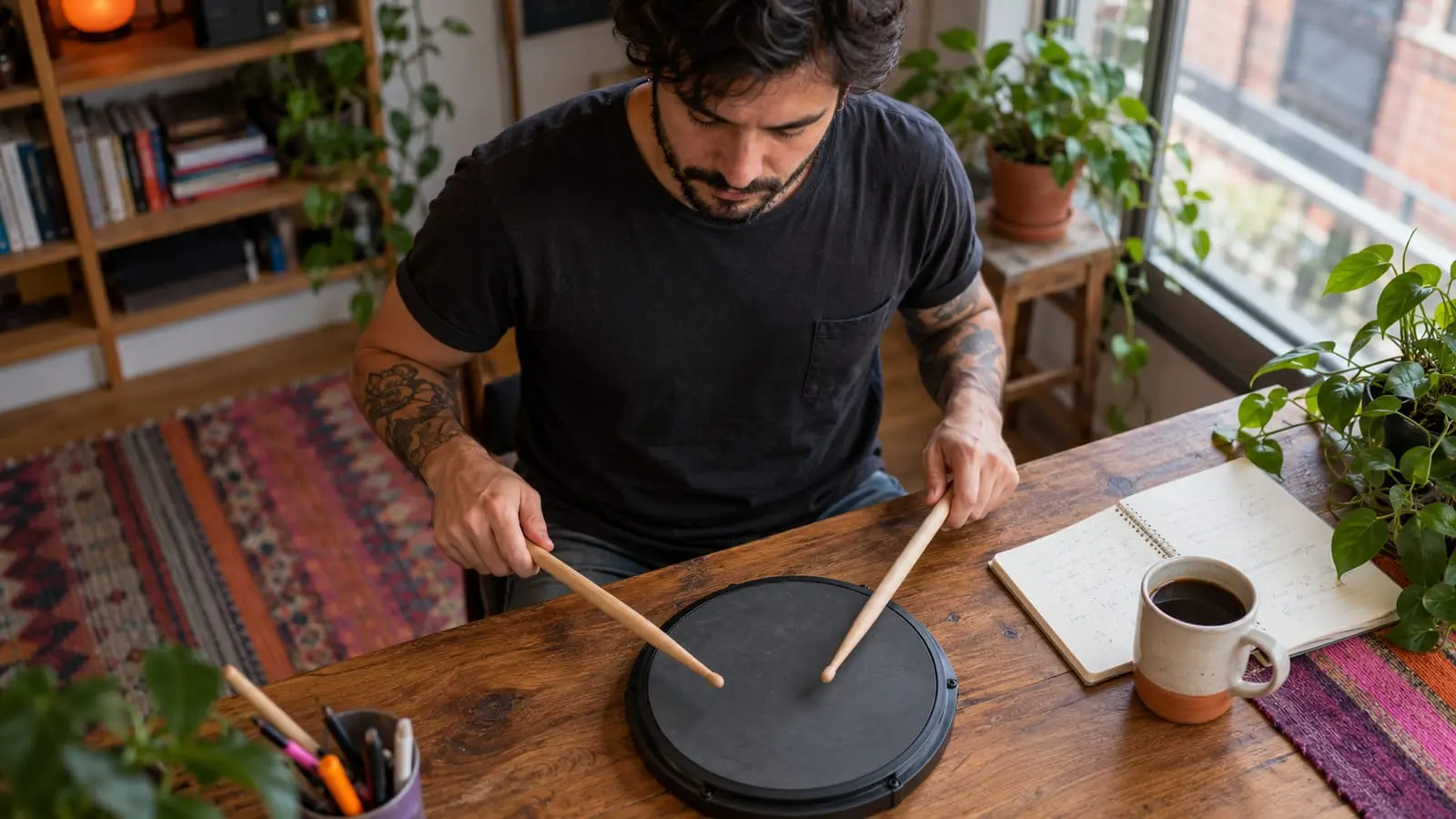
If you're just starting out, focus on five rudiments first: the single stroke (D I D I), the double stroke (D D I I), the paradiddle (D I D D, I D I I), the flam, and the five-stroke roll (D D I I D). They form the basis of many of the grooves and fills you'll play in your first few years.
Practice them slowly on a practice pad with a metronome, keeping both hands at the same height. Ten or fifteen focused minutes a day are more useful than an hour of uncontrolled playing.
In short
- A rudiment is a set hand pattern, or sticking; D means right hand and I means left hand. English-language methods use R and L.
- The first five: single stroke, double stroke, paradiddle, flam, and five-stroke roll.
- Speed comes from control: start slowly, evenly, and relaxed, then build up speed.
- Practice each rudiment starting with your left hand too, so your weaker hand keeps up.
- Rudiments are a means to an end: you use them on the drum kit to create grooves, fills, and accents.
What a rudiment is and why it matters
A rudiment is a set combination of right- and left-hand strokes with specific accents and dynamics. The Percussive Arts Society lists 40 international rudiments, but beginners don't need all of them. The first five cover the essentials: alternating hands, using rebound, combining single and double strokes, and controlling grace notes.
Think of them as a pianist's scales: they don't sound like songs, but once you can play them confidently, everything else sounds cleaner. In how long it takes to learn drums, we explain where they fit into your first year; here, we'll look closely at how to play them.
The five essential rudiments and their sticking
| Rudiment | Sticking | How to count it | Skills it develops |
|---|---|---|---|
| Single stroke roll | D I D I D I D I | Eighth notes: “1 and 2 and”; then sixteenth notes: “1 e and a” | Even alternation and speed |
| Double stroke roll | D D I I D D I I | Sixteenth notes: “1 e and a” | Rebound control; two even notes per hand |
| Single paradiddle | >D I D D >I D I I | Sixteenth notes, accented on “1” and “2” | Combining singles and doubles; switching the lead hand |
| Flam | iD dI iD dI | One flam per beat, in quarter notes | Precision with different stick heights |
| Five-stroke roll | D D I I >D / I I D D >I | Two doubles and an accented stroke | Ending a roll with a clean accent |
Single stroke
This is the foundation of everything. Aim for a sound that doesn't reveal which hand is playing: the same volume, height, and spacing between strokes. Record yourself on your phone and listen for a “loud-soft” pattern; it usually exposes the left hand's weakness (or the right hand's, if you're left-handed).
Double stroke
The classic mistake is playing the second note of each hand more softly. At first, use your wrist for each stroke, as two separate movements. Only as the tempo increases should you let the second stroke come from the rebound, supported by your fingers. At high speed, a well-played double stroke sounds almost the same as a single stroke.
Paradiddle
Its name mimics the sound: “pa-ra” represents the two single strokes and “did-dle” the double. Since each group starts with a different hand, both hands have to lead. Accent the first note of each group and keep the others soft. Once it's solid, try the double paradiddle (D I D I D D, I D I D I I) and the paradiddle-diddle (D I D D I I).
Flam and five-stroke roll
In a flam, one stick starts low (very close to the drumhead) and plays a soft grace note just before the main stroke, which starts from a higher position. If both notes sound at the same time, it is a “flat flam” and loses its effect. The five-stroke roll is your first roll with a clear ending: two double strokes and an accented stroke that closes the phrase, often used to end a fill.
Grip, stick height, and rebound: the technique behind the strokes
- Fulcrum: hold the stick between your thumb and index finger (or middle finger), about a third of the way from the end; let the other fingers wrap around it without squeezing.
- Let it rebound: the drumhead or pad bounces the stick back. Squeezing it stops that rebound and tires you out twice as fast.
- Stick heights: accents start high and soft notes start very low. In a paradiddle, the accent is a downstroke that stays low for the soft notes; the hand rises again just before its next accent.
- Position: relax your shoulders, keep your elbows close to your body, and set the pad at snare height rather than on your knees, if possible.
- Drumsticks: thinner 7A sticks tend to suit children or small hands better; slightly thicker 5A sticks are a popular size among adults.
A 15-minute practice pad routine
A rubber or silicone pad on a stand is quiet, inexpensive, and ideal for an apartment. Set the online metronome to eighth- or sixteenth-note subdivisions and follow this sequence:
| Minutes | Exercise | Detail |
|---|---|---|
| 0–2 | Slow full strokes | Eight with the right hand, eight with the left; the stick rises and returns to the same height. |
| 2–5 | Single stroke | One minute of eighth notes and two of sixteenth notes, starting with each hand in turn. |
| 5–8 | Double stroke | Start by using the wrist for every note; toward the end, let the rebound take over. |
| 8–11 | Paradiddle | With clear accents and very low stick heights for soft notes. |
| 11–13 | Flams | Alternating (iD dI), then flam taps (iD D dI I). |
| 13–15 | Five-stroke roll and free play | Combine rudiments and create a two-measure phrase. |
Each day, write down the tempo at which you played each rudiment cleanly. Increase by 2 to 5 BPM only when you can play it well three times in a row; the full method is in how to use a metronome for practice. For variety, George Lawrence Stone's classic book “Stick Control” has entire pages of sticking combinations.
From pad to drum kit: applying each rudiment
- Single strokes on the toms: four sixteenth notes on the snare, four on tom 1, four on tom 2, and four on the floor tom. It's the world's most widely used fill.
- Paradiddle as a groove: right hand on the hi-hat and left hand on the snare, with the bass drum on 1. This gives you a groove with more movement than a basic rock beat.
- Flam for accents: a snare flam at the end of a fill, or played with a cymbal, adds weight to the arrival on beat 1.
- Split double strokes: play one hand's two strokes on the snare and the other's on a tom for fast fills without much arm movement.
- Five-stroke roll: finish a phrase with the accent landing on the crash cymbal and bass drum together.
Once you can spread the rudiment across the drums, combine it with your first drum grooves: three measures of groove and one of fill. This exercise connects technique with actual music.
Common mistakes when practicing rudiments
- Always starting practice with your dominant hand.
- Increasing the tempo before the pattern is even, training your hands to play sloppily.
- Squeezing the stick with your whole hand and playing from the arm instead of the wrist.
- Accents you can't hear, or soft notes that are as loud as the accents.
- Playing without a metronome and speeding up without noticing.
- Staying on the pad and never taking the rudiment to the drum kit.
- Forgetting hearing protection when moving from a pad to an acoustic kit.
A teacher can spot things you miss in seconds: a stiff wrist, an elbow sticking out, or one hand rising less than the other. In percussion lessons, these corrections start in the first week, saving you months of reinforcing bad habits.
Frequently asked questions
What is the most important drum rudiment?
The single stroke, because it underpins almost every fill and groove. But the paradiddle teaches coordination best, combining singles and doubles and making the lead hand switch with each group.
How many drum rudiments are there?
The Percussive Arts Society's international list includes 40, grouped into rolls, paradiddles, flams, and drags. Five are enough to start; you'll learn the others as your repertoire calls for them.
Can I practice rudiments without a pad?
Yes, on a firm cushion, a thick book, or your knees, though the rebound differs and isn't ideal for double strokes. If you're serious about drumming, a practice pad is one of the most useful and affordable purchases you can make.
How fast should I play a paradiddle?
At whatever tempo lets you play evenly and stay relaxed, even if that's 60 BPM in sixteenth notes. Speed will follow if you increase a few BPM at a time without sacrificing control.
Sources
We checked the facts in this article against these sources on October 22, 2026.