
Benefits of playing drums and percussion
Drummers and percussionists are the engine of any band. Here's what they train, where to play in Colombia and what challenges to consider.
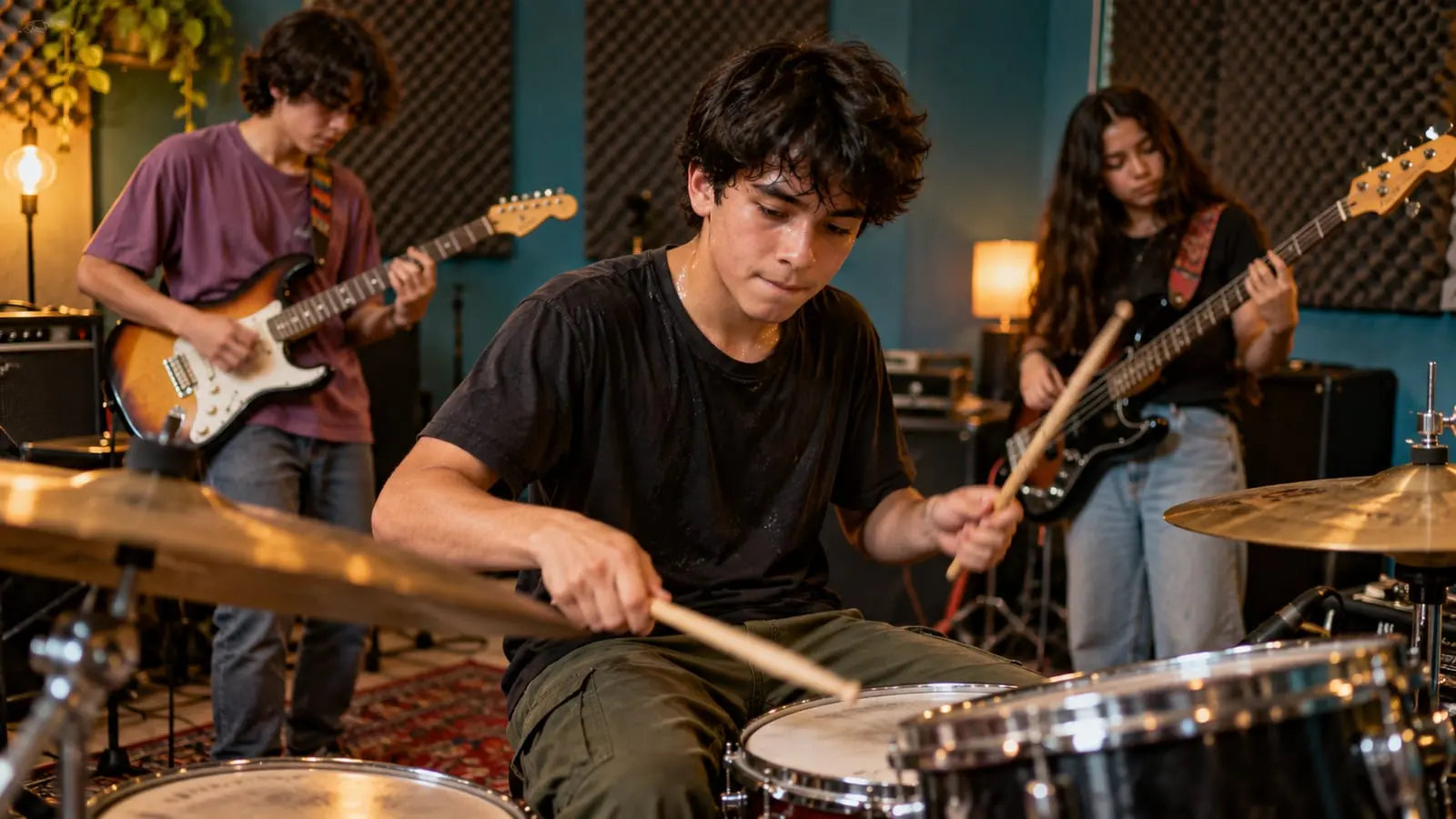
Playing drums or percussion gives you a solid sense of time, coordination between hands and feet, a very physical way to make music and a central role in any group: when the rhythm is steady, everyone plays better. In Colombia, it also connects you with a rich rhythmic tradition, from cumbia to currulao.
Here we explore those benefits through concrete examples, who tends to enjoy them and the practical challenges (volume, space, technique) to understand before you start.
In short
- Percussion develops your sense of pulse: playing in time, without speeding up or slowing down, is one of the skills musicians value most.
- Drumming develops coordination across all four limbs, each with a different task.
- It's a very physical way to make music, which many people experience as an outlet for energy.
- Percussionists almost always play in groups: bands, orchestras, carnival groups, chirimías and worship groups.
- The real challenges are volume, space at home and understanding that playing well means playing with control rather than force.
A sense of rhythm you can rely on
A percussionist's main job is to hold the pulse steady. It seems simple until you try playing the same pattern for five minutes without speeding up, or keeping it going while the guitarist loses their place. That steadiness takes practice, and it's what makes a group sound tight.
- You learn to subdivide: to feel the eighth and sixteenth notes within each beat.
- You practice with a metronome and backing tracks until the beat settles into your body.
- You distinguish straight rhythms from swing, and a meter in four from six-eight time.
- You learn to read rhythms, a skill you can later use on any instrument.
Hand and foot coordination
On a drum kit, your right hand might play the hi-hat, your left the snare, your right foot the bass drum and your left foot open and close the hi-hat, each with a different pattern. At first your limbs copy each other; slow exercises help each one become independent. The day you play a complete groove without thinking about it is one of the most celebrated moments in lessons.
In hand percussion, the challenge is different: your hands strike the drumhead directly. On a conga or cununo, you learn to produce different sounds from the same drum (open, muted, bass, dry) depending on how and where you strike it. This involves finer coordination of fingers and palms.
Energy, movement and a physical way to make music
Few instruments involve the body so much. Playing a complete groove moves your arms, legs and torso, and many people experience it as a way to release energy built up during the day. Children and teenagers who need to move often connect with the instrument right away.
That doesn't mean playing wildly. Much of the technique involves using the stick's rebound, relaxing your wrists and shoulders and managing your force. A relaxed drummer can make it through a whole concert; a tense one tires after two songs and sounds worse too.
The driving force in any group
Percussionists rarely play alone. Their natural place is in a group, and Colombia has plenty:
- Marching and school bands, which parade on national holidays and at school events.
- Rock and pop bands, and church worship groups, where drums underpin the whole repertoire.
- Salsa and tropical music orchestras, with congas, timbales, bongos and cowbell.
- Vallenato ensembles, with caja and guacharaca alongside the accordion.
- Cumbia and gaita groups, with alegre, llamador and tambora drums.
- Chirimías and Pacific-region groups, with cununos, bass drums and snare drum.
- Carnival groups and batucadas at carnivals and festivals.
Playing in a group teaches you to listen before showing off: lower your volume in the verse, signal the move into the chorus and keep everyone else steady when something goes off track.
A gateway to Colombian rhythms
Colombia has enormous rhythmic richness, and percussion is the most direct way into it. Here's a quick overview:
| Rhythm or region | Instruments | What you learn by playing it |
|---|---|---|
| Cumbia (Caribbean) | Alegre, llamador and tambora drums, maracas and guache. | Holding a pattern steady while another drum improvises over it. |
| Vallenato (Caribbean) | Caja vallenata and guacharaca. | The paseo, son, merengue and puya styles, each with its own tempo and accents. |
| Porro and fandango (Córdoba and Sucre) | Bass drum, snare drum and cymbals in bandas pelayeras. | Playing in a wind band with energy and precision. |
| Currulao (Pacific) | Cununos, bass drum, guasá and marimba. | Feeling patterns in two and three at the same time. |
| Bambuco and pasillo (Andean region) | Esterilla, spoons, tambourine and, in modern versions, drum kit. | Triple meters and the distinctive accents of Andean music. |
| Salsa (Cali and nationwide) | Congas, timbales, bongos, cowbell and güiro. | Clave, tumbao and playing as a section. |
You don't have to choose between drums and hand percussion forever: many drummers adapt these rhythms to the kit. If you're unsure where to start, read drums or Latin percussion and, to explore the styles, Colombian rhythms explained.
Real challenges and who tends to enjoy it
The challenges
- Volume. An acoustic drum kit in a Bogotá apartment is a serious issue for neighbors. A practice pad or electronic kit with headphones solves much of the problem.
- Space. A full kit takes up more room than you might expect; see alternatives in how to choose a drum kit or cajón to get started.
- Hearing protection. Playing acoustic drums for hours without earplugs isn't a good idea; get used to wearing them from the start.
- Patience with rudiments. Rolls and paradiddles with a metronome aren't the most exciting exercises, but they're the foundation for everything else.
Who tends to do well
- People who move when they hear music and tap on tables without realizing it.
- People who enjoy playing with others more than playing alone.
- People who want to join their school, church or friends' band.
- Salsa, cumbia or vallenato lovers who want to understand rhythm from the inside.
In percussion and drum lessons, you can focus on the kit, hand percussion or both, depending on the music that moves you.
Frequently asked questions
Is drumming only for young people?
No. Adults of any age can start, provided they use relaxed technique and take breaks. An electronic kit with controlled volume and short sessions at first make getting started much easier.
Do you need to read music to play drums?
Not to get started. But reading rhythms opens many doors: you learn songs faster, understand what's asked of you in rehearsals and can play in bands that use sheet music. You learn it gradually alongside the instrument.
Which develops more skills: drums or hand percussion?
They develop different things. Drums focus more on hand and foot independence; hand percussion focuses on hand-produced sounds, nuances and section playing. Over time, knowing a little of both makes you a more well-rounded musician.
Can a very restless child benefit from drums?
Many energetic children find drums a place to move with purpose. Still, every child is different; what matters is a teacher who combines movement with structure and short exercises.
Sources
We checked the facts in this article against these sources on October 22, 2026.
- Frontiers in Human Neuroscience: percussionists keep the beat more precisely (2014)
- NIOSH (CDC): occupational noise and the recommended exposure limit of 85 dBA
- NIOSH (CDC): hearing protection, types of earplugs, and earplugs for musicians
- UNESCO: traditional vallenato music of the Colombian Caribbean (caja, guacharaca, and accordion)
- El País Cali: currulao and its instruments (marimba, bombo, cununo, and guasá)