
Drums for kids: age, noise and practicing at home
Your child wants to play drums and you live in an apartment. What age to start, what to have at home, how to handle the noise and how to protect their hearing.
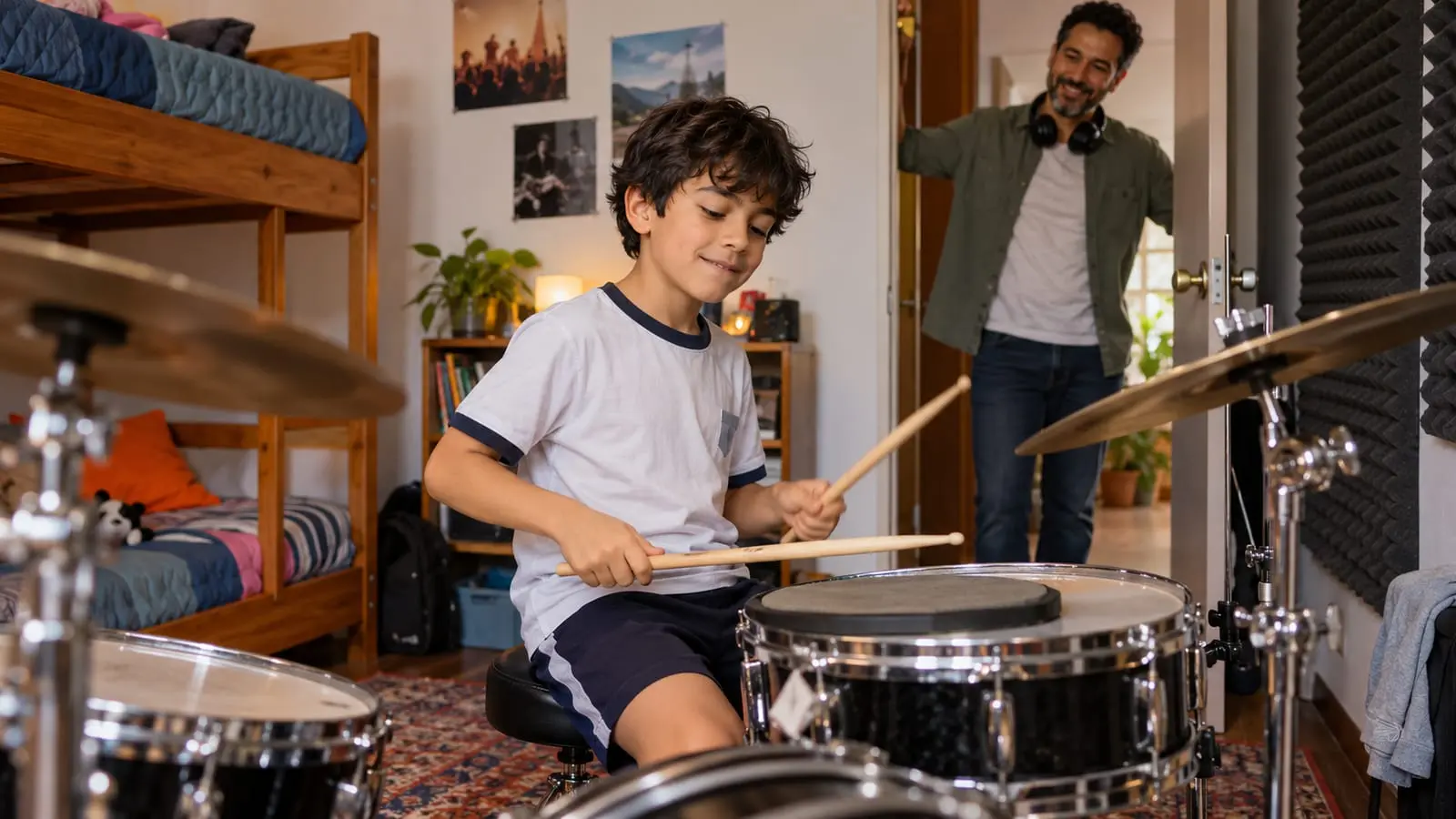
Many children can start drum lessons around age 6 or 7, when they can reach the pedals while sitting on a low stool and coordinate hands and feet in simple rhythms. You don't need a full kit to practice at home from day one: a practice pad and a pair of sticks are enough to get started.
The two things parents worry about most, noise and hearing, can be managed. Here's how to address them and what your child does in the first lessons.
In short
- Around age 6 or 7, many children can reach the pedals and coordinate basic rhythms; before then, small percussion instruments and rhythm games lay the groundwork.
- A practice pad and sticks are the essentials: they let your child develop hand technique almost silently.
- Electronic drums can be used with headphones, but bass drum impacts send vibrations to the floor below.
- Use hearing protection from the first acoustic drum lesson, and keep headphone volume moderate.
- Agreed practice times and an early conversation with neighbors prevent many conflicts.
At what age can a child start playing drums?
Drums pose a particular challenge: four limbs doing different things at once. Around age 6 or 7, many children are tall enough to reach the bass drum pedal and coordinated enough for simple rhythms. Before that, percussion lessons using hand instruments such as drums, maracas, claves, or cajón, along with rhythm games, provide an excellent foundation.
Signs your child is ready:
- They can keep a song's beat by clapping or stepping without losing their place.
- Their feet reach the pedals while sitting on a low stool.
- They can follow simple instructions during a 30 to 45 minute lesson.
- They want to play, rather than just make noise (though the two can seem quite similar at first).
Junior kits have smaller drums and a lower stool for young children. With a standard-size kit, the key is to adjust the stool and bring the pedals and cymbals closer.
Acoustic drums, electronic drums, or a practice pad
| Option | Advantages | Limitations |
|---|---|---|
| Practice pad and sticks | Affordable, portable, and almost silent; develops hand technique. | Doesn't involve the feet or moving between drums. |
| Electronic drums | Can be played with headphones, offers volume control, and usually includes a metronome and songs. | Bass drum impacts and strokes are felt through the floor; the feel differs from an acoustic kit. |
| Acoustic drums | Real sound and response: the full experience of the instrument. | Very loud; needs space and practice times that don't disturb anyone. |
| Cajón | Portable, versatile, and quieter than a drum kit; works for many genres. | It's not a drum kit: it develops a different technique, though it helps a great deal with rhythm. |
For many families in apartments, the most practical combination is a pad for daily technique work and, once the child is committed, an electronic kit with mesh heads. Find buying advice in how to choose a drum kit or cajón for beginners.
Noise and neighbors: practicing in an apartment
In an apartment building or residential complex, drum noise travels in two ways: through the air (the sound of drums and cymbals) and through the structure (bass drum and hi-hat pedal impacts against the floor). Headphones only address the first.
- Talk to your neighbors before the kit arrives. Letting them know and agreeing on practice times makes living together much easier.
- Check the building or residential complex rules, which usually specify quiet hours.
- Isolate the floor. A thick rug or vibration isolation platform beneath an electronic kit reduces bass drum impacts; some people build a wooden platform supported by tennis balls.
- Use sound dampening on acoustic drums: rubber pads on the drumheads, low-volume cymbals, and rods or brushes.
- Avoid rest hours: very early mornings, late nights, and nap time if there are babies nearby.
An often overlooked benefit: if your child develops good hand technique on the pad, time on the full kit becomes much more productive.
Hearing protection from the first lesson
An acoustic drum kit is very loud, especially the snare and cymbals, and your child's ears are just centimeters away. Many professional drummers use hearing protection; children have even more reason to do so.
- Musicians' earplugs, with filters that reduce volume evenly and let you hear music clearly, unlike foam earplugs.
- Child-size earmuffs, easy for younger children to put on and take off.
- With electronic drums and headphones, keep the volume moderate. If it needs to be raised to cover stick impacts, use closed-back headphones that block outside noise instead.
- Take breaks during long practice sessions, and pay attention if your child reports ringing in their ears.
What children learn in their first drum lessons
- Sitting posture: set the stool height so the thighs are almost horizontal and the feet reach the pedals without stretching.
- Stick grip: hold the sticks without squeezing and let them rebound off the drumhead.
- Basic strokes: alternating single strokes, then doubles—the first rudiments.
- Counting out loud: “1, 2, 3, 4” while playing, the foundation for everything else.
- The first beat: bass drum on beats 1 and 3, snare on 2 and 4, and eighth notes on the hi-hat. That's enough to accompany many rock and pop songs.
- Playing along with songs: start early with music your child likes, at a slow tempo.
Later come hand-foot independence, rhythm reading, fills, and Latin and Colombian rhythms. If you're wondering how long each stage takes, read how long it takes to learn drums.
And if you want to know what playing gives your child, read benefits of playing drums and percussion: rhythm, coordination and teamwork.
How to support practice at home
- Ten minutes a day on the pad, with the online metronome at a slow tempo.
- A regular practice time for the kit, agreed with family and neighbors.
- Playing along with favorite songs, through headphones at moderate volume, as a reward at the end.
- Some free time to invent rhythms: drumming is also play.
- Check the equipment: replace splintered sticks, loose screws, or torn heads promptly. Read more in how to care for a drum kit.
Be patient with your child's enthusiasm: it's normal to want to play fast and loud all the time. The teacher helps them learn that controlling volume and speed is what distinguishes a drummer from someone who just hits drums.
Frequently asked questions
Which is better for a child, electronic or acoustic drums?
In an apartment, electronic drums are usually more practical because they allow headphones and volume control, though bass drum impacts can still be felt through the floor. Acoustic drums offer the full experience but require space, agreed practice times, and hearing protection.
Can a child learn drums with just a pad?
A pad can take a beginner a long way: grip, strokes, rudiments, and rhythm reading. To coordinate hands and feet, your child will eventually need to play a kit, even if only in lessons or for a few hours a week.
Are drums only for children with lots of energy?
No. Drums suit any child who enjoys rhythm. They require concentration, listening, and control: playing softly and in time matters just as much as playing loudly.
What does my child need for their first drum lesson?
A pair of sticks suited to their size, a practice pad, and hearing protection if they'll be playing an acoustic kit. The teacher will tell you whether anything else is needed for the lesson format.
Sources
We checked the facts in this article against these sources on October 22, 2026.