
First drum beats: 5 patterns to learn first
Five beats cover much of what a drummer plays in the first few months. Here they are, broken down beat by beat, with starting tempos.
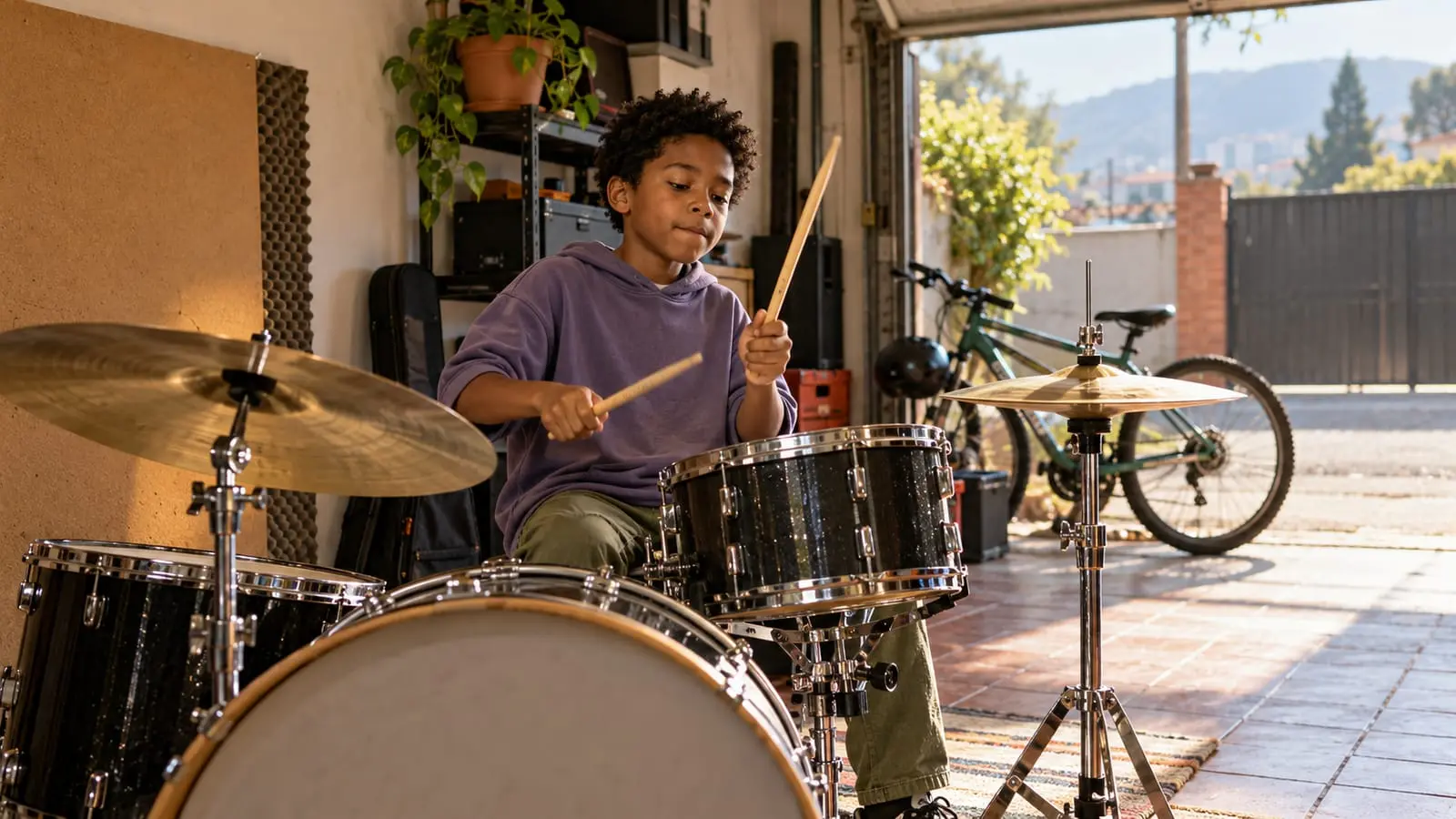
The first beat almost every drummer learns is basic rock: eighth notes on the hi-hat, snare on beats 2 and 4, and kick drum on 1 and 3. That framework leads to the ballad, disco, shuffle and, with a change of accents, a simple Latin beat such as cumbia.
Below, each one is broken down beat by beat in tables that are easy to read even if you cannot read sheet music yet. Play them slowly, use a metronome and count out loud.
In short
- Basic rock: eighth notes on the hi-hat, snare on 2 and 4, kick on 1 and 3. It is the foundation for the others.
- The ballad uses the same framework at a slow tempo, with a cross-stick on the snare and more space.
- Disco puts the kick on all four beats and opens the hi-hat on every “and.”
- The shuffle divides each beat into three and plays the first and third notes of the triplet.
- In cumbia, the cross-stick on the “and” plays a role similar to the llamador.
How to read the rhythm tables
Each column represents a beat of the measure and its subdivisions. For eighth-note beats, count “1 and 2 and 3 and 4 and”: the number falls on the beat and the “and” halfway between beats. Each row corresponds to a limb:
- Hi-hat: right hand (if you are right-handed), with the cymbals held closed by your left foot.
- Snare: left hand.
- Kick drum: right foot.
- Symbols: x = closed hi-hat, o = open hi-hat, ● = hit, · = rest.
If coordination is still difficult, build each beat one layer at a time, as we explain in how long it takes to learn drums. Before sitting down at the kit, warm up your hands with the basic rudiments.
Basic rock: the beat that opens every door
| 1 and | 2 and | 3 and | 4 and | |
|---|---|---|---|---|
| Hi-hat | x x | x x | x x | x x |
| Snare drum | · · | ● · | · · | ● · |
| Bass drum | ● · | · · | ● · | · · |
Notice that the hi-hat never stops: it sounds on every number and every “and.” The snare and kick always line up with a hi-hat hit, so the hands sometimes play together and sometimes separately, but the foot plays only on the numbers.
First variation
Add a kick on the “and” of 3: the pattern becomes “boom – cha – boom boom – cha.” This is the first time the foot plays between beats, and it almost always makes the hi-hat hand hesitate. If that happens, lower the tempo until the hand keeps ticking steadily.
Ballad: less volume, more control
| 1 and | 2 and | 3 and | 4 and | |
|---|---|---|---|---|
| Hi-hat (soft) | x x | x x | x x | x x |
| Snare (cross-stick) | · · | ● · | · · | ● · |
| Bass drum | ● · | · ● | ● · | · · |
The main change in a ballad is the sound. Instead of hitting the drumhead, lay the stick across the snare and strike the rim with its thick end: this is a cross-stick, a dry “tock” that does not overpower the voice. The kick adds a hit on the “and” of 2, pushing toward beat 3.
The challenge here is the slow tempo: at 60 BPM, there is plenty of space between hits, making it easy to rush. Count out loud and imagine each note lasting until the next.
Disco: kick drum on all four beats
| 1 and | 2 and | 3 and | 4 and | |
|---|---|---|---|---|
| Hi-hat | x o | x o | x o | x o |
| Snare drum | · · | ● · | · · | ● · |
| Bass drum | ● · | ● · | ● · | ● · |
This is the famous “four on the floor” of 1970s disco and much of today's dance pop. The trick is in your left foot: release the hi-hat pedal on every “and” so the cymbals sound open, then close them on the next number, together with the kick. This gives the hi-hat a “chick-tsss” sound on each beat. First practice with just your feet, without your hands, until the alternating motion feels automatic.
Shuffle: the lilt of the blues
| Beat 1 | Beat 2 | Beat 3 | Beat 4 | |
|---|---|---|---|---|
| Hi-hat or ride | x · x | x · x | x · x | x · x |
| Snare drum | · · · | ● · · | · · · | ● · · |
| Bass drum | ● · · | · · · | ● · · | · · · |
Here, the subdivision changes. Each beat is split into three equal parts, and the hand plays only the first and third: the result is an uneven “taa-ta, taa-ta,” typical of blues and 1950s rock and roll. Count “one-and-a, two-and-a” and play on “one” and “a.”
To feel it, set the metronome to triplet subdivisions and sing all three notes before playing two of them. The most common mistake is letting the shuffle “straighten out” into rock eighth notes.
A Latin beat to start with: cumbia on drums
| 1 and | 2 and | |
|---|---|---|
| Hi-hat | x x | x x |
| Snare (cross-stick) | · ● | · ● |
| Bass drum | ● · | ● · |
Cumbia is in duple meter and is written in 2/4 or cut time. This version adapts the roles of a traditional ensemble to the drum kit: the bass drum keeps the pulse, like the bass or tambora, and the cross-stick falls on every “and,” in a role similar to the llamador. Once the groove is steady, switch the hi-hat to soft sixteenth notes to imitate the guache or maracas.
This is an adaptation for drum kit; traditional cumbia drumming has its own technique and much greater richness. If that world interests you, read about Colombian rhythms and how the roles are shared in a traditional cumbia group.
How to practice them and in what order
| Rhythm | Time signature | Starting tempo | Where you hear it |
|---|---|---|---|
| Basic rock | 4/4 | 60–70 BPM | Rock and pop from every era |
| Ballad | 4/4 | 60 BPM | Pop ballads and Spanish-language ballads |
| Disco | 4/4 | 70–80 BPM | Disco and dance pop |
| Shuffle | 4/4 with triplets | 60 BPM | Blues, rock and roll, swing |
| Cumbia | 2/4 | 70 BPM | Cumbia and tropical music |
- Play each beat for four consecutive measures without stopping; if you stop, lower the tempo.
- Once you can play four clean measures, play for a full minute while counting out loud.
- Record a minute on your phone and listen to whether the kick and snare line up exactly with the hi-hat.
- Increase by 2 to 5 BPM per session, never in large jumps.
- Put on a song in that style and play along, even if you only play the beat without fills.
A teacher can correct your posture on the throne, hi-hat height and hand-foot independence early on. In percussion lessons, you can work on drums at home in Bogotá or online, as well as Latin and Colombian rhythms.
Frequently asked questions
What is the easiest drum beat?
Basic rock with eighth notes, because the hands and foot play in very predictable places and the kick never plays between beats. If that is still difficult, start with quarter notes on the hi-hat instead of eighth notes.
Which drum beats should I learn first?
Basic rock, its kick variations and then a ballad. Once those feel automatic, add disco, which trains your left foot, and shuffle, which makes you change the subdivision.
Why does my hi-hat hand stop when I play the kick?
Because your hands and feet have not developed independence yet, which is normal at first. Lower the tempo, play only hi-hat and kick until your hand stays steady, and count the eighth notes out loud.
Can I learn these beats on an electronic drum kit?
Yes. All the patterns work the same way, and an electronic kit lets you practice with headphones. What changes is the feel of the open hi-hat and cross-stick, which are worth checking on an acoustic kit from time to time.
Sources
We checked the facts in this article against these sources on October 22, 2026.