
Individual or group music lessons? How to decide
Private lessons move at your own pace; a small group adds motivation and ensemble listening. We help you choose, even for siblings in the same home.
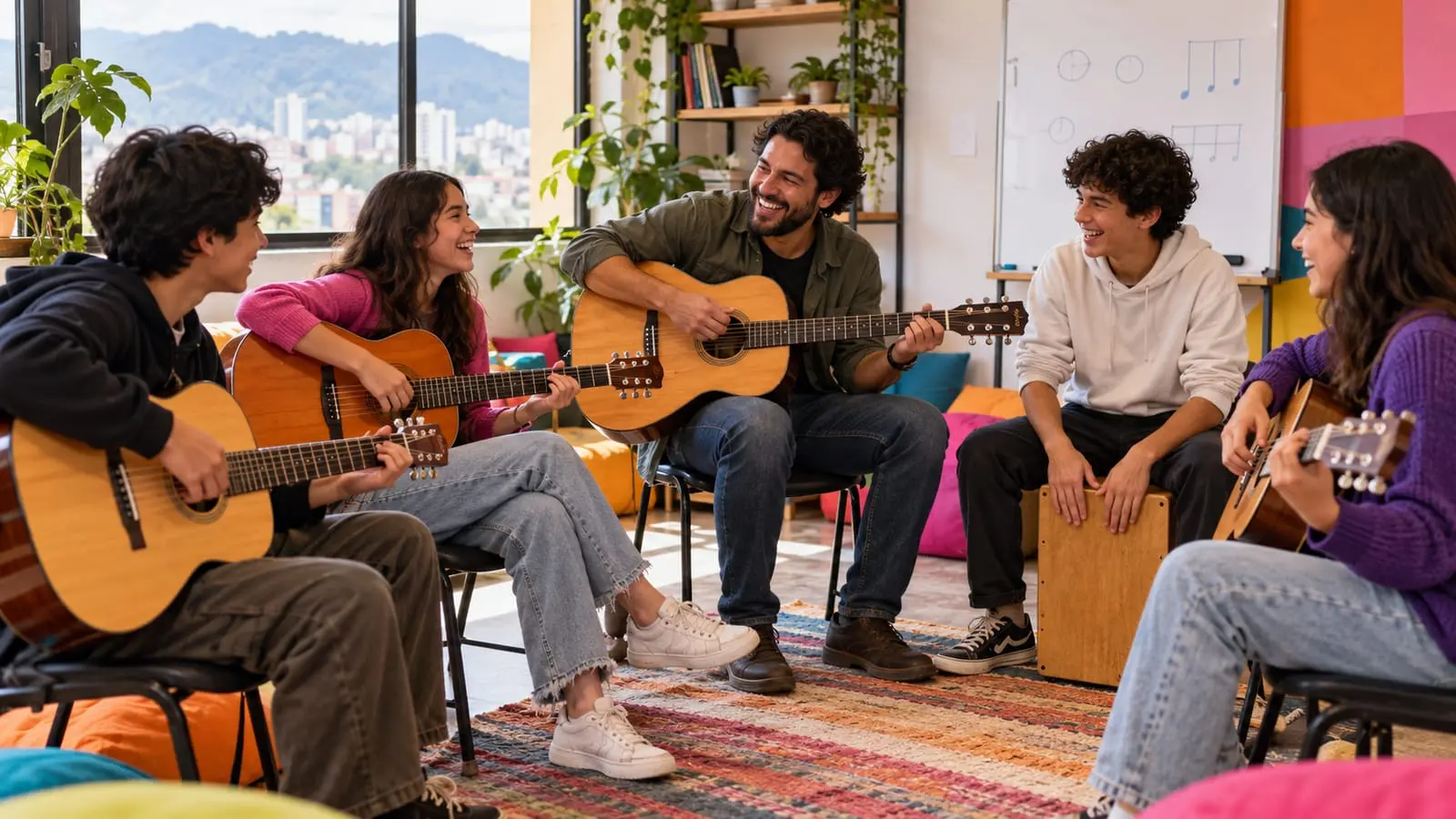
If you want to improve your technique quickly or work toward a specific goal, individual lessons are usually more productive: all the time is yours, and the teacher tailors every minute to your needs. Small groups work very well for introductory music, song accompaniment and singing, and add something individual lessons cannot offer: learning to listen to others and make music together.
The decision depends on age, instrument and goals, and sometimes on something as practical as having two siblings who want to learn in the same home.
In short
- Individual lessons are better for refining technique, pursuing specific goals and learning at your own pace.
- Small groups work well for introductory music, singing and rhythm guitar, as long as everyone is at a similar level.
- In a group, each student spends less time playing but gains ensemble listening skills, motivation and a sense of a shared beat.
- Siblings whose ages or skill levels differ widely usually progress better with individual lessons scheduled one after the other.
- Groups work better in person: you cannot play together in real time on a video call.
Individual lessons or a small group: a comparison
| Aspect | Individual lesson | Small group |
|---|---|---|
| Teacher's attention | All yours; the teacher corrects every detail. | Shared; the teacher takes turns working with each student. |
| Pace of progress | Adjusted to you, neither too fast nor too slow. | Adjusted to the group; someone may feel held back or rushed. |
| Technique and posture | Detailed, ongoing corrections. | More general feedback; individual details are left for practice at home. |
| Playing with others | Only if the teacher plays with you. | From day one: sharing a beat, listening to each other and coming in on time. |
| Motivation | Depends more on you and the repertoire. | The group encourages you and builds a sense of commitment to your fellow students. |
| Repertoire | Tailored to you. | Chosen together; it has to work for everyone. |
| Schedule | Easier to arrange and reschedule. | Several people or families need to coordinate. |
Neither option is better in every way. The difference is what you prioritize: individual depth or a shared experience.
If budget matters too, how much music lessons cost explains why the price per person usually drops in a group and what other factors affect the price.
When individual lessons make sense
- Instruments that require a lot of technique from the start, such as violin, cello or wind instruments, where posture and tone need constant correction during the first few months.
- Specific goals with a deadline: an audition, a university entrance exam or repertoire for an event.
- Students who need their own pace, whether they progress faster than average or need more time at each step.
- Adults who prefer privacy when making mistakes, especially in singing, where many beginners feel self-conscious at first.
- Changing schedules that would make coordinating with other people impossible.
When a small group works well
A small group is not a large class: it means a few students of similar ages and levels, with a teacher who can see and hear each one. It works especially well in the following situations.
Early music education
For children ages 3 to 6, lessons revolve around play, songs, movement and rhythm. Doing this with other children comes naturally: they imitate each other, take turns, listen to one another and enjoy singing games. Introductory music is probably where a group brings the most benefits.
Guitar for accompanying songs
When the goal is to play chords and strumming patterns while singing, a group of two or three people can progress very well: everyone practices the same chord changes, and playing together requires a steady beat. For picking, reading music or classical repertoire, individual guitar lessons are usually more productive.
Singing
Group singing develops something individual lessons do not teach: singing in tune with other voices, holding your part while someone sings a different one and blending your tone with everyone else's. Vocal technique—breathing, register and voice care—is still best developed individually, which is why many people combine singing lessons with a choir.
Friends or couples
Learning with someone close to you helps keep you motivated and turns practice into something you do together. It works if you are both similarly committed; if one person misses lessons often, the other ends up held back. Find more ideas in learning music as a family or a couple.
What if they are siblings?
This is one of families' most common questions. Sharing a lesson seems like the most practical choice, but it is not always the best one. It depends on the age gap, the instrument and each child's personality.
| Situation | What usually works best |
|---|---|
| Siblings ages 4 and 6, both taking introductory music lessons | Shared lesson: games and songs work well in pairs. |
| Siblings ages 8 and 12 playing different instruments | Back-to-back individual lessons, with the same teacher if they teach both instruments, or with different teachers. |
| Twins playing the same instrument at the same level | A shared lesson can work, as long as it does not turn into a competition. |
| One progresses much faster than the other | Separate the lessons before one becomes frustrated and the other bored. |
| One is shy and the other takes all the attention | Individual lessons, at least at first, so the quieter child has space of their own. |
A middle ground is to schedule individual lessons one after the other and occasionally spend a few minutes playing a song together. Each child can then progress at their own pace, while music becomes something they share at home. In-home lessons make this convenient, as the teacher can work with both children in one visit.
A teacher's tip: avoid comparisons. Saying “Look, your brother can already play that” is more discouraging than any technical difficulty.
How to put together a small group that works
- Look for similar skill levels. This matters most: a big gap frustrates some students and bores others.
- Consider age. With children, even a couple of years can make a big difference to attention and interests.
- Agree on a shared goal: playing songs, preparing a performance for the family or learning to read music.
- Decide what happens when someone is absent: whether the lesson goes ahead as planned or the content changes.
- Choose one person to coordinate schedules and messages with the teacher.
- Everyone practices on their own. Group lessons do not replace individual practice at home.
A note on online groups: signal delay prevents students from playing together on a video call, so lessons become a series of turns while everyone else waits. That is why groups work better at home in person, and individual lessons usually make more sense online. If you are choosing between formats, see in-home or online lessons.
Signs it may be time to change formats
- In the group, the same student always falls behind or ends up waiting for everyone else.
- Much of the lesson is spent organizing the group, leaving little time to play.
- A child feels pressured or loses motivation in individual lessons; a small group may help them enjoy music again.
- Someone who started in a group now has a specific goal, such as an audition or a recital.
Changing formats is not a step backward: it means adapting lessons to the student's stage of learning. Many students start in groups, move to individual lessons when they want to go deeper and play with others again in a choir, school band or ensemble.
Frequently asked questions
How many students should a small music group have?
Few enough for the teacher to see and hear each student in every lesson. For lessons at home, groups of two to four people are usually manageable; with more students, individual feedback becomes less thorough.
Does a child learn more in individual or group lessons?
It depends on age and goals. Groups usually add value in introductory music; when a child starts an instrument with demanding technique, individual lessons help build a stronger foundation.
Can two siblings take lessons with the same teacher?
Yes, if the teacher teaches the instruments each child wants to learn. They can share a lesson or have back-to-back individual lessons; it is best to decide with the teacher after they have met both children.
Which is better for learning to sing: individual lessons or a choir?
They complement each other. Individual lessons develop your technique, register and voice care; a choir teaches you to sing in tune with others and listen. Many people start with individual lessons and later join a choir as well.
Sources
We checked the facts in this article against these sources on October 22, 2026.