
Children's songs for learning to play an instrument
Twinkle, Twinkle, Little Star (Estrellita), Los pollitos dicen or Frère Jacques (Martinillo) are more than nursery songs: chosen well, they teach pulse, reading and technique on a first instrument.
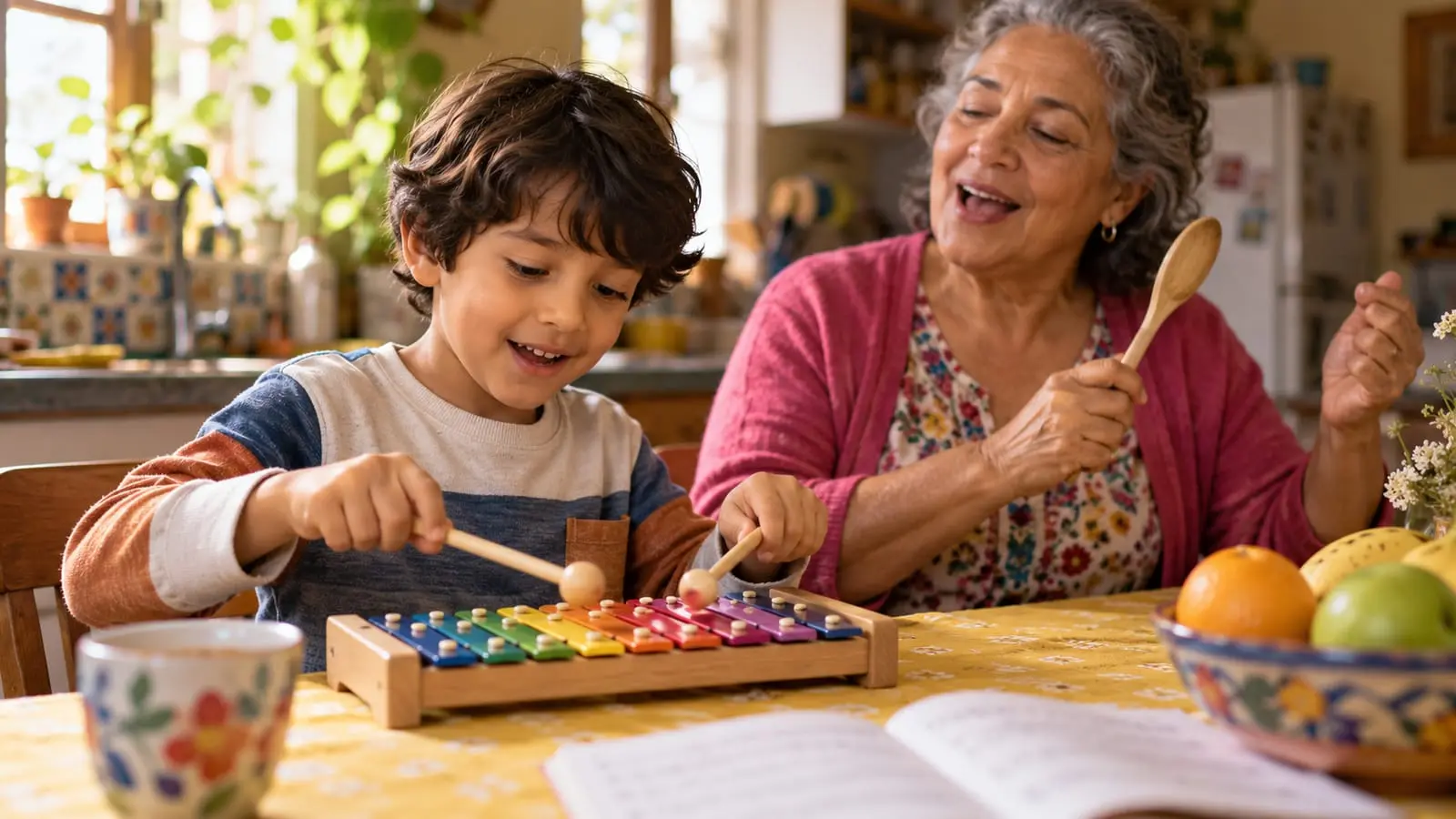
Traditional children's songs make the best first repertoire because children already know how they should sound: if a note goes wrong, they notice it themselves. Estrellita, Los pollitos dicen, Martinillo, Arroz con leche, and Cumpleaños feliz have short, repetitive, easy-to-recognize melodies, and each develops a different skill.
Here's which songs to learn on each instrument, what each one teaches, and how to get the most out of a single melody.
In short
- A familiar song acts like an internal tuner: children correct themselves because they know how it should sound.
- Estrellita is the classic starting song: the Suzuki violin method begins with variations on it, and Mozart wrote twelve piano variations on its melody.
- On recorder, the key matters: playing in G major avoids low C, one of the hardest notes for beginners.
- Martinillo can be accompanied with a single chord and sung as a round: perfect for making music as a family.
- You can sing, clap, play, read, and vary the same song; repeating it in different ways is progress too.
Why start with songs your child already knows
When children play an unfamiliar melody, they rely on the score or their teacher to know whether they're getting it right. With a song they've sung a thousand times, their ears become the teacher: they know when a note doesn't fit and try to correct it. That speeds up learning and gives them something invaluable at the start: the feeling of “I can do it now.”
These songs also have short phrases, plenty of repetition, and few notes. That's exactly what someone still learning where to place their fingers needs.
Children's songs and what each one teaches
| Song | Ideal instrument | What it teaches |
|---|---|---|
| Twinkle, Twinkle, Little Star | Violin, piano, recorder | Repeated notes, an opening leap of a fifth, and a clear three-part form (A-B-A). |
| Los pollitos dicen | Recorder, piano, voice | Short phrases repeated over a very steady pulse. |
| Martinillo (Fray Santiago) | Piano, guitar, voice | A round: the same melody begins at different times; it can be accompanied with a single chord. |
| Arroz con leche | Guitar, piano, voice | Accompanying with very few chords and changing them on time. |
| Cumpleaños feliz | Piano, recorder, violin | Triple meter, a pickup (the melody starts before the first beat), and an octave leap. |
| Mambrú se fue a la guerra | Recorder, piano | The swaying feel of 6/8 time. |
| Los elefantes | Voice, percussion, introductory music lessons | Counting and repeating with variations: the song grows with each repetition. |
| Oda a la alegría (Beethoven) | Piano, recorder | Neighboring notes and a fixed hand position; it isn't a children's song, but it's a first-year classic. |
The order matters less than matching the child's level: the teacher chooses a song based on the notes and rhythms the child already knows, then returns to it when it can teach something new.
On recorder
The recorder is often a child's first melodic instrument at school, and children's songs are its natural repertoire. Three tips from a teacher:
- Choose the key to suit the fingerings. Estrellita in C major requires low C, which means covering every hole without leaks; in G major, the melody uses notes that are much easier for beginners.
- Start with songs that use few notes. Many teachers begin with the first left-hand notes and find melodies that fit within them before adding the right hand.
- Blow gently and tongue each note. The repeated notes in Estrellita or Los pollitos dicen are a great articulation exercise: each starts with a gentle “tu”.
If you don't have a recorder yet or are unsure about Baroque versus German fingering, see how to choose a recorder. And if your child wants to go beyond school music, explore our recorder lessons.
On piano or keyboard
The piano has an advantage: children can see the notes arranged from low to high. Children's songs help them progress from playing with one finger to using the whole hand, in this order:
- One hand, five fingers. Oda a la alegría fits almost entirely in C position, with one finger per key from C to G, and teaches children to play without looking at their hands.
- Small stretches. Estrellita goes beyond that position when it reaches A: a first exercise in moving the hand without losing the pulse.
- A family round. Martinillo can be played as a round: the child starts, and an adult joins with the same melody a few measures later.
- The left hand. With Arroz con leche or Cumpleaños feliz, the left hand can play a single note for each chord on the first beat of each measure.
In children's piano lessons, these songs often go hand in hand with reading exercises from very early on: what children can already play by ear helps them understand what they see on the score.
On violin, guitar, and voice
Violin
Estrellita is the starting point for countless violinists: the Suzuki method begins with rhythmic variations on this melody. Each variation changes the bowing rhythm over the same notes, so the child focuses on the sound rather than remembering the melody.
Guitar
On guitar, children usually begin by accompanying songs rather than playing melodies. Martinillo is perfect because a single chord supports it: the child strums while the family sings, and the chord still works when the voices enter as a round. Then come two- or three-chord songs, such as Arroz con leche, to practice the first chord changes.
Voice and introductory music lessons
Before the instrument comes the voice. In introductory music lessons, circle-game songs such as Arroz con leche or El patio de mi casa are sung, danced, and clapped. Singing a melody in tune is the first step toward playing it.
One song, many ways to learn
A teacher rarely “finishes” a song and moves straight on to another. The same melody can be useful for weeks if you change how you work on it:
- Sing it using note names.
- Clap the rhythm without the melody, or use body percussion.
- Play it phrase by phrase, slowly at first.
- Read it from the score once the child starts reading music, connecting what they hear with what they see.
- Vary it: change the rhythm, play it louder or softer, or move it to another key.
- Play it with others, as a round or with an adult accompanying.
The idea of variations isn't new: Mozart wrote twelve piano variations on the French melody we know as Estrellita. If your child already plays the simple version, listening to those variations together is a lovely way to show how far a simple song can go. For more ways to play with these songs' rhythms at home, see musical games for children.
Common mistakes when choosing and practicing songs
- Moving on to the next song before the first one flows smoothly.
- Insisting on “baby songs” with a 9- or 10-year-old who no longer relates to them; at that age, mix them with music the child enjoys.
- Keeping the songbook's key even when it doesn't suit the instrument or voice.
- Correcting every note as the child plays, instead of letting them finish the phrase and commenting afterward.
- Always learning by ear without ever looking at the score, or the reverse: the two approaches reinforce each other.
Frequently asked questions
What's the first song you learn on recorder?
It depends on the method and teacher, but it's usually a melody of three to five notes played with the left hand. Estrellita and Los pollitos dicen appear very early because children already know them.
Why do violin teachers start with Estrellita?
Because its notes sit comfortably on the first strings children learn, and the melody is so familiar that they can focus on the bow and the sound. The Suzuki method also uses rhythmic variations that prepare their bowing technique.
Is it better to learn children's songs or the songs my child likes?
Both. Children's songs are useful in the first weeks because they're simple; as soon as the child progresses, adding a song they enjoy keeps them motivated. A good teacher combines both and adapts the child's requested song to their level.
At what age can a child play songs on an instrument?
With voice and percussion, from a very young age. Playing melodies on recorder or piano is usually possible between ages 5 and 7, depending on each child's motor skills and attention span.
Sources
We checked the facts in this article against these sources on October 22, 2026.