
How to choose a recorder: Baroque or German fingering, soprano or alto
They all look the same, but fingering system, size and material change how they sound and how easy they are to learn on. What to ask the school before you buy.
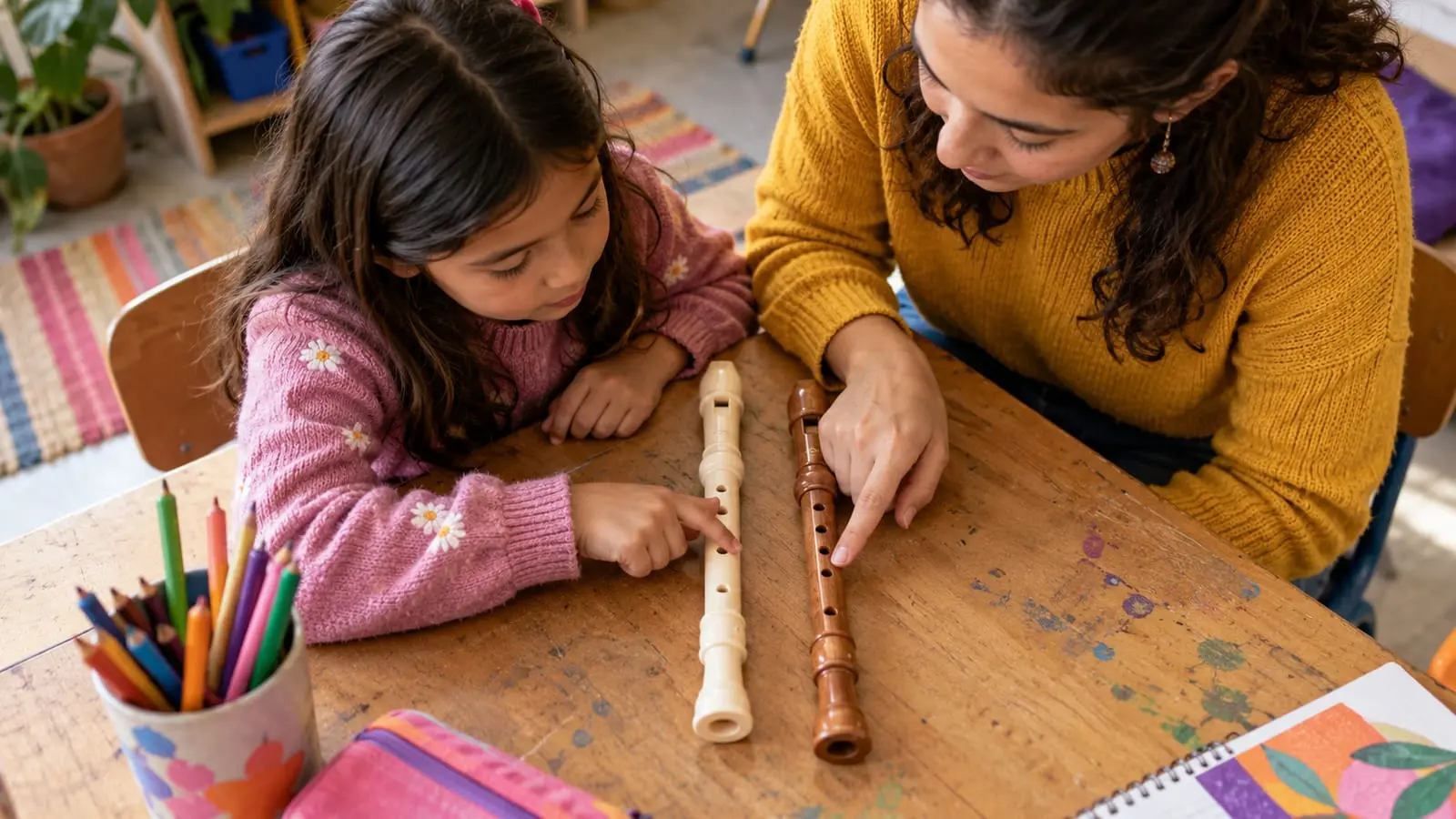
If the recorder is for school, buy the type the music teacher requests: almost always a plastic soprano in C, with the fingering system (Baroque or German) used in their method. For learning on your own or with a teacher, the most common recommendation is a good-quality plastic soprano or alto with Baroque fingering.
Recorders look almost identical, but fingering, size, and material affect their sound, intonation, and how easy they are to learn. Here is a straightforward explanation.
In short
- Before buying for school, ask which fingering system they use: Baroque and German do not mix well in the same class.
- Baroque fingering gives better intonation on sharps and flats and is the standard for serious study.
- The soprano is the school recorder; the alto has a lower, warmer sound and is popular with teenagers and adults.
- A good-quality plastic recorder sounds good, is easy to wash, and handles any climate; a wooden one needs breaking in and careful maintenance.
- Each child should have their own recorder, labeled with their name.
Baroque or German fingering: the most important choice
The difference lies in the size of some holes and, above all, in how you play F. On a German recorder, F uses a simple fingering that seems easier at first. The trade-off is that other notes, such as F sharp, are out of tune or require awkward fingerings.
| Baroque | German | |
|---|---|---|
| F note | Forked fingering: lift one finger while covering the holes below it | Straightforward, simpler fingering |
| Sharps and flats | Good intonation throughout the range | F sharp and other notes are out of tune or awkward to play |
| Methods and repertoire | Standard in formal teaching and early music | Some introductory school methods |
| When to choose it | For ongoing study or lessons with a teacher | If required by the school or method |
How can you tell which type it is? Many recorders have a mark near the holes or on the packaging, with words such as “Baroque” or “German,” or a B or G. If it is not stated, ask before paying: they are easy to confuse at a glance.
A practical detail: if your child has a Baroque recorder and the rest of the class uses German ones, or vice versa, they will need to play F differently from their classmates. That is why you should ask first.
Soprano, alto, or tenor
| Flute | Tuning | Size and hand reach | Who it is for |
|---|---|---|---|
| Soprano | C | Small, with closely spaced holes | Children and schools; most players’ first recorder |
| Alto recorder | F | Longer, with wider finger spacing | Teenagers and adults; Baroque repertoire and ensembles |
| Tenor | C, one octave below the soprano | Large; usually has keys for low notes | Recorder ensembles; rarely a first instrument |
| Sopranino and bass | F | Very small or very large | Ensemble playing later on |
Soprano and tenor share fingerings, as do alto and sopranino. Because the alto is in F, the same finger position produces a different note: switching from soprano to alto means relearning note names, even though the technique is the same. That is why some adults start directly on alto, while children almost always start on soprano.
Plastic or wood
| Plastic (resin) | Wood | |
|---|---|---|
| Sound | Clear and stable; good-quality models sound very good | Warmer, with more tonal nuance |
| Hygiene | Wash with lukewarm water and mild soap | Do not wash with water |
| Climate | Unaffected by Bogotá’s cold or the humidity of hot lowland areas | Sensitive to humidity and temperature changes; may crack |
| Maintenance | Minimal | Break in with short sessions at first; oil as appropriate for the wood |
| Who it is for | Children, school use, and most beginners | Experienced students or adults who will care for it |
A good-quality plastic recorder is not a toy: advanced students often own one for practice or to take anywhere. Avoid very lightweight recorders made of thin plastic and sold as toys: they often play out of tune and are difficult to blow.
What to ask the school and how to make a good purchase
- Ask the music teacher which recorder the class uses: soprano or alto, Baroque or German.
- Choose a three-piece recorder: you can rotate the foot joint so your right little finger comfortably reaches the last hole.
- Check that it comes with a bag, cleaning rod, and, if possible, some joint grease.
- Label the recorder and its bag with the child’s name. In a room full of identical recorders, mix-ups happen.
- Buy one for each child. Sharing a recorder between siblings or classmates is unhygienic; if there is no alternative, wash it between uses.
To wash and store it properly, follow how to clean a recorder.
How to test a recorder before buying
If you cannot play yet, ask someone who can or your teacher to help. These checks take a couple of minutes:
- Low note: cover every hole and blow very gently. On a soprano, you should get a clear C without squeaking or cutting out. This note is the clearest test of a poor-quality or leaking recorder.
- High notes: with the thumb hole partly open, try the upper notes. They should sound without forceful blowing.
- Labium: look at the window, the opening below the mouthpiece. The edge should be clean, without burrs or dents; a small flaw there spoils the sound.
- Joints: the pieces should fit securely, without wobbling or requiring force.
- Holes: run a finger over them: the edges should be smooth, without leftover plastic.
- Intonation: with a tuner, such as our online tuner, check that low C, G, and high C are reasonably in tune with one another.
If you are an adult or want to keep playing after school
The recorder is more than a school instrument. It has a vast repertoire, especially from the Renaissance and Baroque periods, and is comfortable for adults and older adults: it is light, requires little strength, and can be played sitting down.
- If you have never played, start with a good-quality plastic soprano or alto with Baroque fingering.
- If early music or ensemble playing appeals to you, the alto is often the starting point.
- Once you play regularly, you can consider a wooden recorder; ask for advice on wood types and breaking it in.
With a recorder teacher, you progress much faster in breathing, articulation, and reading—the skills that turn blowing notes into making music.
Frequently asked questions
Which recorder do schools usually request?
The most common choice is a plastic soprano in C. Fingering depends on the teacher’s method, so confirm it before buying to avoid ending up with a different recorder from the rest of the class.
At what age can you start playing recorder?
Many children start in the early years of elementary school, around age 6 or 7 depending on the child, when their fingers can fully cover the holes on a soprano recorder. It is good preparation for other wind instruments. Learn more about this stage in music lessons for children ages 6 to 8.
Why does the recorder squeak?
It is almost always too much air, fingers not fully covering the holes, or a misplaced thumb. Blow as if gently saying “du,” and make sure the pads of your fingers, rather than the tips, cover each hole. If it still squeaks with gentle blowing and properly covered holes, the labium may be defective.
How can I tell whether an unmarked recorder is Baroque or German?
Play F with the simple fingering: thumb, all three left-hand fingers, and the right index finger. If it is in tune, the recorder is probably German; if it is sharp and only plays in tune with forked fingering, it is Baroque. A tuner will confirm it.
Sources
We checked the facts in this article against these sources on October 22, 2026.
- Yamaha Music: recorders, Baroque versus German fingering
- Wikipedia: recorder (fingerings, sizes in C and F, materials)
- Moeck: school recorders with Baroque and German fingering
- Moeck: frequently asked questions (wood and plastic in recorders)
- Yamaha Music: the woodwind family (recorder, materials, and sizes)