
Guitar or tiple? Which to learn first
The tiple is tuned like the first four strings of the guitar, but it sounds and plays differently. We help you choose and map out your path.
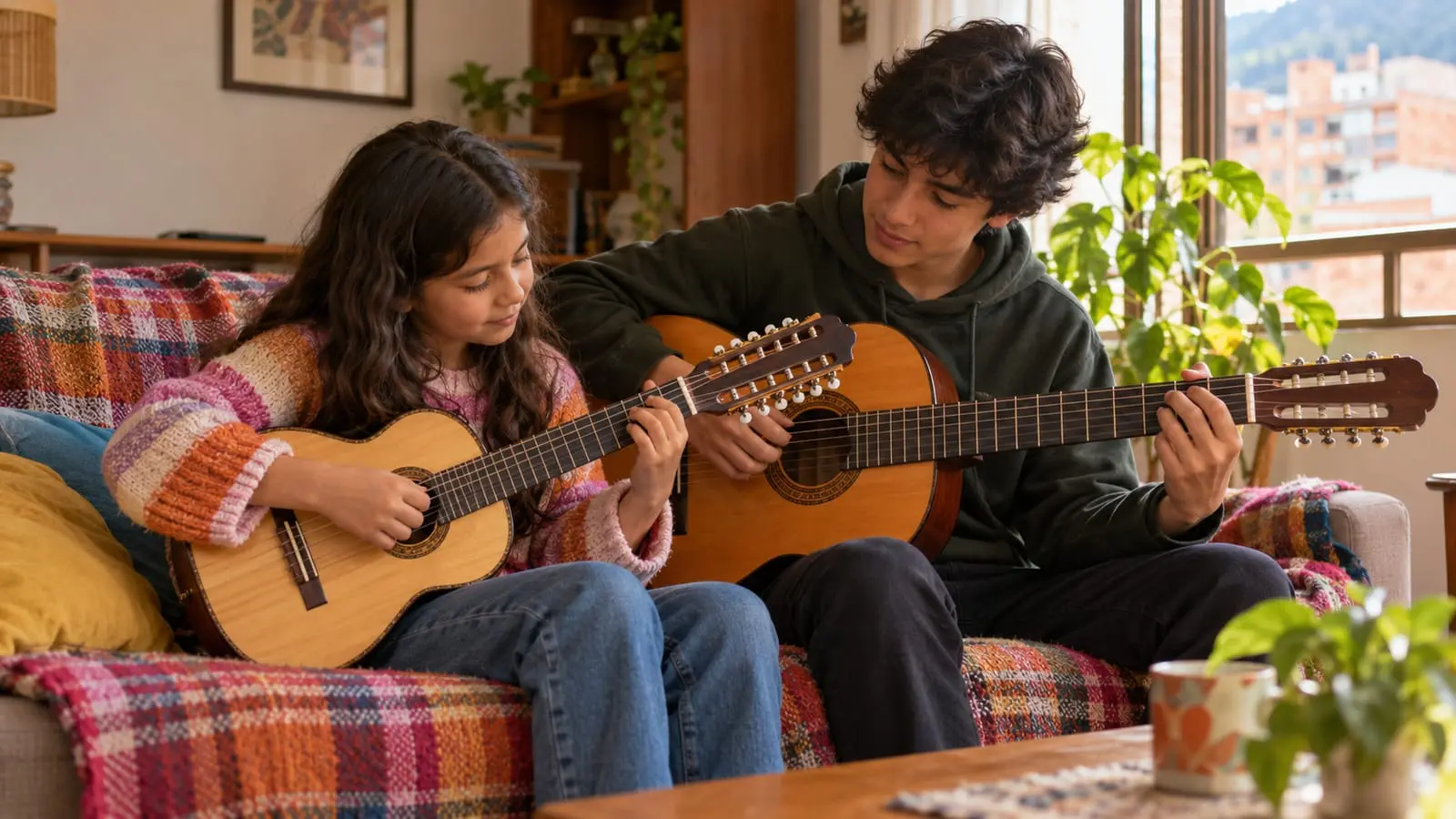
It depends on the music you want to play. If your goal is Colombian Andean music, with its bambucos, pasillos, torbellinos, and guabinas, you can start directly on tiple. If you want to play everything from bolero to pop and build a broad foundation, start on guitar: tiple will come easily later.
The two instruments are related. Tiple is tuned to the same notes as the guitar's four highest strings, so many chord shapes transfer from one to the other. What changes is the feel of its twelve metal strings, its bright sound, and its role in the music.
In short
- Tiple has twelve metal strings arranged in four courses of three, tuned D, G, B, E.
- These are the same notes as the guitar's four highest strings, which is why the instruments share many chords.
- Guitar opens the door to almost every genre; tiple provides rhythm and harmony in Colombian Andean music.
- Tiple requires more finger strength at first; nylon-string guitar is gentler for beginners.
- Both paths work: guitar followed by tiple, starting directly on tiple if Andean music is your goal, or playing both later on.
Guitar vs. tiple: a comparison
| Aspect | Guitar | Tiple |
|---|---|---|
| Strings | Six, either nylon (classical) or metal. | Twelve metal strings in four courses of three. |
| Tuning | E, A, D, G, B, E. | D, G, B, E: the notes of the guitar's four highest strings. |
| Feel | Nylon: gentle on fingertips. | Metal and triple strings: more pressure, with calluses forming sooner. |
| Sound | Full sound, with deep bass notes. | Bright and metallic, with a strong presence when strummed. |
| Role in the Andean trio | Bass lines, known as bordones, and harmony. | Harmony and rhythm; can also play melodies. |
| Music | Almost every genre, including Colombian music. | Mainly Colombian Andean music, and increasingly fusion music. |
| Learning resources | Plentiful: method books and songs of every kind. | Less plentiful; teachers and oral tradition play a major role. |
| Tune | Six strings. | Twelve strings: requires more time and patience. |
| Suggested starting age | From ages 6 or 7, with a small nylon-string guitar. | Around age 8. |
Tuning: the bridge between the two
Each tiple course has three strings tuned to the same note. In the highest course, all three sound in unison; in the lower courses, the middle string is wound and sounds an octave below the other two, creating a sound that is both full and bright. For step-by-step instructions, see how to tune a tiple.
For a guitarist, this has a huge practical benefit: the D major shape you play on the guitar's four highest strings is also D major on tiple. Other guitar chords that use all six strings, such as G or E, are adapted to four courses. Strumming does not transfer in the same way: the tiple player's right hand uses strokes, muted strums, and accents specific to each Andean rhythm.
Andean music or music from around the world
Guitar is a passport: you can use it for bolero, ballads, rock, bossa nova, classical music, and Colombian music too. In the Andean trio, alongside bandola and tiple, guitar plays the bordones, bass lines that move between chords.
Tiple is the rhythmic heart of that same trio. Its strumming distinguishes a bambuco from a pasillo or torbellino, and in skilled hands it sings melodies too. Playing tiple means joining a tradition with its own repertoire, forms, and playing styles. If that music speaks to you, start with our guide to Colombian Andean music.
Learning path: three possible routes
- Guitar first, then tiple. The most common route. You build a foundation in chords, rhythm, and reading music on an instrument that is gentler on your fingers, then add tiple after a few months, using the shapes you already know.
- Start directly on tiple. This makes perfect sense if your goal is Andean music, your family has a tiple-playing tradition, or you plan to join an estudiantina or school ensemble. The first few months demand more of your fingers, but motivation makes up for it.
- Learn both in parallel. Not ideal when starting from scratch. It works better once you have an established routine on one instrument.
Whatever path you choose, you can later add the Andean bandola, which completes the trio by carrying the melody.
Choose guitar if… / choose tiple if…
Choose guitar if…
- You want to play many genres, including Colombian music.
- It is for a child aged 6 or 7 whose fingertips are still sensitive.
- You would like to sing and accompany yourself in all kinds of songs.
- You want to make use of the many method books and resources available.
Choose tiple if…
- Bambuco, pasillo, torbellino, or guabina excite you.
- You want to play in an estudiantina, a trio, or an Andean ensemble.
- You are drawn to a bright sound and an instrument with a Colombian identity.
- You already play guitar and want a new tone color.
Explore the approach in our tiple lessons and acoustic guitar lessons; in both, your teacher adapts the repertoire to your goal.
Moving from guitar to tiple (and back)
- From guitar to tiple: spend the first few weeks building finger strength in short sessions, learn to tune all twelve strings patiently, and work on bambuco and pasillo strumming patterns separately, slowly and with clear accents.
- From tiple to guitar: add two low strings and learn to play bordones; the nylon strings will feel soft and the neck wider.
Playing both helps you understand Andean music better because you know what each instrument does in the trio.
If you already play guitar and wonder how much time you'll save, read how long it takes to learn the tiple.
Frequently asked questions
Which is harder, tiple or guitar?
At first, tiple, because its twelve metal strings require more finger strength and its strumming has many nuances. Over time, difficulty depends more on the repertoire than the instrument.
Can I play tiple using guitar chords?
Many of them, yes. Since tiple is tuned like the guitar's four highest strings, shapes using those strings work the same way. Shapes requiring the guitar's bass strings need adapting.
Is tiple only for Andean music?
That is its home, but not its limit. Today you hear it in jazz, pop, and other fusions, and in arrangements of songs from many genres.
At what age can a child start tiple?
As a guideline, around age 8, when fingers are strong enough to fret metal strings. Before that, a small nylon-string guitar provides excellent preparation.
Sources
We checked the facts in this article against these sources on October 22, 2026.