
Easy guitar songs based on how many chords you know
Two to four chords: a list of well-known songs, Latin and Colombian ones included, with the progression that repeats and what you practice with each one.
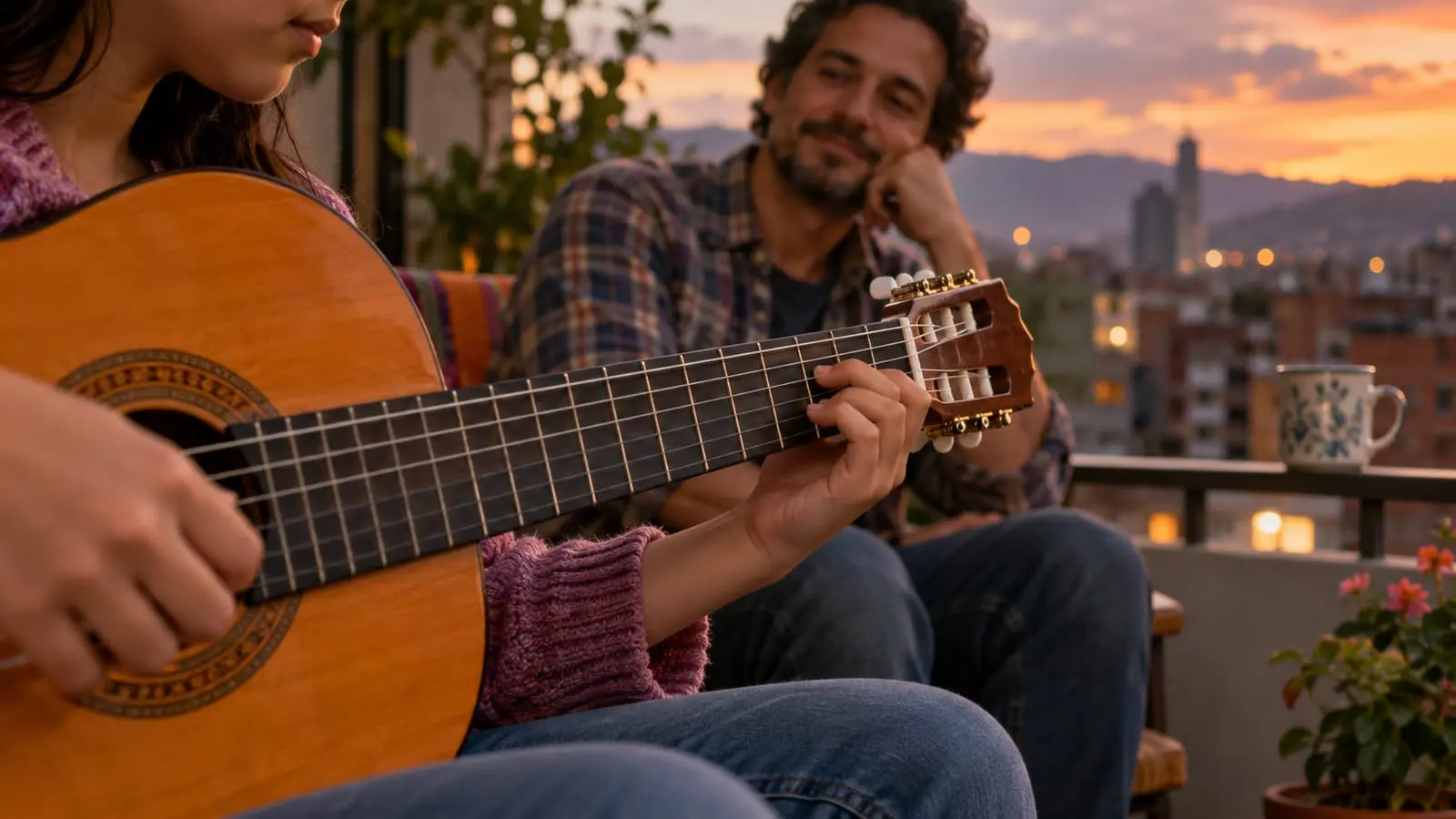
The easiest songs to start with on guitar repeat two, three, or four open chords: “Oye como va” uses two, “La Bamba” and “Guantanamera” use three, and “Let It Be” and “Los caminos de la vida” use four. The number of chords is only part of what makes them easy: slow changes, a repeating strumming pattern, and knowing the tune by ear all help too.
Below, the songs are grouped by number of chords, with the artist or songwriter, the repeating progression, and what you practice with each one. We haven't included lyrics; the progressions use the most common, comfortable chord shapes, and we indicate the capo position when the recording is in a different key. If you're still getting comfortable with open chords, start with basic guitar chords.
In short
- A song is easy when it has few open chords, slow changes, and a repeating strumming pattern.
- With G, D, Em, and C, you can play dozens of songs, because many share the same progression.
- A capo lets you play in the recording's key without changing your chord shapes.
- Learn the chord changes first without a strumming pattern, then add a simple pattern, and finally the one from the recording.
- F comes up early: use the simplified version while you work on barre chords.
- Traditional Spanish-language songs such as “Los pollitos dicen”, “De colores”, or “Cielito lindo” can be played with two or three chords.
What makes a guitar song easy
- Few chords, all open. No barre chords, or just one difficult chord you can simplify.
- Slow changes. One chord per measure, or even every two measures. Two changes per measure are already more demanding.
- A repeating progression. If the verse and chorus use the same chords, you learn them once and can play the whole song.
- A moderate tempo. Very fast songs can throw off your chord changes; very slow ones reveal every mistake.
- A tune you know by ear. If you can hum it, you know when the chord changes even without counting.
- A key you can sing in. If it doesn't suit your voice, try a capo or a different key before giving up.
Songs with 2 chords
Songs with 2 chords almost always alternate between the tonic and dominant, for example C and G7. They are perfect for your first few weeks: you only practice one chord change and can focus on keeping your strumming going.
| Song | Artist or origin | Chords | Key or capo |
|---|---|---|---|
| “Los pollitos dicen” | Traditional children's song | C – G7 | C major, no capo |
| “Arroz con leche” | Traditional children's song | C – G7 | C major, no capo |
| “La cucaracha” | Traditional Mexican | C – G7 | C major, no capo |
| “La pollera colorá” | Juan Madera and Wilson Choperena | G – D7 | G major; the key varies by version |
| “Oye como va” | Tito Puente; made famous by Santana's version | Am – D | A minor, no capo (Am7 and D9 in the recording) |
| “Eleanor Rigby” | The Beatles | Em – C | E minor, no capo |
Songs with 3 chords
With 3 chords, you can play most traditional songs: the I – IV – V7 progression (in C: C, F, and G7; in G: G, C, and D7) underpins “De colores”, “Cielito lindo”, and “Las mañanitas”. If you haven't learned F yet, play those same songs in G.
| Song | Artist or origin | Chords | Key or capo |
|---|---|---|---|
| “De colores” | Traditional song | G – C – D7 | G major (in C: C – F – G7) |
| “Cielito lindo” | Traditional Mexican song | C – F – G7 | C major, basic version |
| “Las mañanitas” | Traditional Mexican song | C – F – G7 | C major, basic version; 3/4 time signature |
| “Estrellita, ¿dónde estás?” | Traditional melody | C – F – G7 | C major, no capo |
| “La Bamba” | Traditional Mexican song, popularized by Ritchie Valens | C – F – G | C major; or G – C – D if you haven't mastered F yet |
| “Guantanamera” | Joseíto Fernández, with verses by José Martí | G – C – D | G major, no capo |
| “Feliz cumpleaños” | A familiar tune | G – D7 – C | G major; 3/4 time |
| “Riptide” | Vance Joy | Am – G – C | A minor; the recording uses a capo on fret 1 |
Songs with 4 chords
With 4 chords, you can already play a large part of pop music, because most hits repeat one of two or three progressions. G, Em, C, and D (or C, G, Am, and F) open the door to dozens of songs.
| Song | Artist or origin | Chords | Key or capo |
|---|---|---|---|
| “Let It Be” | The Beatles | C – G – Am – F | C major, no capo |
| “Los caminos de la vida” | Omar Geles; made famous by Los Diablitos | G – Em – D – C | G major |
| “Zombie” | The Cranberries | Em – C – G – D | E minor, no capo |
| “Stand by Me” | Ben E. King | G – Em – C – D | G major (the original recording is higher, in A major) |
| “Perfect” | Ed Sheeran | G – Em – C – D | Capo at the 1st fret |
| “Despacito” | Luis Fonsi and Daddy Yankee | Em – C – G – D | Capo at the 7th fret |
Easy Spanish-language guitar songs
The easiest Spanish-language guitar songs are traditional songs and children's songs: “Los pollitos dicen” and “La cucaracha” with two chords, and “De colores”, “Cielito lindo”, “Las mañanitas”, or “Guantanamera” with three.
- With two chords: “Los pollitos dicen”, “Arroz con leche”, “La cucaracha”, and “La pollera colorá”.
- With three chords: “De colores”, “Cielito lindo”, “Las mañanitas”, “La Bamba”, and “Guantanamera”.
- With four chords: “Los caminos de la vida” and “Despacito” with a capo.
These are basic progressions: the recording you listen to may add passing chords or seventh chords. Learn the simple version first, then listen for what else the guitar does in the recording.
Songs with two and three chords
If you don't know the chords yet, review them with diagrams and sound in the dictionary: G major, D major, E minor, C major and A minor.
| Song | Artist or songwriter | Chords | What you practice |
|---|---|---|---|
| “Oye como va” | Tito Puente; made famous by Santana's version | Am – D (Am7 and D9 in the recording) | A single chord change over a cha-cha rhythm |
| “La pollera colorá” | Juan Madera and Wilson Choperena | G – D7 (the key varies by version) | Cumbia: tonic and dominant, emphasizing the offbeat |
| “Eleanor Rigby” | The Beatles | Em – C | A minor key and even eighth notes |
| Song | Artist or songwriter | Chords | What you practice |
|---|---|---|---|
| “La Bamba” | Traditional Mexican song, popularized by Ritchie Valens | C – F – G (or G – C – D if you haven't learned F yet) | Quick changes and energetic strumming |
| “Guantanamera” | Joseíto Fernández, with verses by José Martí | G – C – D | The I–IV–V progression, the foundation of thousands of songs |
| “Sweet Home Alabama” | Lynyrd Skynyrd | D – C – G | Laid-back rock; with C add9 (x-3-2-0-3-3), your ring finger stays on the 2nd string |
| “Three Little Birds” | Bob Marley | A – D – E | The short reggae strum on beats 2 and 4 |
| “Riptide” | Vance Joy | Am – G – C | Nimble chord changes with lively strumming |
| “La camisa negra” | Juanes | Em – B7 – Am (capo on fret 2 to match the recording) | Your first seventh chord: B7 (x-2-1-2-0-2) |
| “Feliz cumpleaños” | A familiar tune | G – D7 – C | Waltz rhythm in 3/4 |
If a two-chord song feels “too simple,” remember that the challenge is different: keeping a steady rhythm without speeding up. It's the ideal place to try out basic strumming patterns, from quarter notes to the pop pattern.
Accompanying songs from the very first weeks is one of the benefits of learning guitar, along with how easy it is to take it everywhere and play with others.
Songs with four chords
| Song | Artist or songwriter | Chords | What you practice |
|---|---|---|---|
| “Let It Be” | The Beatles | C – G – Am – F | Your first F chord, simplified or barred |
| “No Woman, No Cry” | Bob Marley | C – G – Am – F | The same progression with a reggae feel |
| “Knockin’ on Heaven’s Door” | Bob Dylan | G – D – Am / G – D – C | A slow ballad and clean chord changes |
| “Zombie” | The Cranberries | Em – C – G – D | Strong strumming and contrast between sections |
| “Los caminos de la vida” | Omar Geles; made famous by Los Diablitos | G – Em – D – C | Vallenato on guitar and well-paced chord changes |
| “Stand by Me” | Ben E. King | G – Em – C – D (in the original key: A – F♯m – D – E) | The I–vi–IV–V progression |
| “Perfect” | Ed Sheeran | G – Em – C – D (capo on fret 1) | A gentle ballad, ideal for arpeggios |
| “Despacito” | Luis Fonsi and Daddy Yankee | Em – C – G – D with a capo on fret 7 (in the original key: Bm – G – D – A) | Latin pop strumming and using a capo |
“Let It Be” introduces F. While you develop your full barre chord, use the four-string version: index finger on the 1st and 2nd strings at fret 1, finger 2 on the 3rd string at fret 2, and finger 3 on the 4th string at fret 3. When you're ready to take the next step, follow our guide to playing barre chords.
Once you can play barre chords
- “Chan chan” (Compay Segundo): Dm – F – G – A7, repeated throughout the song. A barre F chord in a relaxed Cuban son.
- “Colombia tierra querida” (Lucho Bermúdez): it's in a minor key and calls for several barre chords, such as Gm, Cm, and E♭. A good challenge once your barre chord changes feel smooth.
One progression, many songs
Did you notice that several songs on the list use the same chords in a different order? That's no coincidence. Musicians number the chords in a key using Roman numerals (I, IV, V…), and a few combinations appear again and again. Once you recognize the progression, learning a new song comes down to listening for the order of the chords.
| Progression | In G | In C | Songs on this list |
|---|---|---|---|
| I – IV – V | G – C – D | C – F – G | “La Bamba”, “Guantanamera” |
| I – V – vi – IV | G – D – Em – C | C – G – Am – F | “Let It Be”, “No Woman, No Cry” |
| vi – IV – I – V | Em – C – G – D | Am – F – C – G | “Zombie”, “Despacito” |
| I – vi – IV – V | G – Em – C – D | C – Am – F – G | “Stand by Me”, “Perfect” |
| I – vi – V – IV | G – Em – D – C | C – Am – G – F | “Los caminos de la vida” |
Here's an exercise many teachers recommend: take the I – V – vi – IV progression in G, add the pop strumming pattern, and try singing different songs you know over it. You'll discover how many fit.
Colombian and Latin music: where to start
Traditional cumbia is a great starting point because many songs, such as “La pollera colorá”, can be accompanied with two chords: tonic and dominant. The challenge is in your right hand rather than your left: emphasizing the offbeat, which the llamador plays in a traditional group. In vallenato, songs like “Los caminos de la vida” use three or four chords over a lively duple pulse.
Bambucos and pasillos are a different story: their harmony usually has more chords, with passing dominant chords and key changes, and their rhythms call for a distinctive accompaniment. If they appeal to you, explore our selection of Colombian songs for tiple or guitar, organized by difficulty.
And if December is around the corner, easy Christmas carols to learn suggests a key, chords and strumming pattern for each one.
How to learn a song in a week
- Listen while counting. Work out whether the beats fall in groups of three (3/4) or four (4/4), and where the chords change.
- Learn the changes without a strumming pattern. Play one strum per chord along with the song until your left hand arrives on time.
- Add a simple strumming pattern. Four downstrokes per measure, with the metronome slower than the recording.
- Play it in sections. Start with the chorus, usually the most recognizable part, then learn the verses.
- Increase the tempo and add a more complex strumming pattern only when you can do everything above without stopping.
- Sing or hum along. It's the final test: if you can sing while playing, your right hand is working on its own.
A tip for choosing a key: a capo shortens the strings and raises all their pitches equally. If a song is too low for your voice, try a capo on fret 2 or 3 with the same chord shapes. If you'd like help choosing repertoire that suits you, an acoustic guitar teacher can put together a list based on your tastes and level.
Frequently asked questions
What's the easiest song to learn on guitar?
A two-chord song you know well, such as “Oye como va” (Am and D), or a cumbia using tonic and dominant. If you'd rather start with three, “Guantanamera” (G, C, and D) is a classic in early lessons.
What if a song has a chord I don't know?
Look for a simplified version: four-string F, Fmaj7 (x-x-3-2-1-0) instead of F in some ballads, or a capo position that puts the song in a key with open chords. Many songs with Bm, for example, can be played with a capo and easier shapes.
What is a capo for?
It changes the key without changing your chord shapes. If you put a capo on fret 2 and play an Em shape, it sounds as F♯m. You can use it to match the recording or fit the song to your voice.
Where can I find lyrics with chords?
Songbooks and chord websites have versions of almost everything, but many contain mistakes. Always compare them with the recording and trust your ears: if a chord sounds odd, it's probably written incorrectly.
Sources
We checked the facts in this article against these sources on October 22, 2026.
- D'Addario: how to use a capo on the guitar
- Hooktheory: key and chord progression of «Despacito» (Luis Fonsi)
- OnCuba News: Joseíto Fernández and the authorship of «Guantanamera»
- Wikipedia: «Oye cómo va», by Tito Puente, and Santana's version
- Musictonic: «Riptide» by Vance Joy, key, chords, and capo
- La Cuerda: chords for «Chan Chan» (Compay Segundo)