
New or used instrument? What to check before you buy
A used instrument can be a great buy if you know what to look for. Here's a checklist for each instrument family and the signs that should make you wary.
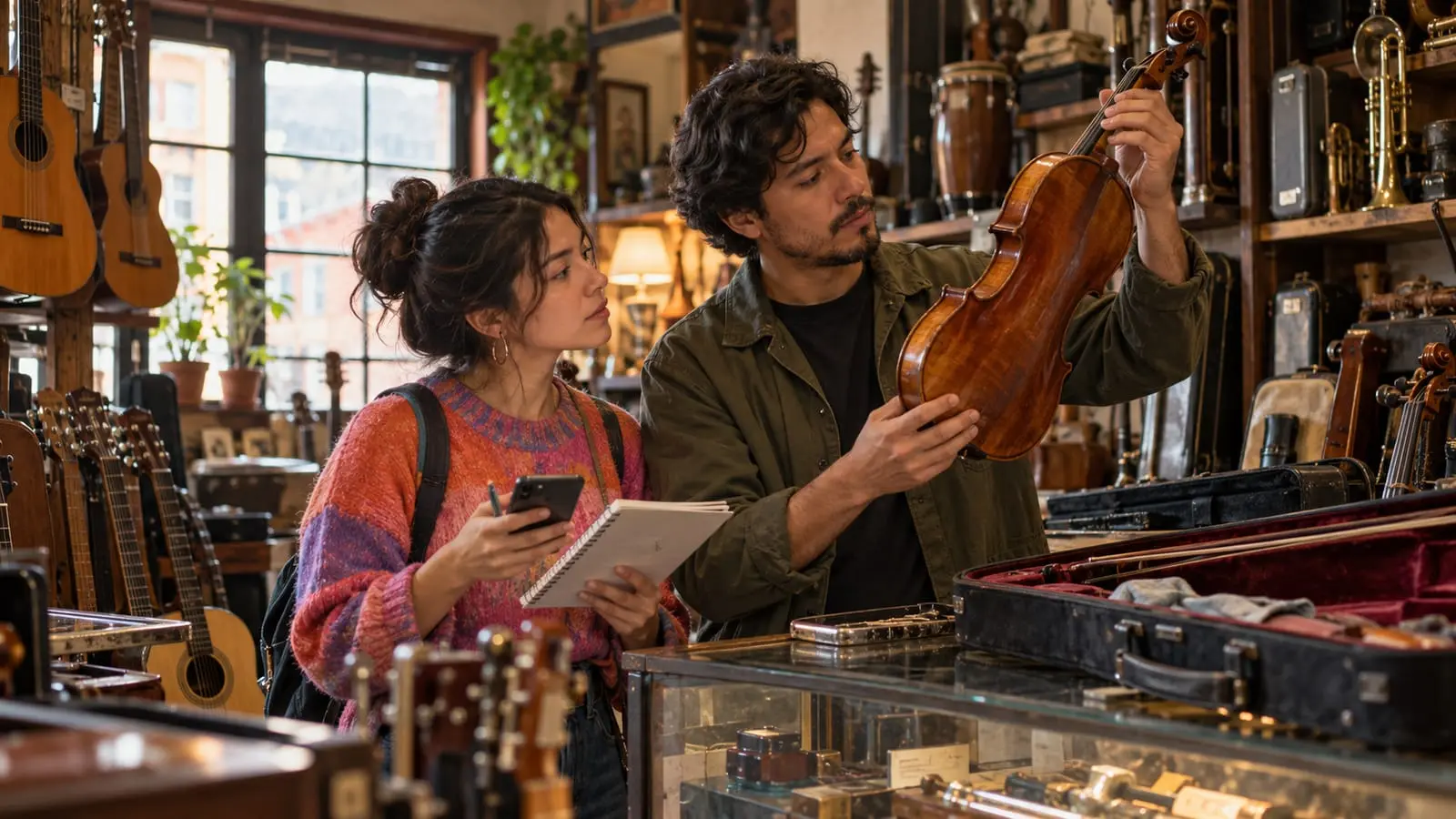
A used instrument can be an excellent buy if someone knowledgeable checks it before you pay; a new one offers a warranty and fewer surprises, but not always better quality. For beginners, the practical rule is: a well-maintained, inspected used student instrument is better than a very low-quality new one.
This guide gives you a method for inspecting any instrument and a checklist for each family. For instrument-specific details, we link to dedicated buying guides.
In short
- A good-quality used instrument that has been thoroughly checked often plays better than a very basic new one.
- Always inspect it in person, in good light, with someone who plays that instrument.
- Estimate the cost of getting it ready to play: strings, key pads, setup, or tuning.
- If the student is a growing child or is still unsure about the instrument, renting or borrowing may be better than buying.
- Be wary of sellers who ask for deposits without showing the instrument or will not let you try it.
New, used, rented, or borrowed
| Option | Benefits | Cons | A good choice if… |
|---|---|---|---|
| New | No wear, with a warranty and receipt | The most basic models may arrive poorly set up | Your teacher knows the quality of the instrument you plan to buy |
| Used | A better-quality instrument for the same investment | Possible hidden damage and no warranty | You can have someone knowledgeable inspect it with you |
| Rented | You can try the instrument without committing | It is not yours, and you must return it in good condition | Your child will grow, or you are unsure whether you will continue |
| Borrowed | You can start right away | It may need repairs and must be returned | A relative, school, or band can lend you one |
Renting or borrowing children's violins, cellos, and guitars makes sense: children outgrow fractional sizes. With pianos, the decision carries more weight because moving them requires specialists; first consider whether a digital piano would meet your needs at the beginner stage.
How to inspect any used instrument
- Ask for detailed photos before visiting: front, sides, joints, and any damage or repairs.
- Ask about its history: how old it is, who played it, where it was stored, and when it was last serviced.
- Inspect it slowly in natural light or with a flashlight, including the inside when possible.
- Play it or ask someone to play it: every note, low to high, softly and loudly.
- Use a tuner to check whether the tuning stays stable.
- Listen for nonmusical noises: buzzing, knocking, clicking, or escaping air.
- Ask whether the seller has proof of where it came from, such as the original receipt.
Ideally, go with your teacher. If they cannot join you, ask them to watch a video of every note being played, or take the instrument to a luthier or technician before finalizing the deal. If you do not yet have a teacher, find one for your instrument in the teacher directory.
Consider the climate too: a wooden instrument moving from a hot region to Bogotá, or vice versa, needs a few weeks to adjust. Cracks or the need for adjustments may emerge during that transition.
Checklist by instrument family
| Family | What to check | Warning sign | Who is best qualified to assess it |
|---|---|---|---|
| Plucked strings (guitar, tiple, bass) | Straight neck, string height, frets, securely glued bridge | Lifting bridge, bulging top, twisted neck | A luthier or your teacher |
| Bowed strings (violin, viola, cello) | Cracks, soundpost in place, straight bridge, pegs that hold, bow condition | Cracks in the top, loose fingerboard, twisted bow stick | A bowed-string instrument luthier |
| Woodwinds (flute, clarinet, saxophone) | Key pads, springs, corks, mechanism without excess play | Low notes that will not speak, cracks in the clarinet's wooden body | A wind instrument technician |
| Brass (trumpet, trombone) | Valves or slide, tuning slides, dents | Worn valves, damaged slide, internal corrosion | A wind instrument technician or your teacher |
| Acoustic piano | Keys, hammers, dampers, tuning stability | Loose tuning pins, cracked soundboard, termites | A piano tuner or technician |
| Digital piano and keyboards | Response of every key, touch sensitivity, pedal, outputs | Keys that make no sound or always sound at the same volume | You can do it yourself with a systematic test |
| Percussion | Shells, bearing edges, hardware, pedals, cymbals | Cracked cymbals or shells | Your teacher or an experienced drummer |
Each instrument has details that will not fit in a table. For wind instruments, for example, see how to choose your first saxophone, including what to check on the key pads and neck.
The special case of a used piano
A used piano can be a great opportunity or a major problem. It may look immaculate outside while internal parts can no longer hold tuning. Before buying, ask a piano tuner or technician to check:
- Whether it holds tuning: loose tuning pins can make it go out of tune within days of tuning.
- That the soundboard and bridges have no large cracks.
- That every key goes down and returns evenly, without sticking.
- That the hammers are not badly worn or moth-damaged, and the dampers stop the sound when you release a key.
- That there are no signs of termites in the case or internal parts.
Add the cost of specialist transport and the first tuning in its new location. If you are weighing this choice, read how to choose your first piano or keyboard, where we compare acoustic and digital instruments, and explore piano lessons if you are starting from scratch.
Violin and other bowed strings: check the bow too
On used violins, violas, and cellos, the most delicate issues are not always obvious:
- Cracks: inspect the top, especially near the f-holes and bridge, and the instrument's edges.
- Soundpost: a small wooden dowel inside the instrument, near the bridge foot on the highest-string side. If it has fallen or shifted, the sound becomes dull; positioning it is a luthier's job.
- Bridge: should stand straight, without bending toward the fingerboard.
- Pegs: should turn smoothly and hold their position.
- Bow: a stick that looks straight when sighted along its length, a screw that tightens the hair, and enough hair remaining.
- Size: a used violin in the wrong size is no bargain. Confirm the size with your teacher before buying.
In how to choose your first violin and its size, we explain how to measure a child and what comes with a student violin.
Warning signs when buying secondhand
- You are asked for a deposit or full payment before seeing the instrument.
- The seller says the instrument is in another city and can only be shipped.
- They will not let you try it or make excuses to avoid an expert inspection.
- The photos look like catalog images rather than pictures of the actual instrument.
- Claims such as “it just needs an adjustment” or “it only needs strings,” without knowing what the adjustment involves.
- A price far below similar instruments, with no clear explanation.
- There is no way to establish where the instrument came from.
Frequently asked questions
Is buying a used instrument worthwhile for a beginner?
Yes, as long as someone knowledgeable inspects it and you have it properly set up before starting. Beginners cannot tell whether a difficulty comes from their playing or the instrument, so a poorly adjusted used instrument can discourage them unnecessarily.
Is it better to rent or buy an instrument for a child?
If the child uses fractional sizes or is just trying it out, renting or borrowing is usually more sensible. Buying makes more sense once they reach their final instrument size and have practiced consistently for a few months.
Can my teacher inspect an instrument before I buy it?
Ask them: many teachers are happy to review photos, videos, or the instrument in person. For internal diagnoses or repairs, a luthier or technician is the right choice.
What do I give up when buying used?
Usually the warranty and certainty about the instrument's history. That is why you should ask about past servicing and set aside part of your budget for adjustments.
Sources
We checked the facts in this article against these sources on October 22, 2026.
- Piano Technicians Guild: how to buy a used piano (inspection by a technician, pinblock, soundboard, and hammers)
- D'Addario: violin, viola, and cello survival guide (instrument and bow care)
- Taylor Guitars: how to fix string buzz (strings, neck, humidity, and frets)
- Taylor Guitars: repairing cracks and dents in a guitar