
How long does it take to learn to play piano?
Your first pieces come within weeks; intermediate repertoire takes years. We walk you through the real stages of learning piano and what helps you progress faster.
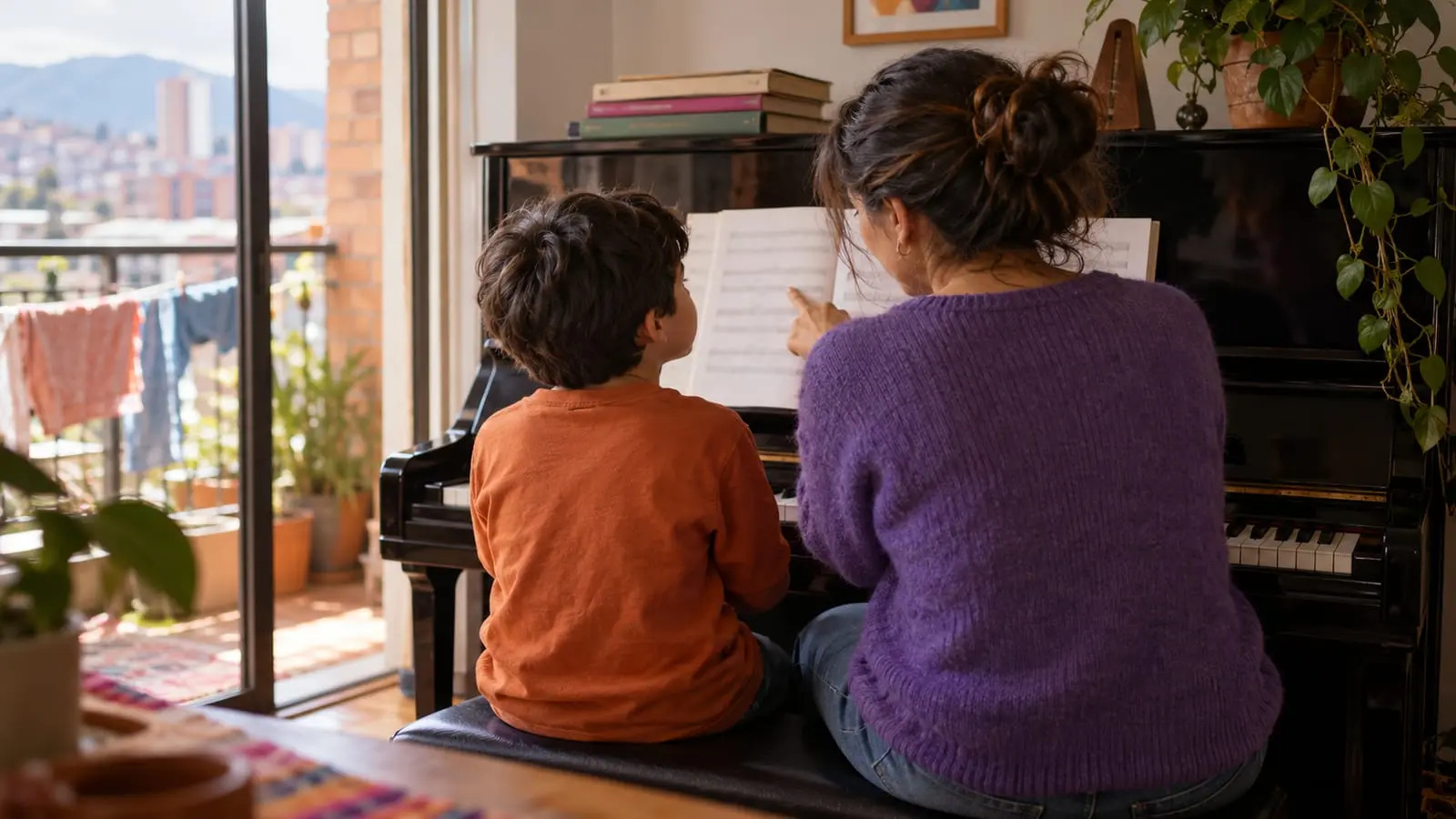
With a weekly lesson and around 20 to 30 minutes of practice almost every day, most beginners play their first simple two-handed pieces between the second and fourth month, read easy sheet music without writing in note names around the end of the first year, and reach intermediate repertoire, such as sonatinas or full song arrangements, between the second and fourth year.
These are rough timelines, not promises. They depend on how much and how you practice, your age, the instrument you have at home, and above all what “knowing how to play piano” means to you: accompanying songs with chords takes months; playing Chopin takes years.
In short
- With regular practice, your first two-handed pieces usually come between the second and fourth month.
- Reading simple sheet music reasonably fluently in treble and bass clefs usually takes around a year.
- Intermediate repertoire, such as sonatinas or full song arrangements, generally comes between the second and fourth year.
- What helps most is practicing almost daily, slowly and in short sections, on a full-size, touch-sensitive keyboard.
- Accompanying songs with chords is a goal measured in months; intermediate or advanced classical piano is a goal measured in years.
Quick answer: how long each milestone takes
| Milestone | Approximate time | Assumed practice routine |
|---|---|---|
| Playing a melody with one hand | 2 to 6 weeks | One lesson a week and 20 to 30 minutes almost every day |
| First pieces with both hands | 2 to 4 months | One lesson a week and 20 to 30 minutes almost every day |
| Accompany songs with chords | 6 to 12 months | One lesson a week and 20 to 30 minutes almost every day |
| Reading simple sheet music with both hands | 6 to 12 months | One lesson a week and 20 to 30 minutes almost every day |
| Playing intermediate-level pieces | 2 to 4 years | Regular practice, gradually increasing to 45 to 60 minutes |
The stages of learning piano and how long each takes
Piano has an advantage at the start: every key produces a clear sound from day one. That's why the first few weeks can feel quick. The real challenge comes later, when your hands need to do different things and you have to read two clefs at once.
| Stage | What you achieve | Approximate time with regular practice |
|---|---|---|
| Getting started | Posture, bench height, finding middle C, five-finger position, and one-handed melodies. | 2 to 6 weeks |
| First two-handed pieces | Melody in the right hand and long notes or simple chords in the left; beginning to read bass clef. | 2 to 4 months |
| Basic reading and coordination | Reading easy pieces in both clefs without writing in note names, one-octave scales, and accompanying songs with chords. | 6 to 12 months |
| Beginner to intermediate repertoire | Simple minuets, your first pieces with pedal, dynamics, and different rhythms in each hand. | 1 to 2 years |
| Intermediate repertoire | Sonatinas, full arrangements of popular songs, and sight-reading easy material. | 2 to 4 years |
| Upper intermediate level | More accessible Chopin waltzes or nocturnes, Bach inventions, and more demanding scale and arpeggio technique. | 4 to 7 years or more |
The ranges deliberately overlap. Some people read quickly but take longer to coordinate their hands; others are the opposite. What matters is seeing that each month you can play something you couldn't before, rather than meeting the table's deadlines.
The toughest milestones: coordinating your hands and reading
Playing with both hands at once
This is the most common hurdle in the first few months. At first, your brain wants your left hand to copy your right, and when the left needs to hold a note while the right moves, everything falls apart. It's normal, and a very specific method helps you get past it:
- Learn each hand separately until you can play without looking at the keyboard so much.
- Put your hands together in a short section of one or two measures, at a very slow tempo.
- Once you can play it cleanly three times in a row, add the next section.
- Gradually increase the tempo with a metronome, only once the passage stays coordinated.
Reading treble and bass clefs
Most people learn treble clef first because the right hand usually carries the melody. Bass clef lags behind, and it's tempting to write each note's name above it. That works for a couple of weeks but slows you down in the long run: your teacher will ask you to read by intervals—whether a note moves up or down by step or skips—and use reference notes. If reading is your weak point, how long does it take to learn to read sheet music? explains it in depth.
The pedal
Pressing the pedal is easy; releasing it and pressing it again just after a chord change, without muddying or interrupting the sound, takes practice. Pedal work usually begins toward the end of the first year or during the second, when the pieces call for it.
How many hours of practice do you need?
There's no magic number, but there is one rule: frequency matters more than duration. Half an hour six days a week adds up to three hours and is much more effective than three straight hours on Sunday, because your fingers and memory consolidate what you've learned between sessions. As an outside reference, ABRSM estimates that preparing for a Grade 1 piano exam takes about 60 hours in total (lessons plus independent practice), and a Grade 8 exam about 320; these are averages that, according to ABRSM itself, vary with each person's experience. The times below are common guidelines among teachers, not rules.
- Children ages 5 to 7: about 10 to 15 minutes, sometimes split into two short sessions.
- Older children and adult beginners: 20 to 30 minutes, including a scale, a section of a piece, and some review.
- Intermediate level: around 45 to 60 minutes, including technique, two or three pieces at a time, and sight-reading.
- Audition preparation: often more than an hour, divided into blocks with breaks.
To organize those minutes, how many hours should you practice each day? explains how to divide your time according to your level and age.
What helps or slows your progress on piano
| Speeds up progress | Slows progress |
|---|---|
| Practicing almost daily, even if only for 20 minutes. | Saving all your practice for one day a week. |
| An acoustic or digital piano with 88 weighted, touch-sensitive keys. | A small keyboard without touch sensitivity or a pedal, which isn't enough for second-year pieces. |
| Practicing slowly in short sections and gradually increasing the tempo. | Always playing the whole piece fast, carrying the same mistakes along. |
| Reading from the start, even slowly. | Learning only by copying videos with light-up keys, without ever reading music. |
| A teacher who corrects posture, fingering, and tension from the first lessons. | Drooping wrists or flat fingers that you'll later need to unlearn. |
| Repertoire you're excited to play. | Spending months on pieces you don't enjoy. |
The instrument deserves special attention. A basic keyboard works for the first few weeks, but once dynamics and pedal work enter the picture, light keys without touch sensitivity limit what you can learn. How to choose your first piano or keyboard explains what to check.
Children, adults, and different goals
Children
Young children progress more slowly in each session because their attention spans are short and their hands are growing, but they are often very consistent when practice becomes part of their routine, like school homework. Music reading tends to take off once they can read fluently at school.
Adults
Adults understand theory faster and know why they're doing each exercise. Their biggest obstacles are limited time and high expectations of themselves: they compare their sound with professional recordings and get discouraged. If you're starting as an adult, our guide to learning piano as an adult helps you set realistic goals.
Your goal changes the timeline
- Accompanying songs with chords, to sing at family gatherings or in church: around 6 to 12 months.
- Playing simple classical pieces from sheet music: around 1 to 2 years.
- Auditioning for admission for a music degree: usually several years of prior training; the music admissions prep course helps in the final stretch.
How to measure your progress without getting discouraged
Learning piano isn't a straight line. Some weeks everything works; others feel like you're going backward. These habits help you see the bigger picture:
- Record yourself playing the same piece on your first day of studying it and again a month later.
- Keep a list of pieces you can already play all the way through, from memory or from sheet music.
- Write down the metronome tempo at which you can play each difficult passage cleanly.
- Ask your teacher what the next milestone is and what you're working on to reach it.
Frequently asked questions
Can you learn piano in six months?
It depends on what you mean by learning. After six months of regular practice, it's realistic to play simple two-handed pieces, read easy sheet music slowly, and accompany songs with basic chords. Reaching intermediate pieces isn't realistic in that time: it takes years of accumulated work.
Is learning piano harder as an adult than as a child?
It isn't harder; it's different. Adults understand theory faster and organize their practice better; children have more time and less fear of mistakes. Consistency matters most: an adult who practices 20 minutes almost every day usually progresses more than a child who only practices the day before a lesson.
Can I learn piano just with apps or videos?
You can learn songs and basic concepts, and these tools are a good supplement. The risk is that no one corrects your posture, fingering, or wrist tension, and those habits can take months to unlearn. Many students combine videos with a weekly lesson for guidance and ongoing feedback.
How many piano lessons do I need each week?
For most people, one weekly lesson is enough if you practice between lessons. In our piano lessons, online or at home, your teacher sets specific goals for the week; two weekly lessons make sense if you're preparing for an audition or exam with a set date.
Sources
We checked the facts in this article against these sources on October 22, 2026.