
How many hours a day should you practice an instrument?
There's no magic number: it depends on your level, your age and your goal. Here are realistic benchmarks and how to make every minute of practice count.
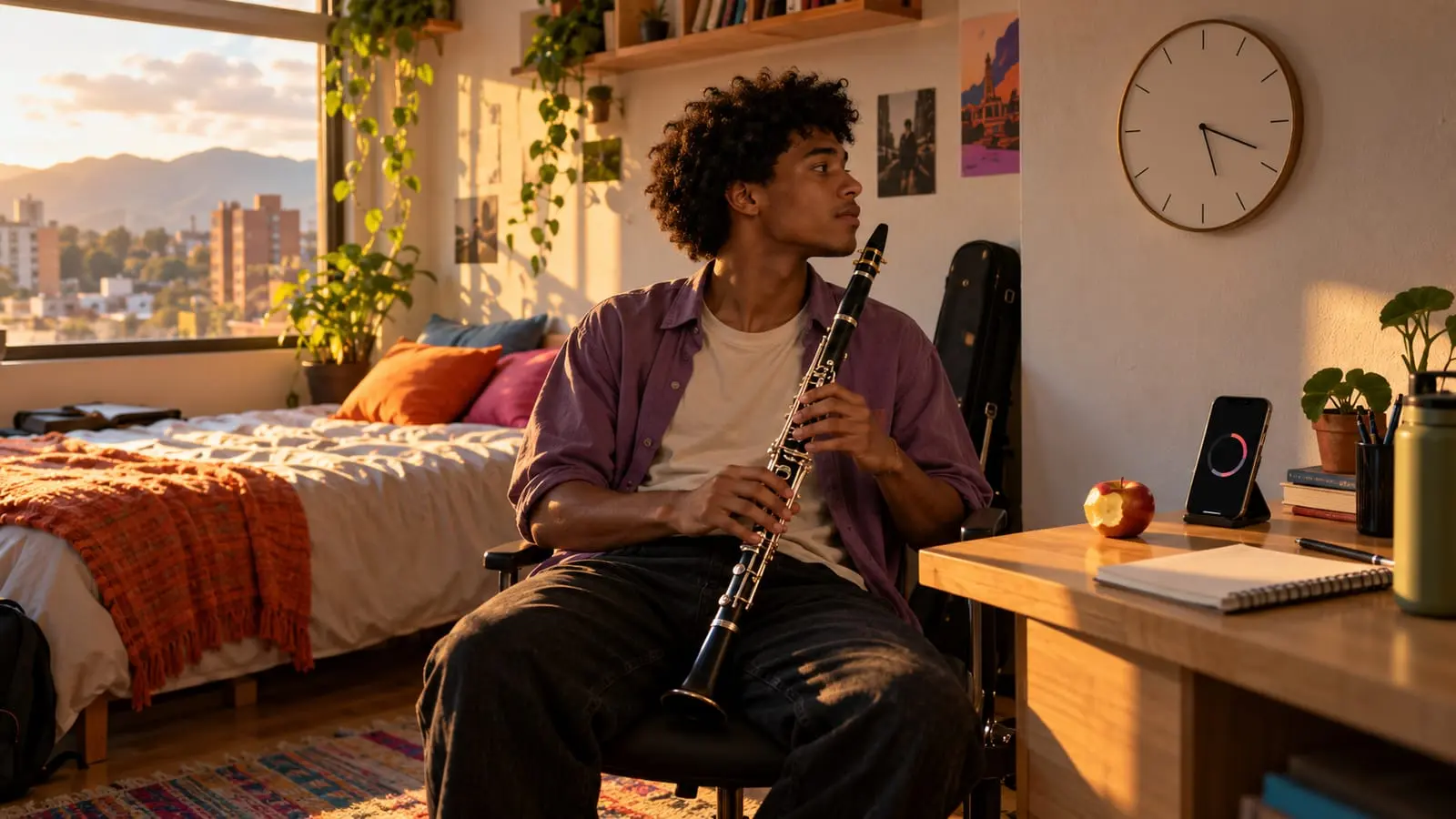
As a general guide, beginners make good progress with 15 to 30 minutes most days; intermediate students usually need between 30 minutes and an hour; and those preparing for an entrance audition or pursuing a music degree practice for several hours, split into blocks with breaks.
How you use that time matters more than the number of hours. Half an hour of focused practice with a clear goal achieves more than two hours on autopilot. And no amount of practice is worth it if it leaves you in pain.
In short
- Beginners: 15 to 30 minutes most days. Intermediate learners: 30 minutes to an hour. Advanced learners and music-degree applicants: several hours in blocks.
- Short sessions work best for young children, and sometimes it helps to split practice into two parts of the day.
- Quality matters more than quantity: each session needs a specific goal.
- Take short breaks every 20 to 30 minutes, and if you practice a lot, spread the time across several sessions.
- Pain isn't part of learning: if it hurts, stop and review your technique with your teacher.
How much to practice at your level
These figures are guidelines and assume practice most days, with one or two rest days a week. Your teacher will adjust them to your instrument and goals:
| Level | Daily time | Focus |
|---|---|---|
| Beginner (first few months) | 15 to 30 minutes | Posture, tone, basic reading, and building a habit |
| Intermediate | 30 minutes to 1 hour | Specific techniques, scales, longer pieces |
| Advanced amateur | 1 to 2 hours | Challenging repertoire, expression, ensemble playing |
| Music-degree applicant | 2 to 4 hours in blocks, plus theory and solfège | Audition repertoire, technique, reading, and dictation |
| University student or professional | Several hours, depending on the period | Concert repertoire, rehearsals, maintaining technique |
If you're preparing for an entrance exam, your instrument won't take up all your practice time: reading, solfège, and dictation need daily practice too. Our music college preparation program organizes that time week by week.
How much to practice at each age
| Age | Time per session | Tip |
|---|---|---|
| Ages 3 to 5 | 5 to 10 minutes of musical play | Focus on singing, keeping the beat, and exploring sounds rather than formal practice |
| Ages 6 to 8 | 10 to 20 minutes | With an adult nearby and one small goal each day |
| Ages 9 to 12 | 20 to 30 minutes | Children start practicing independently; check the teacher's assignment notebook |
| Teenagers | 30 to 60 minutes | Motivation grows when they include music they enjoy |
| Adults | Whatever fits your schedule, consistently | 20 minutes daily is better than 2 hours on Saturday |
| Older adults | Short sessions with more breaks | Care for your hands, back, and posture; increase the time gradually |
With children, it's better to end a session while they're still eager than because they're exhausted. If your child resists practicing, see our ideas for motivating your child to practice.
Quality vs. quantity: making practice time count
Practice time only counts if you're working something out. The difference lies in what you do during the session:
| Effective practice | Practicing on autopilot |
|---|---|
| You start knowing what you'll improve today | You sit down to "see what happens" |
| You isolate the difficult measure and work on it slowly | You play the whole piece over and over |
| You use a metronome and increase the tempo gradually | You always play at whatever speed comes naturally |
| You record yourself and listen back | You rely on how it felt while you were playing |
| You stop when you lose focus | You keep going just to fill the allotted time |
Ten minutes working out a passage with a metronome can be worth more than half an hour going over what you already play well. To organize each session into blocks, follow our home practice routine.
Breaks: how to spread out your time
- Work in blocks of 20 to 30 minutes and rest for a few minutes between them: relax your hands, walk around, and drink water.
- If you practice for more than an hour, split that time into two or more sessions throughout the day. Spreading out your practice is usually more sustainable for your hands and concentration than playing for two hours straight.
- Alternate demanding and lighter work: after an intense technique exercise, play something relaxed or practice reading.
- Allow at least one day a week for rest or very gentle practice.
- Sleep well: rest helps consolidate what you've practiced.
For your instrument
Wind playing and singing tire the lips and voice sooner than the hands, so they need shorter sessions and more frequent breaks. On violin, watch for shoulder and neck tension; if discomfort appears, review the height of your shoulder rest and chin rest with your violin teacher. On piano, take care of your wrists and forearms. On guitar, your fingertips may hurt during the first few weeks as calluses develop: practice several short sessions a day rather than one long session.
How to avoid injuries from overpracticing
Overuse injuries often appear when you suddenly increase practice time, such as before a recital or audition, or when you practice with tension. Learn to recognize the signs:
| Sign | What to do |
|---|---|
| Mild muscle fatigue that eases with rest | Normal. Take a break and resume more gently |
| Tension that persists when you relax | Stop and check your posture and the height of your chair or music stand |
| Pain that keeps returning in the same spot | Stop that practice activity and discuss it with your teacher |
| Tingling, numbness, or loss of strength | Stop and consult a healthcare professional |
- Warm up with slow exercises before playing, rather than starting with the hardest passage.
- Increase practice time gradually, never suddenly from one day to the next.
- Review your posture with your teacher: bench height on piano, music stand position, and how you support your instrument.
- If your body feels tense, slow the tempo or switch tasks.
When time is short: how to make the most of it
Between work, school, and traffic jams, many adults and students struggle to find a free hour. Here are some ideas:
- Prioritize the day's technique exercise and the hardest passage. The rest can wait.
- Use short sessions: fifteen minutes before heading out still count.
- Practice without your instrument: read rhythms, mentally rehearse the piece, or listen to your repertoire while following the sheet music on your commute.
- Use the weekend for a longer session, but don't let it replace weekday practice.
- Keep your instrument visible and ready to play; taking it out of its case shouldn't become an excuse.
Frequently asked questions
Is it bad to practice every day?
No, as long as you vary the intensity and listen to your body. Even so, one day of rest or very gentle practice each week helps your hands, lips, or voice recover.
How many hours do professional musicians practice?
It varies widely with the instrument, career stage, and commitments. Many practice for several hours a day, but almost always in blocks with breaks. What sets them apart is both the time spent and how focused each session is.
Does practicing only on weekends help?
It helps less than spreading the same amount of time across the week. Your hands and memory consolidate learning better with frequent sessions. If weekends are your only option, add at least some mental practice or reading during the week.
Does practicing without your instrument count?
Yes, as a supplement. Mentally rehearsing a piece, reading rhythms, practicing solfège, or listening while following the sheet music strengthens memory and reading skills. It doesn't replace physical practice with your instrument, but helps on busy days.
Sources
We checked the facts in this article against these sources on October 22, 2026.