
How do you prepare for a music entrance exam?
Music entrance tests combine theory, ear training, reading and instrument, and each university weighs them differently. This guide gives you the full map and a 6-to-12-month plan.
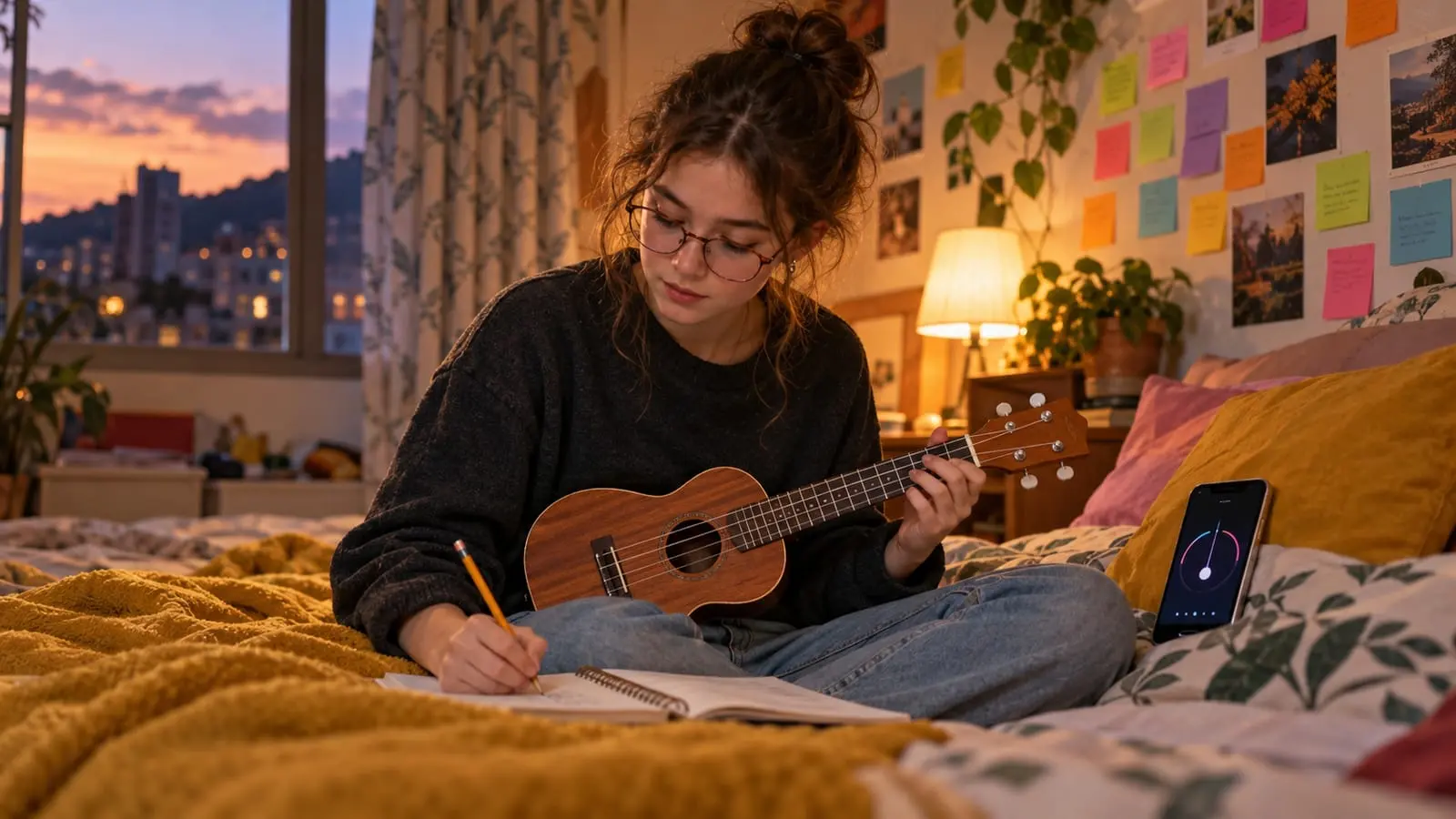
Preparing for a music entrance exam means training five things at once: theory, your ear (dictation), rhythm reading and sight-singing, your instrument, and your ability to do it all under pressure. If you already play and read music confidently, six months of structured work is a reasonable timeframe; if you are just starting with theory or ear training, allow a year or more.
But your first step is choosing which programs to apply to. Each university designs its own exam and publishes its requirements for each admissions cycle. This guide gives you an overview and points you to our guides for each university.
In short
- Almost all exams combine musical aptitude, theory, dictation, music reading, and an audition on your instrument; some also include an interview and Saber 11.
- Each university gives the components different weights, which may change between admissions cycles: always read the current instructions.
- If you have a foundation, plan for at least six months of preparation; if you are starting from scratch, a year or more.
- Dictation and sight-singing take the longest to develop: practice them daily in short sessions.
- Take timed mock exams with someone assessing you: performing under exam pressure is also a skill you can train.
What do music entrance exams assess?
Although each university designs its own exam, almost all assess the same broad skill areas. The order, difficulty, and weight of each section vary.
| Component | What you are asked to do | Examples from the admissions rounds reviewed |
|---|---|---|
| General requirements | High school diploma and Saber 11 exam | Its weight varies widely: at Pedagógica it was required but did not count toward the score; at ASAB it accounts for 5 % of the final score and the university requires a minimum score; at Los Andes it was a reference with no minimum |
| Musical aptitude | Repeating rhythms and melodies, recognizing intervals, musical memory | The aptitude exam at Los Andes; the musical aptitude test at Javeriana; dictation at ASAB |
| Theory and rudiments | Keys, key signatures, intervals, scales, triads, and seventh chords; at advanced levels, harmonic analysis and counterpoint | Music theory questionnaire at Nacional; harmony and two-part counterpoint at ASAB |
| Dictation | Writing down rhythms, melodies, intervals, chords, and progressions you hear | Written musical dictation at Nacional; interval, chord, melody, rhythm, and harmony dictation at ASAB |
| Reading | Rhythm reading and melodic sight-singing, often with unfamiliar material | Sight-reading before a panel at Nacional, on an instrument other than the one you applied for |
| Instrument or voice | A piece of your choice or an assigned piece, etudes, scales, sight-reading | Elimination round at Nacional (minimum 60/100 in Music) and ASAB (specialization exam, minimum 60/100); a piece of your choice, an assigned piece, and reading at Pedagógica |
| Interview | Motivation, musical background, and, for music education degrees, readiness to teach | Carried 40 % in the Pedagógica music education degree; at El Bosque it took place on the same day as the exams |
Pay attention to the term elimination round. In several programs, if you do not reach the minimum score on the instrument or specialization exam, the rest of the exam does not count. That is why strong theory skills cannot make up for weak instrumental performance, or vice versa.
There are important nuances if you are self-taught. Los Andes makes it clear that its musical aptitude exam is not a knowledge test, and Javeriana's Music Education specialization asks for a piece of your choice from any genre, although all applicants take aptitude tests that require basic theoretical knowledge: theory will catch up with you sooner or later.
First, choose which programs to apply to
Preparing for a generic “music exam” is not very efficient. An exam that assesses harmonic analysis and counterpoint is quite different from a twenty-minute aptitude test. Choose two or three programs and read their instructions before making your plan.
| University | What carries the most weight or defines the exam | Detailed guide |
|---|---|---|
| Nacional (Conservatorio) | General entrance exam plus a music-specific exam; you must pass the instrumental section to continue, and there is vocal sight-reading | Nacional entrance exam |
| Distrital (Facultad de Artes ASAB) | Elimination-round specialization exam (minimum 60/100), followed by dictation, reading, harmony and counterpoint, Spanish literacy, and Saber 11 | Admission to Artes Musicales at ASAB |
| Pedagógica Nacional | Musical aptitude and knowledge, interview, and principal instrument | Admission to the music education degree |
| Javeriana | Musical aptitude tests and tests specific to each specialization: a portfolio for Composition, a conducting audition for Conducting, and an essay for Education | Admission to Estudios Musicales |
| Los Andes | Required musical aptitude test lasting about 20 minutes; the instrumental audition takes place after admission | Admission to Music at Los Andes |
| El Bosque | Aptitude, a computer-based theory and ear test, instrumental performance, and an interview on the same day | Admission to Formación Musical |
Official details are available on pages such as the Universidad Nacional's program-specific exams or the music admissions process at Los Andes. If you plan to study outside Bogotá, see studying music in Medellín, Cali, and other cities and our guides to UdeA, EAFIT, Univalle, UIS, Universidad del Atlántico, Universidad de Caldas, and Conservatorio del Tolima. If you are still unsure which degree you want, start with music degree programs in Colombia and the difference between Maestro en Música and Licenciatura degrees.
Questions to answer before you start preparing
- Which degree and specialization do you want: performance, composition, conducting, education, jazz, production?
- Does that program offer your instrument?
- When do applications open? For example, El Bosque admits students every semester, while Univalle does so once a year.
- Which sections must you pass to continue, and how much does each count?
- Where do you take it? At Nacional, for example, the instrument exam is in person, which matters if you live in another city.
- Do they publish repertoire, etudes, or an assigned piece? How far in advance?
A 6 to 12 month preparation plan
This plan assumes you already play your instrument reasonably confidently. If you cannot read music yet, add a few months at the beginning to learn to read sheet music before starting the plan below.
| Stage | Theory | Ear training and dictation | Reading | Instrument |
|---|---|---|---|---|
| Months 1 to 3: foundations | Intervals, major and minor scales, key signatures, triads | Sung intervals, simple rhythm dictation, short stepwise melodies | Rhythm reading in 2/4, 3/4, and 4/4; sight-singing in C major and A minor | Choosing repertoire, daily technique routine, scales |
| Months 4 to 6: building skills | Seventh chords, circle of fifths, cadences, harmonic functions | Melodies with leaps, chord dictation, harmonic intervals | Compound meters, syncopation, keys with more sharps or flats | Learning pieces section by section; first complete recording |
| Months 7 to 9: exam level | Harmonic analysis; voice leading and counterpoint if your programs require them | Harmonic dictation of progressions, longer dictations | Daily sight-reading with new material | Pieces at tempo, technical etudes, first mock auditions |
| Months 10 to 12: mock exams | Reviewing weak areas, timed exercises | Timed dictations under exam conditions | Reading before someone acting as an examiner | Full program before an audience; fine adjustments, no major changes |
If you have six months, combine the first two stages in months 1 to 3 and set aside at least the last four to six weeks for mock exams. If your university releases an assigned piece shortly before the exam (Pedagógica released it about a month beforehand in the cycle reviewed), leave time in those weeks to learn it.
What a typical week looks like
- Every day: 20 to 30 minutes of ear training and reading in short blocks. This is much more effective than one long session on Saturday.
- Five or six days: instrumental practice, including technique, etudes, and pieces.
- Two or three times a week: written theory (exercises, analysis, harmony).
- Once a week: record yourself playing your program and review corrected dictations.
- One lesson a week with a teacher, or more in the final months, to address things you cannot spot on your own.
The five skills you need to train
1. Music fundamentals and theory
It is the foundation for everything else: if you cannot recognize a key signature or a chord on paper, you will not be able to write it down in a dictation exercise either. Master major and minor scales, intervals, triads, and seventh chords with their inversions. If the programs you are applying to assess harmony (ASAB tests voice leading in common-practice harmony and two-part species counterpoint), you need someone to correct your exercises: those mistakes are almost impossible to spot on your own.
2. Ear training and dictation
This takes the most time and cannot be mastered by studying the night before. Work on intervals, rhythms, melodies, and chords every day, and get used to writing the rhythm first, then the notes. We explain it step by step in how to prepare for music dictation.
3. Rhythmic and melodic reading
You may be asked to read a rhythm, sing a melody, or sight-read before a panel. At Nacional, for example, sight-reading is done on an instrument other than the one you applied for. Work on a steady pulse, singing scale degrees, and the habit of continuing without stopping. You can find techniques and exercises in rhythmic and melodic reading for the entrance exam.
4. Your instrument or voice
In many programs, this section carries the most weight and must be passed to continue. The point is not to play the hardest piece: the panel listens for tone, intonation, rhythm, technical control, and musicality. Choose pieces you can play confidently, and prepare scales and etudes. We help you choose in repertoire for an admissions audition.
5. Secondary piano skills
Even if you play another instrument, a basic piano or keyboard can transform your preparation: it lets you hear the chords you write, check your dictation exercises, play a reference note before singing, and understand harmony with your hands. Supplementary piano is also a common course in music degree programs. You do not need to be an accomplished pianist: scales, triads, simple progressions, and one-handed melodies are enough. If you are starting from scratch, a few months of piano lessons can make a big difference.
Mock exams: practice handling pressure too
Knowing something in your room is different from doing it against the clock with a panel watching. Mock exams show you where you struggle under pressure and help you get used to the format, so nothing feels new on exam day.
- Put together a written exam in your program's format: theory, analysis, and dictation, with the same time limit you would be given.
- Ask someone else to play the dictation for you. If you play it yourself, you already know the answer.
- Sight-read material you have never seen before in front of someone, without a second attempt.
- Play your entire program straight through, without breaks or a half-hour warm-up beforehand, as may happen at the audition. Record it on video.
- If there is an interview, rehearse your answers aloud: why you want to study music, what you have done, and what you expect from the degree. We cover this in the music admissions interview.
- Review your work, note recurring mistakes, and adjust your plan for the following weeks.
Take your first mock exam around the middle of your plan to assess your progress, then at least one every two weeks during the final month and a half. Ideally, your examiner should have experience preparing applicants and know what is required and at what level.
Exam day
What to bring
- Your ID and anything listed in your exam notice. Read it twice, checking the time and location of each test.
- Your instrument, checked and ready, plus spares: strings, reeds, rosin, drumsticks. In the Univalle admissions cycle reviewed, applicants brought their own instruments except for piano, double bass, and percussion.
- Your sheet music, plus copies if the instructions require you to give them to the panel.
- Pencil, eraser, and sharpener for the written section.
- Water and something to eat: some exam days are long.
During the exam
- Arrive early and warm up calmly: slow scales and long tones, rather than playing the whole piece ten times.
- If your exam is early in Bogotá, the cold can make your hands stiff: keep them warm until you play.
- In dictation, write down what you are sure of first (time signature, rhythm, anchor notes), then fill in the rest on subsequent hearings.
- Before reading, check the key signature, time signature, and difficult passages, and keep going if you make a mistake.
- If the panel interrupts you or asks for another section of the piece, that is normal: they often listen to excerpts.
You will feel nervous; the aim is to keep nerves from taking over. Find practical strategies in how to overcome stage fright.
Who can help you prepare?
You have three options, and many applicants combine them:
- University prep programs. Nacional, ASAB, Javeriana, El Bosque, Universidad de Antioquia, EAFIT, and others offer extension programs. None guarantees admission: Javeriana, for example, makes it clear that entry to the degree program is only through the official exam, and Nacional's prep program also requires you to pass an entrance exam.
- Private music schools with group pre-university courses.
- Private lessons in theory and your instrument, with a plan tailored to the programs you are applying to.
We compare these options in what a pre-university music course is. At Gissi, you can take music theory lessons, sight-singing and dictation, and lessons on your instrument with vetted teachers, online or at home in Bogotá; see how we organize this in preparation for music entrance exams. No preparation, including ours, replaces the exam: each university decides who gets a place.
Frequently asked questions
Can I enter a music degree if I cannot read sheet music?
In most programs, this is very difficult because the exam includes theory, dictation, and reading. The clearest exception among the programs reviewed is Los Andes, whose aptitude test does not test knowledge. Even so, learning to read before applying gives you many more options.
How far in advance should I start preparing?
If you already play and read confidently, six months of consistent work is a reasonable timeframe. If you are starting theory or ear training from scratch, allow a year or more. Dictation takes the longest to develop, so start there.
Is there a maximum age for applying to a music degree?
We found no age limits in the undergraduate programs reviewed. Some prep programs do have age ranges: the undergraduate preparatory cycle of Nacional's Programa de Estudios Básicos Musicales is for young people ages 15 to 21.
What happens if I do not pass the entrance exam?
You can apply again in a later admissions round. Review where you lost points, adjust your plan, and make the most of the extra time. Some programs open applications every semester, such as El Bosque, so the wait may be short.
How much does Saber 11 count toward admission to music degrees?
It depends on the program. In the admissions rounds reviewed, Pedagógica required it without including it in the score, ASAB gives it 5 % of the final score and the university requires a minimum, and Los Andes used it as a reference. Confirm the current requirements in each university's instructions.
Sources
We checked the facts in this article against these sources on October 22, 2026.
- Universidad Nacional de Colombia: program-specific exams for Music and Instrumental Music
- Universidad Nacional de Colombia: Music, instrument exam and theory, ear training, and reading exam
- Universidad Distrital, Facultad de Artes ASAB: Musical Arts admissions
- Universidad del Valle, Escuela de Música: program-specific music entrance exam
- Universidad El Bosque: entrance exams for the Music Training program
- Universidad Nacional de Colombia: Programa de Estudios Básicos Musicales (undergraduate preparatory cycle)