
Music admissions at Conservatorio del Tolima: entrance tests and preparation
The Maestro en Música and Licenciatura en Música degrees at Conservatorio del Tolima have very different entrance tests: one focuses on your audition, the other on musical aptitude. We explain both.
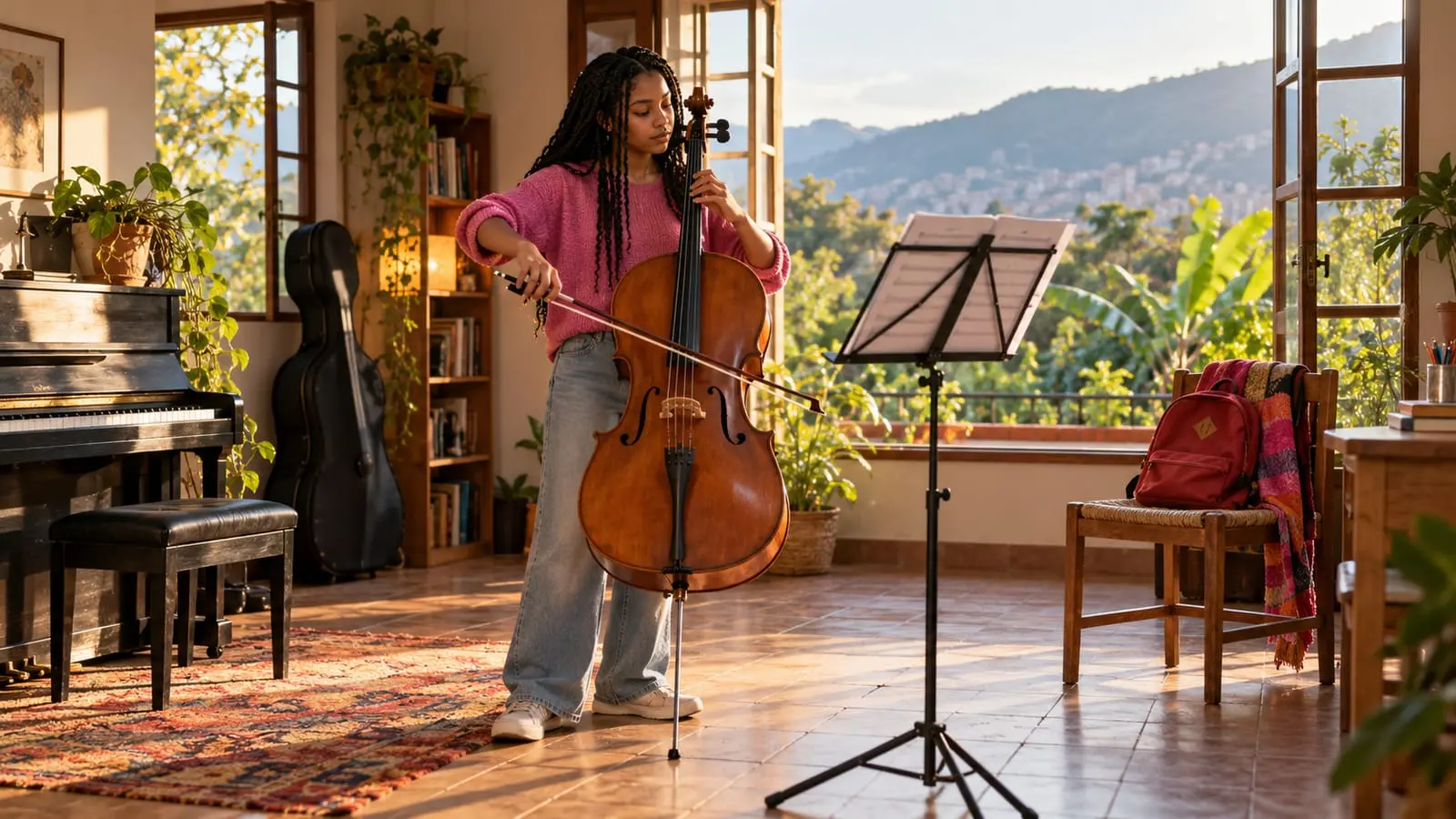
Conservatorio del Tolima, a public institution in Ibagué, offers two 10-semester undergraduate music programs: Maestro en Música and Music Education. Its current admissions guidelines (resolutions 16 and 17 of 2022, linked from each program's page) set very different assessments for each.
For Maestro en Música, your audition counts for 60 % and must be passed to remain eligible. The music education degree has no instrument audition: musical aptitude, theory, a reading and writing assessment, and the interview determine your result. In both cases, you need a weighted score of 3.5 out of 5 for admission.
In short
- Maestro en Música: instrument or classical voice audition 60 % (elimination below 3.0), theory and aural skills 25 %, reading and writing 5 %, and interview 10 %.
- Music education degree: musical aptitude 40 %, music theory 20 %, reading and writing 20 %, and interview 20 %; no instrument audition.
- Admission to both programs requires a weighted total of at least 3.5 out of 5.
- You must have taken Saber 11, but the Conservatorio does not require a minimum score.
- For 2027-1, applications ran from September 7, 2026 to January 19, 2027, with assessments in several phases starting November 23, 2026.
Programs and admissions schedule
| Program | Qualification | Duration | Distinctive feature |
|---|---|---|---|
| Maestro en Música | Maestro en Música | 10 semesters | Trains instrumentalists and singers; the curriculum begins with a preparatory cycle to bring students up to the required level |
| Music Education | Licenciado en Música | 10 semesters | Trains music teachers; holds high-quality accreditation |
The application fee was 10 % of one minimum wage, and tuition was covered by the free-tuition policy, subject to terms and conditions. The Conservatorio admits students each semester and holds assessments in several phases, giving you more than one possible date:
| Phase | Tests | Results |
|---|---|---|
| Applications | From September 7, 2026 to January 19, 2027 | — |
| Phase I | November 23 to 30, 2026 | December 1, 2026 |
| Phase II | December 2 to 4, 2026 | December 7, 2026 |
| Phase III | December 7 to 11, 2026 | December 14, 2026 |
| Phase IV | December 14 to 17, 2026 | December 18, 2026 |
| Phase V | January 13 to 18, 2027 | January 19, 2027 |
| Phase VI | January 20 and 21, 2027 | January 22, 2027 |
The Conservatorio's FAQ is clear about Saber 11: you must have taken it, but no minimum score is required. It does not appear in the assessment weighting tables either.
Maestro en Música: the audition is decisive
| Test | Weight |
|---|---|
| Instrumental performance or classical voice | 60 % |
| Theoretical knowledge and aural skills | 25 % |
| Music reading and writing | 5 % |
| Interview | 10 % |
The audition is the most important criterion and is a must-pass assessment: a weighted score below 3.0 rules out admission. It takes place at the start of the process, before a panel of teachers, and may last between 15 and 30 minutes at the panel's discretion. The resolution lists repertoire by instrument (winds, strings, percussion, piano, classical voice, guitar, tiple, and bandola); its required scales and arpeggios are mandatory.
For example, flute applicants were asked for a Reichert exercise, an Andersen étude, and two movements of Stamitz's Concierto en Sol mayor; violin applicants needed three-octave scales with bow strokes and arpeggios, études by Polo, Kayser, and Sitt, and the first movement of a concerto from a list of composers. Prepare exactly what is listed for your instrument and know it confidently: an audition lasting up to half an hour reveals everything. We help you organize it in repertoire for the admissions audition.
The theory and aural skills exam
| Part | Format | Weight within the exam | Topics |
|---|---|---|---|
| Theoretical knowledge | Group assessment, 45 minutes | 50 % | Treble and bass clefs, major and minor key signatures, intervals, major, minor, augmented, and diminished triads with inversions, and major and minor scales (natural, harmonic, and melodic). |
| Aural skills | Group assessment with piano, 45 minutes | 30 % | Melodic and harmonic intervals, triads, rhythmic dictation in 2/4, 3/4, and 4/4, simple diatonic and chromatic melodic dictation, and harmonic dictation of the three basic functions. |
| Sight-singing | Individual assessment, 10 minutes | 20 % | Reading diatonic melodies in treble and bass clefs, and rhythm reading in simple meters. |
This exam also determines your placement in the curriculum: students admitted with less than 50 % must attend introductory workshops in solfège, ear training, and fundamentals. For dictation, follow how to prepare for musical dictation.
Reading and writing, and the interview
The reading and writing assessment includes multiple-choice reading comprehension questions and an argumentative text based on a reading passage. The interview explores your context, musical background, view of music as a profession, knowledge of the program, and some history of music and your instrument.
Music Education: aptitude, theory, and vocation
| Test | Weight |
|---|---|
| Musical aptitude | 40 % |
| Music theory knowledge | 20 % |
| Music reading and writing | 20 % |
| Interview | 20 % |
There is no instrument audition. The theory assessment is written and taken in a group, lasts up to one hour, and contains 50 exercises; you pass with 35. It assesses naming and placing notes in treble and bass clefs, basic note values, 2/4, 3/4, and 4/4 time signatures, all simple intervals within the octave, major key signatures, major and minor triads, and sheet music markings (dynamics, ties and slurs, staccato).
The aptitude assessment is individual, lasts up to 20 minutes, and contains 25 exercises:
- Rhythm: repeat a two-measure rhythm at quarter note = 70, reproduce the rhythm of a melody played on piano, and perform a basic polyrhythm using claps and voice.
- Melody: repeat short melodic phrases sung or played on piano, and sing a song of your choice, with or without accompaniment, assessed for rhythm, meter, intonation, and interpretation.
- Aural skills: identify whether an interval rises or falls and sing it, and reproduce intervals played on piano with your voice.
With a score from 3.0 to 3.4 in theory and aptitude, the admissions committee may decide to select you. If you do not pass, the resolution refers you to the Conservatorio's Escuela de Música programs as pre-university preparation. For the interview, which counts for 20 % here, see the music admissions interview.
How to prepare for Conservatorio del Tolima
- If you are applying to Maestro en Música: start with the exact repertoire for your instrument in the resolution, with daily scales and arpeggios. It counts for 60 % and can rule you out.
- If you are applying to Music Education: practice rhythmic and melodic imitation with someone who gives you exercises, and rehearse your chosen song until you can sing it in tune and in time.
- For both: cover all the music theory, do short dictations several times a week, and practice sight-singing with a metronome.
- Do not underestimate reading and writing: read texts about music and practice writing an argumentative paragraph with a main idea, reasons, and a conclusion.
Use our ear training tool for intervals and triads, and the method in rhythmic and melodic reading for the entrance assessment for solfège. The full schedule is in how to prepare for a music entrance assessment.
If you are in Ibagué or another city, you can prepare with teachers in online lessons at Gissi: music theory, solfège, musical dictation, and your instrument, with a plan leading up to your chosen assessment phase. Learn more in preparation for music entrance assessments.
Frequently asked questions
Does Conservatorio del Tolima require a minimum Saber 11 score?
No. According to its FAQ, you must have taken the state exam, but no minimum score is required.
Does Conservatorio del Tolima's music education degree have an instrument audition?
Under Resolution 16 of 2022, no. The assessments are musical aptitude (40 %), theory (20 %), reading and writing (20 %), and interview (20 %). In the aptitude assessment, you sing a song of your choice.
How long is the Maestro en Música audition?
Resolution 17 of 2022 says it may last between 15 and 30 minutes, at the panel's discretion. Prepare all the repertoire required for your instrument, including the mandatory scales and arpeggios.
Are the assessments in person?
For Maestro en Música, the resolution states that the assessment takes place in person at the Conservatorio, with online or hybrid formats only in exceptional cases. The reading and writing assessment may be online or in person, as decided by the admissions committee.
What score do I need for admission?
In both programs, a weighted total of at least 3.5 out of 5. For Maestro en Música, the audition also eliminates applicants who score below 3.0.
Sources
We checked the facts in this article against these sources on October 22, 2026.
- Conservatorio del Tolima: Acuerdo 17 of 2022, admission guidelines for the Maestro en Música degree
- Conservatorio del Tolima: Acuerdo 16 of 2022, admission guidelines for the undergraduate degree in music education
- Conservatorio del Tolima: Acuerdo 020 of 2026, academic calendar with registration and tests for 2027-1
- Conservatorio del Tolima: Maestro en Música degree program
- Conservatorio del Tolima: undergraduate degree program in music education
- Conservatorio del Tolima: admission FAQs