
Music entrance exam at Universidad Nacional: what it assesses and how to prepare
For the Música and Música Instrumental programs at UNAL, the general exam isn't enough: the specific test, with an elimination round on your instrument, carries most of the weight. We explain what each part assesses.
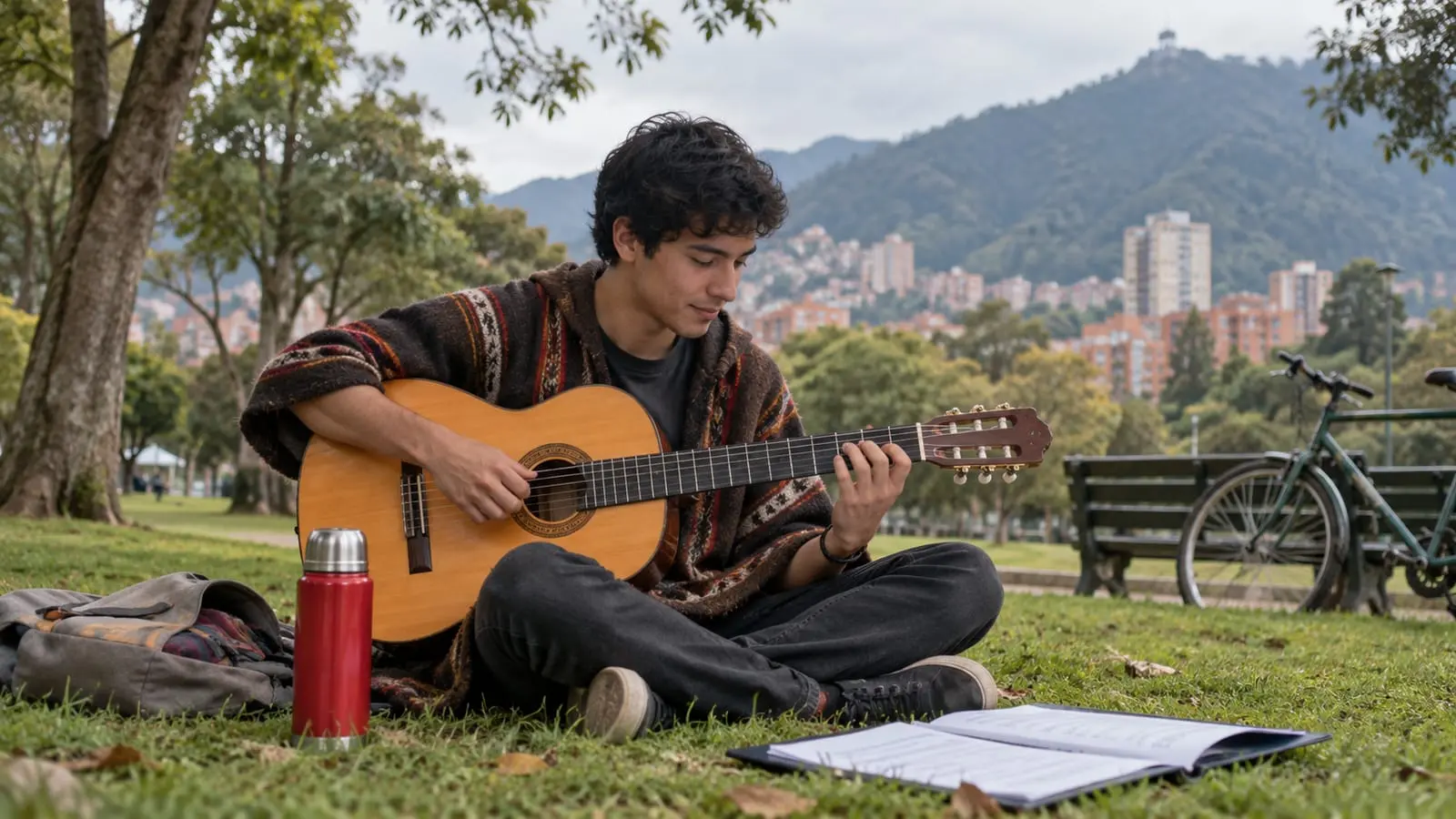
To enter Música or Música Instrumental at the Bogotá campus of Universidad Nacional de Colombia, you take two tests: the general admission exam, like every applicant, and a music-specific admission test at the Conservatorio. In the most recent admission cycle we reviewed (2027-1, with tests held in September 2026), the general exam accounted for 30 % and the music-specific admission test for 70 %, and each music-specific admission test was an elimination stage, starting with the instrument test.
In practical terms, your music score decides most of the outcome, and the university itself warns that applicants need “extensive musical preparation.” Here is what each part assesses and how to organize your preparation well in advance.
In short
- 2027-1 calendar (already closed for music): instrument test on September 7, 2026, theory, aural skills, and sight-reading on September 11, general exam on September 20, and results from October 9. The 2027-2 calendar has not yet been published.
- In the latest admissions round we reviewed (2026), UNAL music admission combined a general exam (30 %) and a specialized exam (70 %); the percentages may change.
- You must pass each specialty test to continue, starting with the instrument test (a minimum of 60 out of 100 for Music and 65 for Instrumental Music); the repertoire and technical studies are published in PDF format for each admissions cycle.
- The Theory, Ear Training and Reading exam has a written section on harmony and dictation, and an oral sight-reading section that you do not perform on your instrument.
- The Music program adds an exam for your chosen specialization: Composition, Conducting, Jazz or Research in Instrumental Pedagogy.
- The Conservatorio has a Programa Preparatorio within its Estudios Básicos Musicales for young people roughly 15 to 21 years old.
How music admissions work at UNAL
UNAL has two undergraduate music programs in Bogotá, both at the Conservatorio de Música de la Facultad de Artes. Music offers specializations in Composition, Conducting, Jazz and Research in Instrumental Pedagogy. Instrumental Music focuses on training you as a performer on your instrument. Both follow the same structure: a general exam plus a specialized exam.
| Component | Weight | What it involves |
|---|---|---|
| General entrance exam | 30 % of the total | The same exam taken by applicants to any UNAL degree program. |
| Subject-specific test | 70 % of the total | It takes place at the Conservatorio and includes instrument performance, Theory, Aural Skills and Music Reading, and, for Music, a specialization test. |
| Instrument audition | 70 % of the specialty test score in Instrumental Music (30 % in Music); a passing score is required | Repertoire and technical studies published in PDF files for each admissions round. |
| Theory, Ear Training and Reading | 30 % of the specialty test score; a passing score is required | Written part A and oral part B, before a panel in Bogotá. |
Do the math: in Instrumental Music, your instrument accounted for nearly half your total score (70 % of 70 %), and it could also eliminate you from consideration. In Music, it carried less weight (30 % of the specialty test), alongside a specialization test (40 %). That is why preparation starts with your instrument, but does not end there.
2027-1 admission calendar (and what to expect for 2027-2)
UNAL admits students once per admission cycle, and the music dates for the first term of 2027 (2027-1) have already passed: applications closed in August, and the music-specific admission tests took place in September 2026. If you applied in that cycle, check your results; otherwise, use this to plan ahead. The 2027-2 calendar has not yet been published on the admissions page, so there are no confirmed dates for the second semester of 2027. If the university follows the 2027-1 pattern, applications open halfway through the year before the term starts.
| Stage | Date | Notes |
|---|---|---|
| Application fee payment and completion | July 6 to August 24 | This is the university application; there is no separate registration for the music test. |
| Notice to attend the instrument test | From August 28 | Check it in the application portal. |
| Instrument test (Música and Música Instrumental) | September 7 | Elimination stage: you must pass to advance to the next test. |
| Notice to attend theory, aural skills, sight-reading, and specialization tests | September 10 | Only for applicants who passed the instrument test. |
| Theory, aural skills, and sight-reading; specialization (Música only) | September 11 | The specialization test depends on your area of focus. |
| General entrance exam | Sunday, September 20 | The same exam used for all UNAL degree programs. |
| General exam score | From October 1 | |
| Admission results | From October 9 | Admitted students submit documents to Registro y Matrícula from October 15 to 20. |
| Second allocation of places | Applications October 15 to 19; results from October 22 | Only for programs with available places; document submission October 26 to 30. |
| Final allocation of places | Applications November 9 to 11; results from November 13 | Only for places that have opened up; document submission November 17 to 23. |
| 2027-2 | Not yet published | There is no official calendar yet. |
Music tests take months of preparation, so start working on your instrument repertoire now. To arrive well prepared, our music pre-university prep includes mock exams and mock auditions; see the packages and prices.
The general exam and dates
The general exam is the same for all degree programs. It counts for less than the music exam, but a good result gives you some breathing room when competition is tight. Check the applicant guide for the subjects it assesses and practice well in advance; do not leave it until the last week because you are focused on your instrument.
UNAL usually opens two admission processes a year, but check each announcement to confirm that music programs are offered for the term you’re interested in. For the 2027-1 term, the general exam took place on Sunday, September 20, 2026, and the music-specific admission tests followed their own calendar (see the section above).
You may have read that, for 2027-1, UNAL admitted students to some programs based only on Saber 11. Based on our review, that route applied to regional campuses and special programs and, in Bogotá, only to Speech-Language Pathology and Occupational Therapy; music still required the general and specialized exams. Check the current admissions announcement before making plans.
The instrumental exam: repertoire and technical studies
This is the core of the specialized exam. For each admissions round, the Conservatorio publishes PDF files by instrument listing the repertoire and technical studies you must perform. Download them as soon as they are available: they specify exactly which works and level are expected, and you cannot put them together in just a few weeks.
How to prepare for it
- Read your instrument's list with your teacher and, where choices are offered, select works that show your actual level rather than those that look most impressive on paper.
- Work on scales, arpeggios and studies every day: your technique shows from the very first measures.
- Prepare the repertoire months in advance, so you have time to develop it beyond simply reading the notes.
- Do mock auditions: play straight through, without restarting, in front of people outside your family.
- Record yourself and listen as if you were on the panel: intonation, pulse, tone and phrasing.
- Check the instructions for practical details specific to your instrument, such as accompaniment or sheet music for the panel.
In how to choose and prepare audition repertoire, we explore how to organize pieces and studies by instrument family.
Theory, Ear Training and Reading: the part that catches applicants off guard
Many applicants arrive strong on their instrument but underprepared here. In the admissions round we reviewed, this exam had two parts:
| Part | Format | What it assesses |
|---|---|---|
| A. Written | Written exam | Key and mode, chords, harmonic progression, harmonic analysis, melodic dictation and harmonic interval dictation. |
| B. Oral | Before a panel, in Bogotá | Sight-reading that is not performed on your instrument. |
What to practice for the written section
- Identify the key and mode of a passage from the key signature, accidentals and the leading tone in minor.
- Build and name triads in their inversions and seventh chords.
- Follow progressions and analyze them using scale degrees (I, IV, V7, ii, vi), including cadences.
- Melodic dictation: start with four-measure phrases in simple keys and gradually make them longer.
- Harmonic interval dictation involves two notes sounding at the same time. If you still confuse thirds and sixths, review what is a musical interval? and practice them daily.
Sight-reading without your instrument
Since this part is not performed on your instrument, the most useful preparation is daily rhythmic reading and sight-singing with new material: check the key signature, time signature and difficult rhythms first, keep the pulse and do not stop after a mistake. We explain the method in rhythmic and melodic reading for the entrance exam.
Music or Instrumental Music: the specialization exam
If you apply to Music, you also take a specialization exam for your chosen emphasis, in addition to the exams above. Each specialization assesses different skills, and the details are in the admissions announcement: read it months in advance, rather than waiting until you are already registered.
- If your goal is to perform as a pianist, violinist, guitarist or trumpeter, Instrumental Music is the natural path.
- If creating music appeals to you, explore Composition.
- If you see yourself leading choirs, bands or orchestras, explore Conducting.
- If your background is in improvisation and modern harmony, explore Jazz.
- If you want to research how an instrument is taught and learned, explore Research in Instrumental Pedagogy.
Applying to a program that truly fits what you do now tends to work better than choosing the one that sounds most prestigious.
A realistic preparation plan
You cannot reach the required level in a month. If you are in tenth or eleventh grade, ideally start a year or more in advance and divide your time between instrument and theory:
| Time before the test | Instrument | Theory, ear training and reading |
|---|---|---|
| 12 to 9 months | Daily technique: scales, arpeggios and studies. | Music fundamentals in full: keys, intervals, scales, triads and seventh chords. |
| 9 to 6 months | Prepare the published repertoire, or works of a similar level while waiting for it. | Harmony: progressions, cadences and scale-degree analysis; short melodic dictation. |
| 6 to 3 months | Final repertoire and first auditions in front of an audience. | Harmonic interval dictation, longer melodies and daily reading. |
| Final month | Play straight through, record yourself and simulate the audition. | Timed mock written exams and reading in front of another person. |
The Conservatorio's Programa Preparatorio
UNAL has its own option: the Conservatorio's Programa de Estudios Básicos Musicales, which includes a Programa Preparatorio for undergraduate study, intended for young people roughly 15 to 21 years old. Entry also requires an aptitude and knowledge exam.
Private lessons
If you prefer a plan tailored to you, at Gissi you can work on music theory and harmony, solfège and dictation, and your instrument with vetted teachers, through online lessons or in-home lessons in Bogotá. We explain how in music entrance exam preparation. No preparation guarantees a place, but it does let you arrive with a plan. For the full process, follow how to prepare for a music entrance exam.
Frequently asked questions
Can I enter music at Universidad Nacional without knowing theory?
In practice, it is very difficult. The Theory, Ear Training and Reading exam includes harmony, analysis and dictation, and the university requires extensive musical preparation. If you play well but do not read fluently or know harmony, start working on those areas as soon as possible.
What happens if I fail the instrumental exam?
In the admissions round we reviewed, you had to pass it: failing eliminated you from that round, even if you did well in everything else. That is why you should present repertoire you truly know, even when you are nervous.
Is the sight-reading done on my instrument?
No. In the admissions round we reviewed, the oral sight-reading section was not performed on your instrument and took place before a panel in Bogotá. Check the current instructions for the exact format and practice rhythmic reading and sight-singing.
Does entering the Conservatorio's Programa Preparatorio guarantee a place in the degree program?
We found no indication of that. The preparation program provides training, and as far as our review showed, undergraduate admission is decided through UNAL's official process, with the general and specialized exams.
How often does UNAL open music admissions?
The university usually holds two admissions cycles a year, but that does not mean music programs are offered in both. Check the programs available in each cycle on the admissions website before planning your schedule.
Sources
We checked the facts in this article against these sources on October 23, 2026.
- Universidad Nacional de Colombia: 2027-1 undergraduate admission calendar
- Universidad Nacional de Colombia: undergraduate step-by-step guide (2027-1 music-specific admission test dates)
- Universidad Nacional de Colombia: admission to programs with specialty tests (Music and Instrumental Music)
- Universidad Nacional de Colombia: Music Theory, Aural Skills, and Reading test
- Universidad Nacional de Colombia: Instrumental Music program and score weightings
- Universidad Nacional de Colombia: Music program and score weightings
- Universidad Nacional de Colombia: undergraduate admissions FAQ (prior music training)
- Universidad Nacional de Colombia, Facultad de Artes: basic music studies program