
Repertoire for your admission audition: how to choose it
For your audition, play what you've mastered, not the hardest thing you know. We explain how to choose your free-choice piece, prepare the set piece and rehearse the audition.
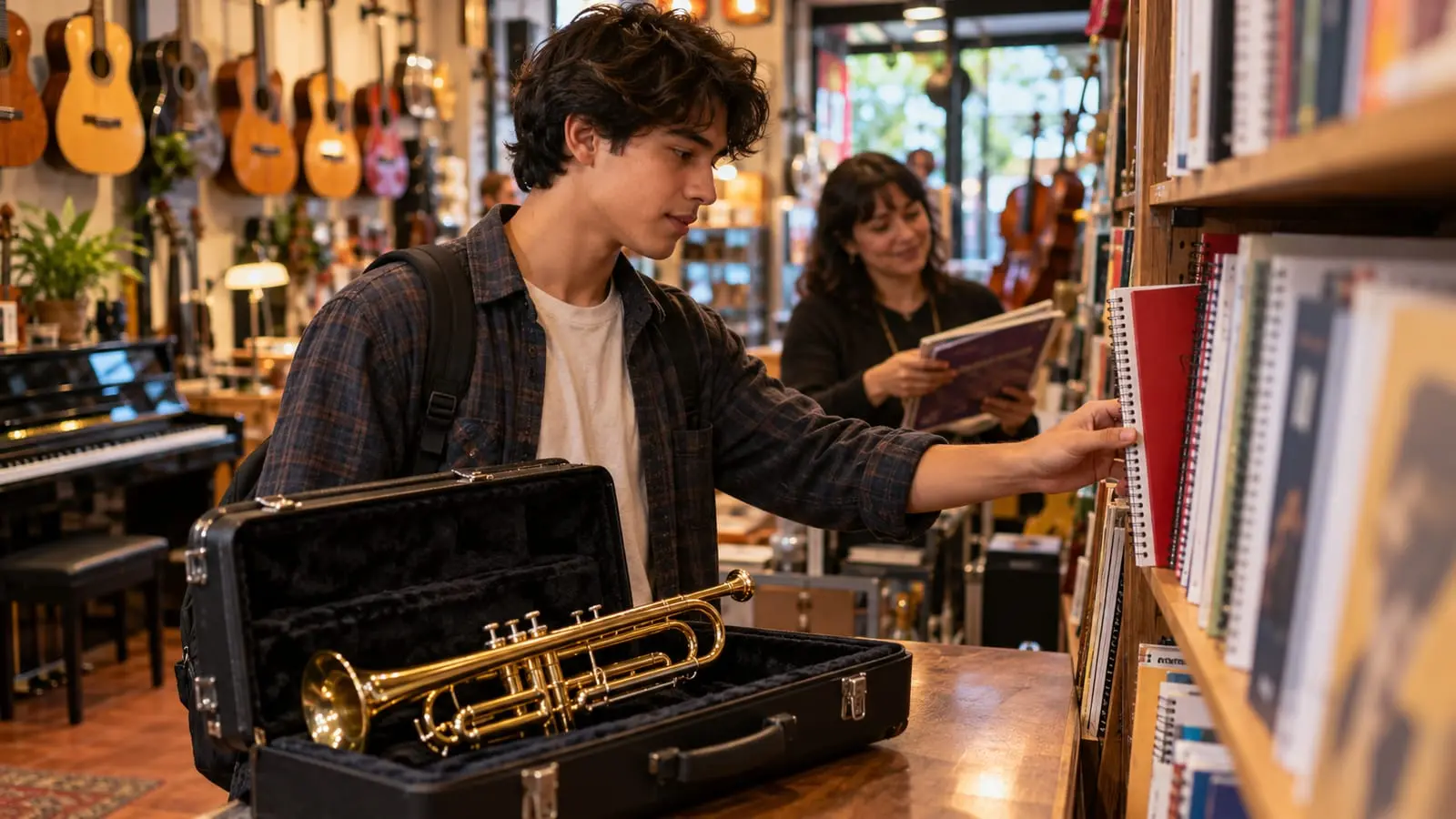
For your admissions audition, choose pieces you truly know well, rather than the hardest ones you can play: the panel listens for tone, intonation, rhythm, technical control, and musicality. If several pieces are required, choose contrasting characters or periods, always within the program’s official requirements.
Each university publishes its own repertoire requirements for each admissions cycle, so reading them is the first step. Then comes the work: learning the pieces well in advance, doing mock auditions, and recording yourself.
In short
- Read the official list first: each university publishes its requirements for pieces, etudes, and scales for each admissions cycle.
- Choose pieces you can play confidently with a good tone; a difficult piece played badly hurts more than it helps.
- If several pieces are required, aim for contrast: fast and slow, different periods or styles.
- If there is a required piece, keep your technique up to date so you can learn it quickly.
- Do mock auditions and record yourself on video in the weeks before the exam.
What universities require at an audition
| University | Instrument requirements at the time |
|---|---|
| Universidad Nacional | Repertoire and technical etudes published each admissions cycle in PDF documents; the instrument exam was an elimination stage |
| Distrital ASAB | Instrumental performance exam with an elimination cutoff of at least 60 out of 100 |
| Pedagógica Nacional (2026-2) | A self-selected piece, a required piece published about a month beforehand, and sight-reading |
| Javeriana | Audition by concentration: in person for Performance, one self-selected piece in any genre for Music Education, and a portfolio of two original works plus an audition for Composition |
| Univalle | Instrumental audition of up to 10 minutes; applicants brought their own instrument, except for piano, double bass, and percussion |
| Los Andes | The audition for the performance track takes place after admission |
There is no universal repertoire: the same piece may be accepted at one university and fail to meet the requirements at another. Check, for example, the program-specific tests at Universidad Nacional or the program-specific test at Univalle.
How to choose your self-selected piece
Your self-selected piece introduces you as a musician. Choose it with your teacher using these criteria:
- You can play it reliably at the intended tempo. If a passage works “almost every time,” it will probably fail under audition nerves.
- It shows off your tone. A lyrical piece or movement lets the panel hear intonation, tone quality, and phrasing, which reveal a lot about a musician.
- It meets the requirements: period, style, duration, number of movements, and whether it must be memorized.
- You like it. You’ll play it hundreds of times; enjoyment comes through.
- It fits the time limit. If the audition is short, the panel may hear only an excerpt; if you can choose, start with the section that best represents you.
Aim for contrast
If several pieces are required, vary the character and period: one fast and one slow, one Baroque or Classical and one Romantic or contemporary, or one classical and one Latin American piece if the list allows it. Contrast reveals more aspects of your playing than two similar pieces.
What about Colombian or popular music?
If the admissions requirements allow a self-selected piece in any genre—as Javeriana’s Music Education concentration did in the cycle we reviewed—a well-played bambuco, pasillo, or popular piece can work very well. For programs with a specified classical repertoire, follow the list. If you’re unsure, ask the university before learning the piece.
Etudes, scales, and the required piece
Technical etudes
An etude demonstrates a specific technical skill: speed, arpeggios, position shifts, bow strokes, or articulation. Play it cleanly and as close as possible to the indicated tempo; if you’re not there yet, ask your teacher whether to prioritize accuracy at a slightly slower tempo.
Scales
Even if they are not explicitly required, major and minor scales and their arpeggios throughout your instrument’s range underpin everything else. If the instructions do require them, prepare every listed key and practice them in random order, since the panel may ask for them that way.
Required piece
This is a piece the university assigns to every applicant, sometimes at short notice: at Pedagógica, it was published about a month beforehand in the admissions cycle we reviewed. To avoid a last-minute rush:
- Keep your technique and reading skills up to date beforehand: you can learn a piece in a month, but not build the technique it requires.
- On the day it is published, read through the entire piece and mark the difficult passages.
- Work on it in sections, starting with the hardest parts.
- Listen to reference recordings, but make your own phrasing decisions.
- Set aside the final week for uninterrupted run-throughs of the whole piece.
Tips by instrument family
| Family | What the panel usually listens for | What to prepare or bring |
|---|---|---|
| Piano | Clarity of voices, pedal control, independence of the hands | Practice on pianos other than your own, because you will play the university’s piano |
| Violin and viola | Intonation, bowing quality, vibrato, position shifts | Rosin, spare strings, and the violin tuner within reach |
| Cello and double bass | Intonation in the upper register, tone in the lower register, bow control | Ask whether the university provides the instrument; Univalle did not require applicants to bring a double bass |
| Guitar | Clear polyphony, even tone across the fingers, intonation | Well-maintained nails if you play with them; replace strings several days beforehand, never on the day |
| Woodwinds | Tone, intonation, articulation, breathing | Spare reeds you have already tested (clarinet, saxophone, oboe) and a clean, checked instrument |
| Brass | Centered tone, flexibility, articulation | Valve or slide lubricant, and time to warm up your lips |
| Singing | Intonation, technique, diction, interpretation of the text | Ask whether you need to bring an accompanying pianist or backing track; sheet music in your key |
| Percussion | Steady beat, dynamic control, stick technique | Your own sticks and mallets; check which instruments the university provides |
If the exam is in Bogotá, allow for cold mornings and dry air: they affect your hands, strings, and reeds. Arrive with time to warm up and adjust your tuning on site.
How to prepare for the audition
| When | What to do |
|---|---|
| 6 months or more beforehand | Choose repertoire with your teacher from the official list and learn it in sections |
| 3 months ahead | All pieces read through in full; work on difficult passages and make a first recording |
| 2 months beforehand | Pieces at tempo; first mock auditions in front of other people |
| 1 month ahead | Run through the entire program several times a week; fine-tune details rather than making major changes |
| Final week | Maintain your preparation, rest well, and introduce nothing new: no new pieces, strings, or untested reeds |
Mock auditions
- Play for your teacher, family, musician friends, or at a student recital.
- Rehearse everything: entering, greeting the panel, announcing your piece, tuning, and starting.
- Occasionally play without warming up first, because you may have little warm-up time on exam day.
- Record yourself on video and watch with the sheet music: check tempo, posture, and signs of tension.
- Choose restart points: places in the piece where you can pick up again if you get lost.
Even very experienced musicians get nervous. You’ll find practical strategies in how to overcome stage fright.
On audition day
- Arrive with time to warm up and tune on site.
- Bring your sheet music, plus copies if the instructions require giving them to the panel.
- Choose a tempo you can maintain, rather than the one on your favorite soloist’s recording.
- If the panel interrupts you or asks you to move to another section, don’t take it as a bad sign: sometimes they have already heard what they needed.
- If you make a mistake, keep going. The panel evaluates the whole performance, not a single measure.
- If the instrument exam also includes sight-reading, use your usual preview routine; we explain it in rhythmic and melodic reading for the admissions exam.
The audition is one part of the exam; theory and ear training count too. To organize everything, see how to prepare for the music admissions exam. If you’d like support preparing your repertoire, Gissi offers piano and other instrument lessons, as well as theory, online or in-home in Bogotá, as part of your admissions preparation.
Frequently asked questions
Do I have to play from memory at the audition?
It depends on the university and the instrument. If the instructions don’t make it clear, ask beforehand. If you decide to play from memory, start memorizing months ahead and try performing for other people without the sheet music.
How many pieces should I prepare?
As many as your program’s admissions requirements specify. Some ask for just one self-selected piece; others add pieces in different styles, etudes, scales, or a required piece. Prepare exactly what they ask for, and prepare it well.
Can I change my piece shortly before the exam?
It’s not advisable in the final month. A piece needs time to settle and hold up under nerves. If one isn’t working, make the decision with your teacher two or three months ahead.
Does the quality of my instrument matter a lot?
More than an expensive instrument, you need one in good condition and properly adjusted. Have it checked well in advance: settled strings, bridge, pads, or valves. If the university provides the instrument, as is often the case with piano, practice on instruments other than your own.
Sources
We checked the facts in this article against these sources on October 22, 2026.
- Universidad Nacional de Colombia: admission to programs with specialty tests (Music and Instrumental Music)
- Universidad Distrital (ASAB): admissions instructions for Musical Arts 2027-1
- Universidad del Valle: Escuela de Música's program-specific entrance test
- Universidad del Atlántico: instructions for the 2026-2 Music admission exam