
Licenciatura en Música at Universidad Pedagógica: what the admission test is like
At UPN, the interview counts as much as the aptitude and knowledge test, and the instrument exam includes a set piece. Here's how to prepare each part.
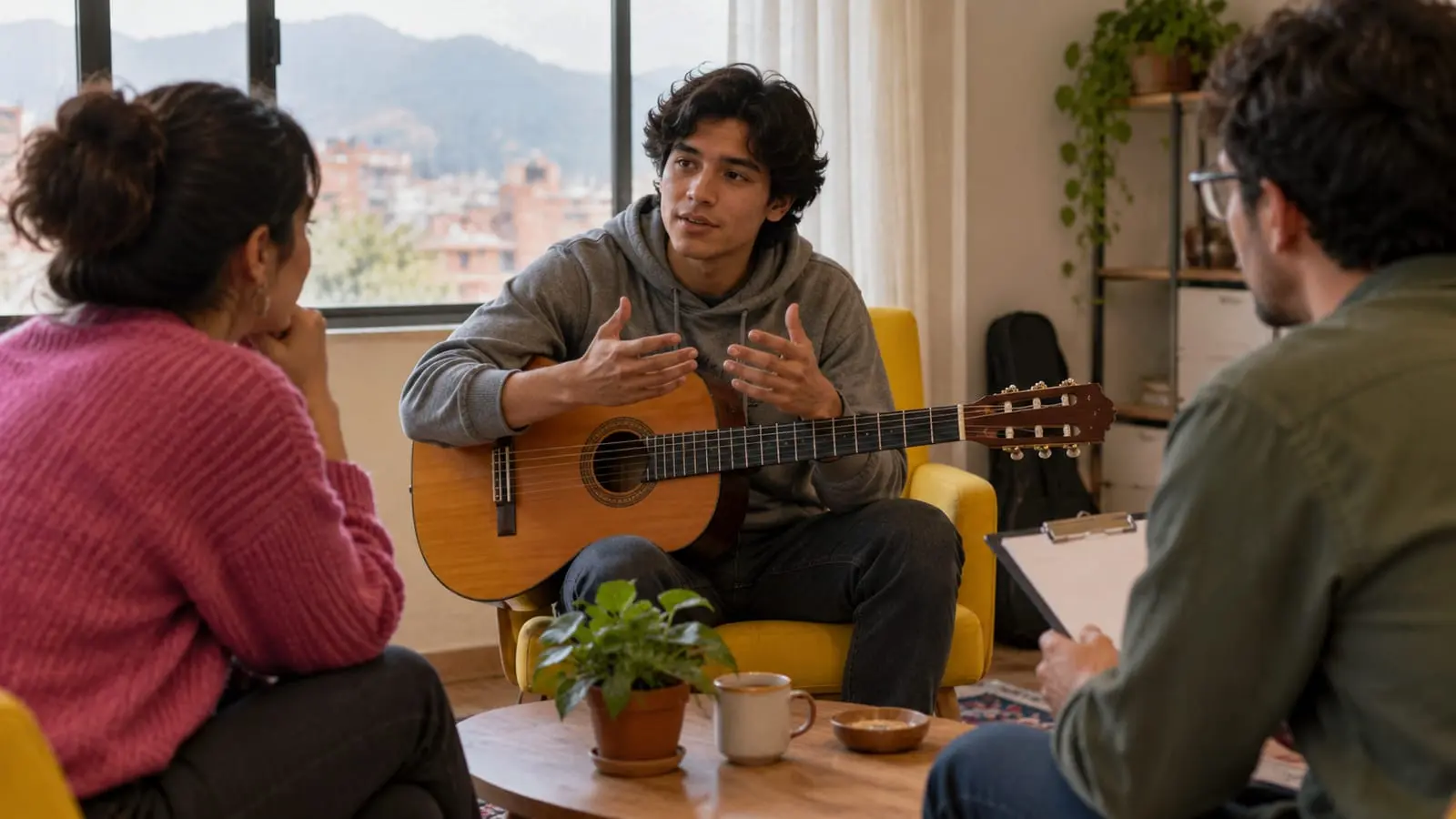
Admission to the Licenciatura en Música at Universidad Pedagógica Nacional (UPN) is based on your performance on your main instrument, your musical aptitude and knowledge, and an interview. For the 2027-1 admissions cycle, applications run from September 28 to November 8, 2026, tests take place on November 30 and December 1 and 2, and the instrument accounts for 20 %, aptitude and knowledge for 40 %, and the interview for another 40 %. Saber 11 is required to apply, but it does not count toward your score.
That weighting says a lot: UPN trains musicians who will teach, and the interview counts as much as the entire listening, reading, and theory assessment. Here is how to prepare for each part.
In short
- 2027-1 admissions: free applications from September 28 to November 8, 2026, program tests on November 30, December 1 and 2, and the list of admitted students on December 18, 2026.
- UPN's music education degree is a public university program lasting 10 semesters and awarding the title Licenciado en Música.
- For the 2027-1 admissions cycle, the assessment is divided into main instrument (20 %), musical aptitude and knowledge (40 %), and interview (40 %).
- The instrument test includes a piece of your choice, an assigned piece, and sight-reading; guidelines for each instrument are published one month beforehand (October 30, 2026 for 2027-1).
- The university expects prior musical training and a chosen main instrument: this is not a program for starting from scratch.
- The interview counts as much as the aptitude and knowledge assessment, so it deserves the same level of preparation.
2027-1 admissions calendar
UPN admits students to the Licenciatura en Música once each semester, and the 2027-1 admissions cycle has already been announced. These are the official dates for the program:
| Stage | Date | Notes |
|---|---|---|
| Registration | September 28 to November 8, 2026 | It is free and completed online using the UPN admissions form. You must have taken Saber 11. |
| Program information session | October 27, 2026, 8:10 to 8:45 a. m. | Online, alongside the other Facultad de Artes information sessions. |
| Instrument test guidelines | October 30, 2026 | Published on the program website for each instrument, including the required piece. |
| Notice to attend the instrument and musical aptitude tests | November 26, 2026 | Published at admisiones.upn.edu.co. |
| Instrument and musical aptitude and knowledge tests | November 30 and December 1, 2026 | In person at the El Nogal campus (calle 78 n.º 9-92). Bring your identity document. |
| Notice to attend the interview | December 1, 2026 | Applicants with the highest combined scores on the previous tests are invited to the interview. |
| Interview | December 2, 2026 | In person at El Nogal. |
| List of admitted students | December 18, 2026 | Published by the Dirección de Admisiones y Registro. |
| Enrollment | No date published | UPN announces it on its admissions website after publishing the list of admitted students. |
If you want to arrive prepared for the test, our music pre-university prep includes mock exams and auditions; see our packages and prices.
How admission at UPN is organized
The music education degree is a 10-semester public university undergraduate program in Bogotá that trains musicians to teach. The assessment therefore looks for more than the strongest instrumentalist: it seeks someone with a solid musical foundation and a real interest in teaching.
| Component | Weight | What it included |
|---|---|---|
| Saber 11 | Required, with no weighting | You need it to apply, but it does not count toward your score. |
| Main instrument | 20 % | A piece of your choice, a required (assigned) piece, and sight-reading. |
| Musical aptitude and knowledge | 40 % | Rhythmic and melodic imitation, memory, coordination, reading, key signatures, intervals, scales, chords, and musical dictation. |
| Interview | 40 % | It carries the same weight as the entire aptitude and knowledge test. You are invited if your combined score on the previous tests is among the highest. |
UPN expects you to arrive with prior musical training and a chosen main instrument. If you are still deciding between two instruments, settle that with your teacher before starting to prepare for the assessment.
Main instrument: chosen piece, required piece, and sight-reading
Although it counts for 20 %, this assessment is your introduction to the panel: they see your actual level in just a few minutes.
Piece of your choice
Choose a piece you can play cleanly even when nervous. A polished, musical performance of a moderately difficult piece is better than a half-finished difficult one. Check the instructions for requirements on length, style, or sheet music.
Required piece
The guidelines for each instrument, including the required piece, are published one month before the test (October 30, 2026 for the 2027-1 admissions cycle). One month is not long: your technique should already be strong enough to learn a new piece in that time. Once it is released, organize the four weeks like this:
- Week 1: read through the whole piece slowly, write in fingerings or breaths, and mark difficult passages.
- Week 2: work on difficult passages separately, with a metronome.
- Week 3: connect sections, increase the tempo, and work out phrasing and dynamics with your teacher.
- Week 4: play through without stopping, record yourself, and perform for other people.
Sight-reading
Read something new on your instrument every day: take a minute to check the key signature, time signature, and difficult rhythms, then play without stopping, even if you make mistakes. We explain how to practice in rhythmic and melodic reading for the music entrance assessment.
Musical aptitude and knowledge: the 40 % you can train
This is the broadest assessment, combining listening, reading, and music theory. The good news is that every skill it assesses can be developed:
| Area | What it assessed | How to practice |
|---|---|---|
| Aptitude | Rhythmic and melodic imitation, short- and medium-term memory, coordination | Repeat clapped rhythms and sung motifs; tap the beat with your foot while clapping another rhythm. |
| Reading | Music reading | Daily rhythm reading and sight-singing, always with new material. |
| Music theory | Key signatures, intervals, scales and chords, and identifying intervals by ear | Recognize key signatures instantly, write major and minor scales, and build triads and seventh chords. |
| Dictation | Music dictation | Short rhythmic and melodic dictations several times a week. |
Coordination often catches out applicants who have only practiced their instrument. Train it with independence exercises: tap the beat with your foot and a rhythm with your hands, or sing a simple melody while clapping the beat.
The interview: how to prepare as a future teacher
At 40 %, the interview can affect your result as much as the knowledge assessment. In a music education degree, it makes sense that the panel wants to know your background, motivation, and connection to teaching. Prepare like this:
- Describe your musical background in about two minutes: how you started, who you have studied with, and which groups you have played in, whether a school band, choir, or Andean music group.
- Have specific examples of teaching experience, even informal ones: helping a classmate with theory or supporting a younger sibling who is starting out.
- Explain why you want a music education degree rather than another music undergraduate program; understand how it differs from a Maestro en Música degree.
- Read about the program: its curriculum and approach.
- Think about where music is taught in Colombia: schools, music schools, cultural centers, and bands.
Avoid memorized or generic answers and practice with someone who asks you meaningful questions. In the music admissions interview, you will find questions worth preparing and the mistakes that hurt your chances most.
A preparation plan in stages
| Stage | Instrument | Aptitude and knowledge | Interview |
|---|---|---|---|
| 6 months ahead or more | Daily technique practice and chosen piece selected | Music theory: key signatures, scales, intervals, and chords | Write down your musical background |
| 3 months ahead | Chosen piece ready to play through; daily reading | Musical dictation and sight-singing several times a week | Read about the program and teaching work |
| 1 month ahead | Required piece, as soon as it is released | Mock imitation, memory, and coordination assessments | Practice interviews |
| Final week | Play through without stopping and rest | Light review | Organize your thoughts without memorizing answers |
If you want guidance as you prepare, Gissi offers music theory, solfège, musical dictation, and instrument lessons with teachers online or at home in Bogotá. You can also rehearse the interview with your teacher. Learn more in preparation for music entrance assessments.
UPN also offers open extension courses, including preparatory piano and introductory musical ear training. These are training courses and, as far as we could establish, do not provide direct admission. For a plan that prepares you for several universities at once, see how to prepare for a music entrance assessment.
Frequently asked questions
Do I need musical knowledge to apply to UPN's music education degree?
Yes. The university expects prior musical training and a chosen main instrument, and the assessment includes reading, music theory, and musical dictation. If you are just starting, first spend some time building those foundations.
When is the required piece released?
Guidelines for each instrument are published one month before the test: October 30, 2026 for the 2027-1 admissions cycle, with tests on November 30 and December 1. Check the admissions process page regularly and have your technique ready by then so you can learn the piece quickly.
Does the Saber 11 score count at UPN?
It is required to apply (for 2027-1, you must have taken it), but it does not count toward the Licenciatura en Música admission result: selection is based on the music-specific admission test and the interview.
How long is UPN's music education degree, and what qualification does it award?
It lasts 10 semesters and awards the title Licenciado en Música. This undergraduate program trains musicians to teach, unlike Maestro en Música programs, which focus on artistic practice.
Sources
We checked the facts in this article against these sources on October 23, 2026.
- Universidad Pedagógica Nacional, Admissions: requirements and dates for the 2027-1 admissions cycle
- Universidad Pedagógica Nacional, Admissions: 2027-1 undergraduate selection schedule
- Universidad Pedagógica Nacional, Admissions: 2027-1 Licenciatura en Música selection process document (PDF)
- Universidad Pedagógica Nacional, Admissions: 2027-1 information sessions
- Universidad Pedagógica Nacional: structure of the Licenciatura en Música admission test
- Universidad Pedagógica Nacional: undergraduate degree in music education (degree awarded, duration, and credits)
- Universidad Pedagógica Nacional: non-degree extension courses at the Facultad de Bellas Artes