
Music aptitude test at Universidad de Caldas: what it's like and how to prepare
At Universidad de Caldas, your Saber 11 score decides who takes the test and counts for half of the final score. The other half is a test of rhythm, intonation and instrument. We explain each part.
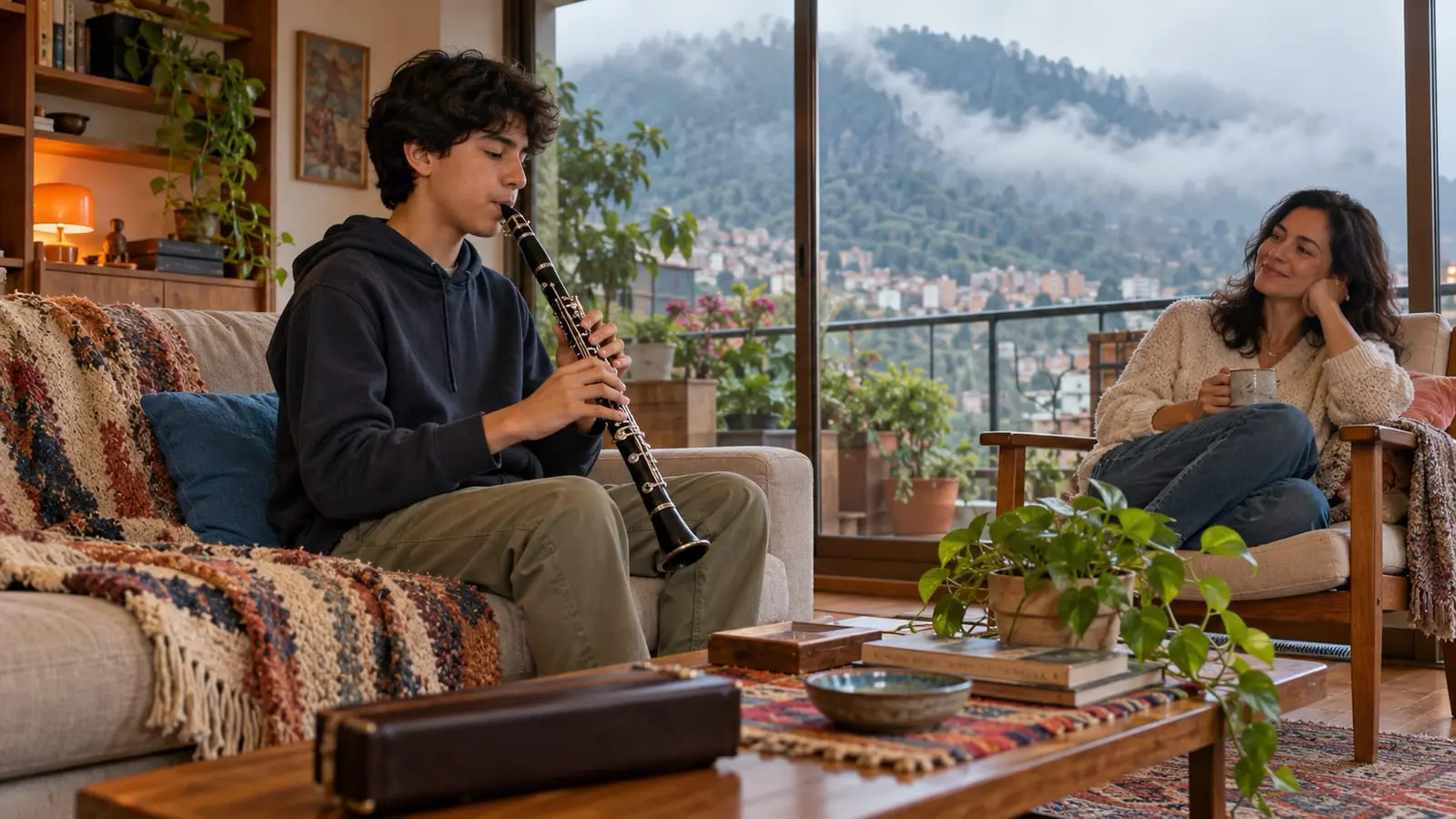
Universidad de Caldas in Manizales offers two undergraduate music degrees: music education and music performance. For both, the final score is calculated as 50 % weighted Saber 11 score and 50 % in-person aptitude test, and Saber 11 also determines who is shortlisted to take that test.
Both programs share a rhythm test and a singing test. The music performance program then adds an interview and instrumental audition, while music education adds a teaching test and a short instrumental audition. Bear in mind: according to the information we reviewed, admissions are annual, and neither program was listed as available for 2027-1.
In short
- The final score for music education and music performance is 50 % weighted Saber 11 and 50 % aptitude test.
- The university uses Saber 11 to shortlist applicants for the aptitude test; the number shortlisted and the available places are specified in each year's instructions (in 2025, there were 70 shortlisted applicants and 30 places per program).
- Shared tests: rhythm and singing (with a song of your choice and possible sight-reading); music performance adds an interview and instrument, while music education adds a teaching test and instrument.
- In music education, the teaching test involves teaching one of five prepared songs, chosen by the panel.
- Both programs are offered annually and, according to the 2027-1 admissions calendar, the university lists them as unavailable.
The music programs and when admissions open
| Program | Qualification | Class schedule | Availability |
|---|---|---|---|
| Music Education | Licenciado(a) en Música | Daytime, in person, in Manizales | Annual; not offered for 2027-1 |
| Maestro en Música | Maestro(a) en Música | Daytime, in person, in Manizales | Annual; not offered for 2027-1 |
Both programs are offered once a year, and the 2027-1 admissions calendar lists them as unavailable. If the annual offering continues, the next opportunity would be the midyear admission cycle, but confirm this when the university publishes its calendar.
Music education or music performance? The former trains teachers; the latter trains professional musicians with a practical focus. If you are unsure, read a music performance degree or a music education degree?.
Shortlisting based on Saber 11 and the final score
Saber 11 really matters here. According to the official page, the university uses Saber 11 to shortlist applicants for the aptitude test, and anyone who does not take that test cannot be considered for a place. The weighted Saber 11 score accounts for 50 % of the final score, and the aptitude test accounts for the other 50 %. The 2025 instructions shortlisted 70 people per program for 30 places; confirm the current numbers.
In practice, that means preparing on two fronts: a strong Saber 11 result to make the shortlist and compete for a place, and a strong aptitude test. If you are still in school, do not sacrifice the state exam by studying only music.
The shared tests: rhythm and singing
| Test | What it assesses | Weight in music performance | Weight in music education |
|---|---|---|---|
| Rhythm test | Observation and repetition exercises; you may be asked to sight-read a rhythmic exercise in simple and compound meter. | 30 % | 25 % |
| Singing test | Imitation and repetition exercises, a song of your choice, and possibly sight-singing a melody in a major or minor mode. | 30 % | 25 % |
For your chosen song, the university suggests one with a melody that moves across different pitches, so your pitch accuracy can be assessed. Avoid songs limited to three or four notes, however comfortable they may feel.
- Rhythm: clap patterns in 2/4, 3/4, and 6/8 with a metronome, and have someone give you new patterns to repeat after one hearing.
- Singing: sing major and minor scales, and imitate short phrases played on a piano or in an app, without instrumental support.
- Sight-reading: read an unfamiliar rhythmic exercise and short melody every day. Find the method in rhythmic and melodic reading for the entrance exam.
The program-specific tests
Maestro en Música
- Interview (10 %): a 5 to 8 minute conversation with teachers to assess your profile and potential as a student.
- Instrumental audition (30 %): an audition with scales, études, and repertoire. The repertoire is assigned only to shortlisted applicants and published on the admissions page.
Music Education
- Teaching test (25 %): you take the role of teacher and teach one of five songs you prepared beforehand, chosen by the panel. You can bring an instrument for harmonic accompaniment or use percussion instruments in the room.
- Instrumental audition (25 %): a short audition to demonstrate basic knowledge of the instrument you want to study, with scales, études, and repertoire.
You must bring your instrument, except for double bass, tuba, piano, harp, and percussion. Since the repertoire is announced after shortlisting, there is little time to prepare it: keep your basic technique (scales, arpeggios, and reading) in shape so you do not start from scratch. We help you organize it in repertoire for the entrance audition.
You can rehearse the teaching test: choose a simple song, decide what you want the group to learn, teach it in parts (rhythm, lyrics, melody), and practice with family or friends. Find more ideas in the music admissions interview, which explores the same commitment to teaching.
How to prepare for the Universidad de Caldas test
- Plan around the annual calendar: once the calendar is published, work backward from the test dates.
- Saber 11: prepare seriously, because it determines shortlisting and half your score.
- Rhythm and singing every day: these account for 60 % of the test in music performance and 50 % in music education.
- Instrument: keep your basic technique in shape so you can prepare the assigned repertoire quickly.
- Music education: rehearse the teaching test with the five songs you are given.
The university has offered a pre-university music prep program covering music fundamentals, vocal practice, music appreciation, and instrumental study. Check the Facultad de Artes y Humanidades page for an open cohort.
You can also prepare with teachers in online lessons at Gissi from Manizales or any other city: music theory, singing in tune, reading, and instrument, with a plan built around the test date. Find out how in music entrance exam preparation. For intervals and ear training, use our ear training tool; for the overall schedule, see how to prepare for a music entrance exam.
Frequently asked questions
How much does Saber 11 count for music at Universidad de Caldas?
50 % of the final score, according to the admissions page, and Saber 11 also determines who is shortlisted to take the music test.
When does Universidad de Caldas open music admissions?
Both programs are offered annually, and the university lists them as unavailable for 2027-1. Check the next term's calendar when it is published.
What is the teaching test for the music education degree?
You take the role of teacher and teach one of five songs you prepared beforehand, chosen by the panel. It accounted for 25 % of the aptitude test under the 2025 instructions.
When do I receive the audition repertoire?
According to the 2025 instructions, repertoire is assigned only to shortlisted applicants and published on the admissions page after shortlisting based on Saber 11. That is why you should arrive with solid basic technique.
Sources
We checked the facts in this article against these sources on October 22, 2026.
- Universidad de Caldas: on-campus undergraduate admissions, score weights, and 2027-1 calendar
- Universidad de Caldas: FAQs on selection, weighted scores, and aptitude tests (2025)
- Universidad de Caldas, Facultad de Artes y Humanidades: undergraduate degree in music education
- Universidad de Caldas, Facultad de Artes y Humanidades: Maestro en Música degree