
Admission to Estudios Musicales at the Javeriana: auditions by specialization and preparation
At the Javeriana, the audition depends on your specialization: Performance, Composition, Conducting and Music Education each ask for different things. Here's how to prepare for each.
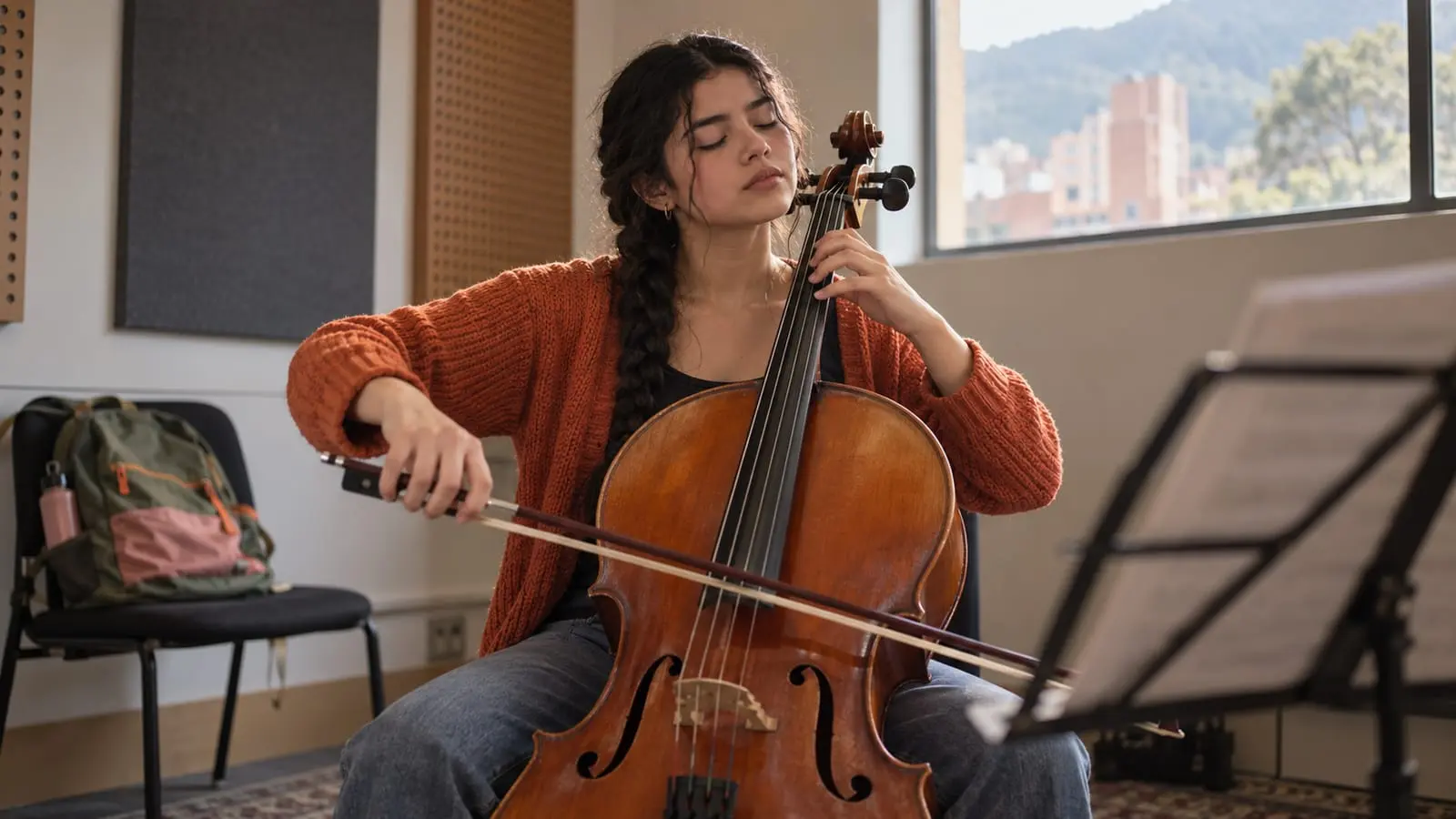
Admission to the Musical Studies degree at Pontificia Universidad Javeriana combines musical aptitude tests with exams that depend on your chosen specialization. According to the official program page, Performance applicants attend an in-person audition; Composition or Songwriting and Production applicants submit a portfolio of two original compositions in addition to an instrumental audition; Conducting applicants audition in choral or orchestral conducting; and Music Education applicants submit a short essay and perform a piece of their choice in any genre.
Your first decision, then, is which specialization to apply for. Once you have made that choice, you can decide what to play. Here we help you think it through and prepare for each option.
In short
- First term of 2027: Javeriana opened applications for Estudios Musicales on August 24, 2026, and closed them on October 11, 2026; audition dates have not been published.
- Javeriana’s Musical Studies degree is a private undergraduate program with 9 semesters and 160 credits that awards the professional degree Maestro en Música, with eight specializations.
- All applicants take musical aptitude tests; the other exams vary considerably by specialization.
- The Composition and Songwriting and Production specializations each require a portfolio of two original compositions.
- Music Education accepts a piece of your choice in any genre (classical, rock, pop, popular, jazz), opening the door to musicians with a popular music background; it also requires a short essay.
- Ask the program whether you will need placement exams or a foundation course after admission.
2027-1 admissions calendar
Javeriana’s official undergraduate application dates table lists Estudios Musicales for entry in the First Term of 2027. Here is what has been published:
| Stage | Date | Notes |
|---|---|---|
| Applications open | August 24, 2026 | For first-semester entry, enrollment in an additional program, transfers from another university and internal transfers. |
| Applications close | October 11, 2026 | This date has passed. The official table lists Estudios Musicales only for the First Term of 2027. |
| Application fee payment and documents | No separate date published | Pay the fee and submit supporting documents through the admissions self-service portal during the application period. |
| Audition, portfolio, essay and interview | No date published | According to the university’s guide, the self-service portal shows the program’s activities and whether the program schedules them for you or you need to book them yourself. |
| Results and enrollment | No date published | Details are provided through the admissions self-service portal. |
To arrive well prepared for your audition, our music pre-university prep includes mock exams and auditions; see the packages and prices.
How admission to Estudios Musicales works
Musical Studies is a private undergraduate program in Bogotá with 9 semesters and 160 credits, taught in person during the day. It awards the professional degree Maestro en Música and has eight specializations: Composition, Conducting, Music Education, Sound Engineering, Performance, Jazz and Popular Music, Songwriting and Production, and Colombian Regional Music.
Everyone takes musical aptitude tests (singing in tune, tonal awareness, rhythmic sense, aural recognition, and basic music theory), and almost every specialization includes an interview; the remaining requirements vary. Saber 11 results are listed among the application documents, but we found no weight for this degree, so ask the university directly instead of relying on what a forum says.
What each specialization requires
| Specializations | What it included | What to focus on |
|---|---|---|
| Performance | In-person audition (instrument-specific details are in a separate program document) | Well-prepared repertoire, solid technique, and good tone. |
| Composition | Portfolio of 2 original compositions + instrumental audition + interview | Completed works, with clear scores in the format required by the admissions notice. |
| Songwriting and Production | Portfolio of 2 original compositions + instrumental audition + interview | Complete original songs: lyrics, structure and a clear demo. |
| Conducting | Choral, orchestral, or band conducting audition + instrumental or vocal audition + interview | Clear gestures, thorough score preparation and good communication with the musicians. |
| Music Education | Short essay (1200 to 1500 words) + a piece of your choice + interview | A piece that represents you and that you can play confidently, and an essay showing thoughtful reflection on music and teaching. |
| Sound Engineering | Written exam in mathematics and the physics of sound | Review the speed of sound, frequency, period, wavelength, timbre, and intensity. |
| Jazz and Popular Music | In-person audition with an ensemble provided by the program | Prepare your part so you can play with musicians you have not met. |
| Colombian Regional Music | In-person instrumental or vocal audition + interview | A regional piece you know well and can explain. |
The Music Education requirement is among the most flexible we found in Bogotá: if your background is in vallenato, Andean music, rock or salsa, that experience counts. If you learned by ear, also compare the Los Andes musical aptitude test, which likewise does not test theoretical knowledge.
How to prepare for the Performance or Music Education audition
- Choose pieces you can play well even when nervous, rather than the hardest ones you have attempted.
- If the format allows more than one piece, aim for contrast: one slow and lyrical, another lively and rhythmic.
- Prepare the opening carefully: tune calmly, choose your tempo before starting, and breathe.
- Rehearse the whole audition: walking in, greeting the panel, getting ready, playing and answering questions.
- Record your rehearsals and listen the next day with fresh ears.
- If you sing, arrive with your voice warmed up and avoid straining it in the preceding days.
For Music Education, freedom of genre does not mean choosing at the last minute. Pick a piece that shows your musicality: a steady beat, accurate pitch and a clear musical intention. A well-played popular song says more than an uncertain performance of a classical piece. We explore the choice in repertoire for the admissions audition.
Composition portfolio and conducting test
A portfolio of two original works
- Submit finished works, rather than sketches. Two polished pieces say more than five loose ideas.
- Aim for contrast: differences in instrumentation, character or musical language show a broader range of skills.
- Take care with the score: it should be legible, with dynamics, articulations and tempo markings; check the required format.
- For songs, make the structure clear (verse, chorus, bridge) and ensure the demo communicates your idea.
- Be ready to explain your choices: why that form, harmony or instrumentation.
Conducting an ensemble
Conducting musicians you do not know requires thorough score study: knowing every entrance, singing the main parts and being clear about what you want to hear. Practice clear gestures for beating time and cueing entrances, and give specific, brief corrections. If you can, ask your school choir or band to let you conduct a few rehearsals.
After admission: placement and foundation courses
Passing the audition is not the end. Some programs hold placement exams or offer foundation courses after admission; we found no published information about this for this degree, so ask the program. In any case, arriving with a solid foundation saves you time.
This matters especially if you enter Music Education with a popular song: admission is flexible, but the degree involves theory, reading and ear training from the start. Before beginning, strengthen:
- Music theory: keys, scales, intervals and chords.
- Rhythmic reading and sight-singing.
- Rhythmic and melodic dictation; for step-by-step practice, see how to prepare for music dictation.
UCollege and other ways to prepare
Javeriana offers UCollege – Music Preparatory Program, covering solfège and ear training, aural and vocal technique, music appreciation, and pop ensemble. The faculty makes clear that the course strengthens the required skills, but admission to the degree program is only through the official entrance exam: the preparatory program builds your skills but does not guarantee a place.
You can also prepare with private lessons. At Gissi, you work on music theory, solfège, dictation and your instrument or voice with teachers, through online or in-home lessons in Bogotá. Learn how in preparation for music entrance exams. For the full process, from the first month to test day, see how to prepare for a music entrance exam.
Frequently asked questions
Can I apply to Javeriana if I cannot read sheet music?
It depends on the specialization. For Music Education, the official page asks for a piece of your choice in any genre, but all applicants take aptitude tests that include basic music theory, and the entry profile mentions basic music reading and writing. It is a good idea to start reading music now.
How much does Saber 11 count for music admissions at Javeriana?
Saber 11 is listed among the application documents, but we found no published weight for this degree. Ask the admissions office before drawing conclusions.
What does it mean if I am assigned a foundation course?
A foundation course helps reinforce the basics before you continue with the curriculum. We found no published information on whether or how this degree program uses one; ask the program. Arriving with a solid grounding in theory and aural skills always helps.
Does completing UCollege guarantee a place in the degree program?
No. The Facultad de Artes makes clear that admission to the degree program is only through the official entrance exam.
Sources
We checked the facts in this article against these sources on October 23, 2026.
- Pontificia Universidad Javeriana: undergraduate application dates (First Term of 2027)
- Pontificia Universidad Javeriana: application and admission process guide
- Pontificia Universidad Javeriana: Musical Studies degree (specializations, entrance exams, 9 semesters)
- Pontificia Universidad Javeriana, Facultad de Artes: UCollege, Music Preparatory Program