
How do you clean and look after a violin (and a viola)?
Rosin, bow, bridge, soundpost and humidity: what your violin teacher expects you to do after every practice session, every week and every year. The same goes for the viola.
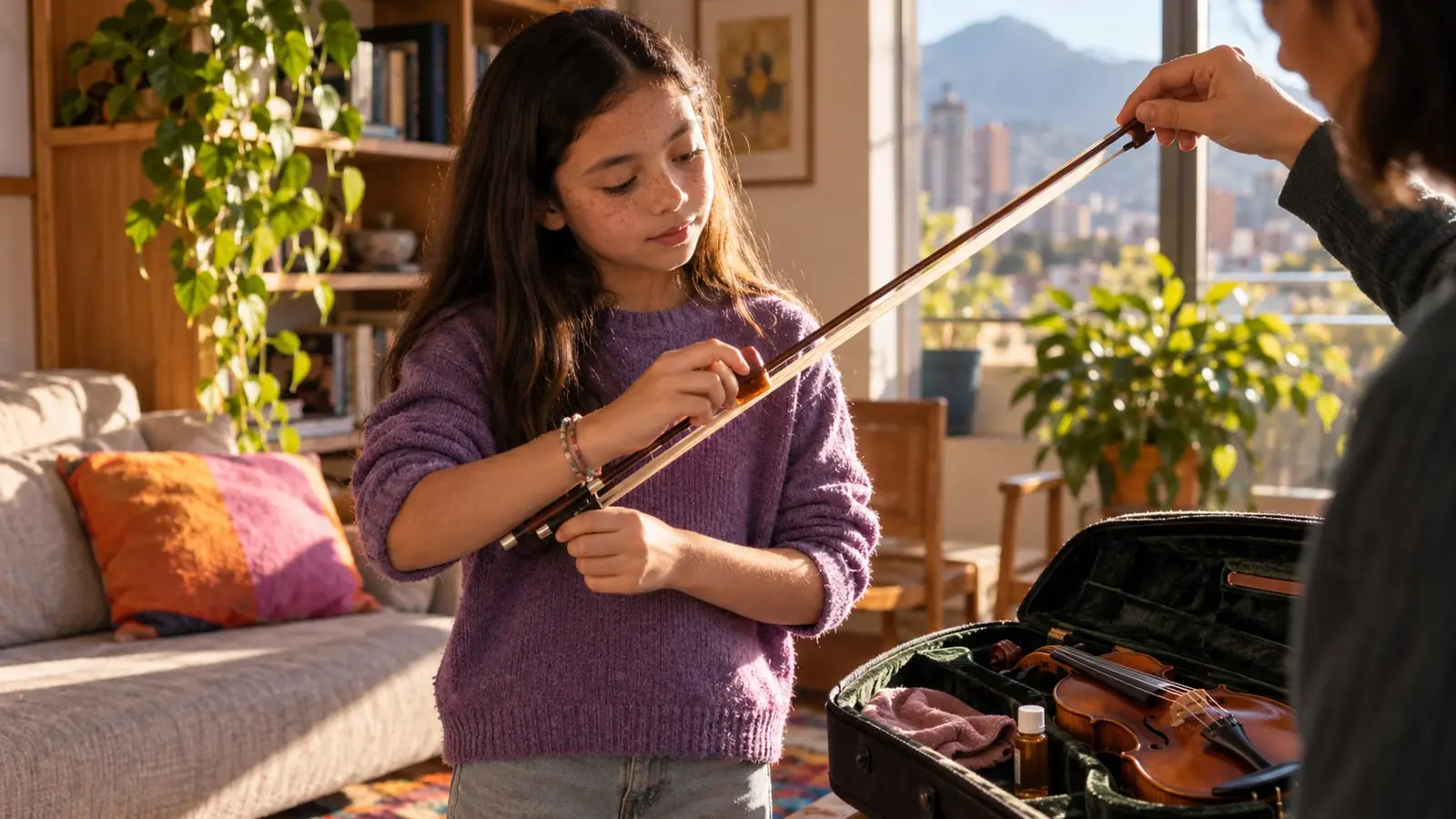
After each practice session, loosen the bow, wipe the rosin off the strings and top with a dry cloth, and put the violin in its case with all fasteners secured. Once a week, look at the bridge from the side to make sure it's still upright. Never touch the bow hair with your fingers.
Everything that follows also applies to the viola: it's a little bigger and lower in pitch, but needs exactly the same care.
In short
- Loosen the hair every time you put the bow away: leaving it tight makes the stick lose its curve.
- Don't touch the hair: oils from your skin prevent the rosin from gripping, and that area stops producing sound.
- Wipe rosin off the strings, top, and bow stick with a dry cloth after playing; keep alcohol away from the varnish.
- Tuning pulls the bridge toward the fingerboard: check it weekly and straighten it before it falls.
- The soundpost is an internal part that only a luthier should move; if it falls, loosen the strings and don't play the instrument.
What to do after each practice session, each week, and each year
| When | What to do |
|---|---|
| After each practice session | Loosen the bow, wipe rosin off the strings, top, and bow stick, place it in its case, and secure the fasteners |
| Every week | Check that the bridge is upright and the fine tuners aren't at the end of their travel |
| Every month | Check for broken bow hairs, inspect the rosin, and check the inside of the case |
| Every 6 to 12 months | Replace worn strings and have a luthier check the instrument |
| Every one or two years, depending on use | Replace the bow hair (rehairing) |
If you play several hours a day, these intervals get shorter. The timelines for strings and bow hair are only a guide: the sound and your teacher's advice matter most.
Rosin and bow: the most common mistakes
How to apply rosin (colophony)
- Tighten the bow until the gap between the stick and hair at the center is about the width of a pencil. No more, no less.
- Move the rosin slowly along the hair, from frog to tip. Three or four passes are usually enough.
- If the rosin is new and smooth, it won't grip: gently scratch the surface to roughen it up; your teacher or luthier can show you how.
- A freshly rehaired bow needs many more passes the first time.
Too much rosin is easy to spot: a scratchy sound, a white cloud while you play, and dust stuck to the top. A little rosin every one or two practice sessions is better than a lot at once. Store it in its box or wrapped in cloth: it breaks if dropped and softens in heat, such as in a car in the sun.
Caring for the bow
- Never touch or wash the hair, or apply talcum powder or other products to it.
- Loosen the hair when putting the bow away, until it's relaxed but not hanging loose.
- If a hair breaks, cut it with scissors near the tip and frog. Don't pull it out: you could loosen the wedge that holds the hair in place.
- Protect the bow tip: it's the most fragile part, and hitting a music stand or the floor can break it.
- If the case stays closed for long periods, open it and air it out occasionally: tiny insects can eat the bow hair in dark, unused cases.
If you're still learning your bow hold, see how to hold a violin bow: a relaxed hand also protects the stick and hair.
How to clean the strings, top, and varnish
Use a soft cotton or microfiber cloth reserved for the violin. Hold the instrument by the neck, not the top, and:
- Wipe the strings between the bridge and the end of the fingerboard, where rosin builds up.
- Clean the top beneath the strings and around the f-holes without moving the bridge.
- Clean the fingerboard, the edge of the chin rest, and the bow stick.
If rosin has already hardened on the strings, don't scrape it off with your nails or metal objects. Some players clean the strings with alcohol on a cloth, but that's risky: one drop on the varnish is enough to stain or dissolve it. There are cleaners for strings and for the varnish on bowed string instruments; even so, it's best to leave deep cleaning of the varnish to a luthier at your checkup.
Never use furniture products, glass cleaner, or general-purpose polishes. A dull patch where your jaw or hand rests is normal wear from sweat; a luthier can protect it.
Bridge, soundpost, and tuning pegs
The bridge
The bridge isn't glued in place: string pressure holds it up. Each time you tune with the pegs, the strings pull the top of the bridge a little toward the fingerboard. After weeks of tuning, the bridge leans, warps, and, in the worst case, falls over.
- Look at it from the side: the face toward the tailpiece should be roughly perpendicular to the top.
- If it's leaning, rest the violin in your lap, grip the upper part of the bridge with the thumbs and index fingers of both hands, and gently move it back into position. If you've never done this, ask your teacher to show you first.
- When changing strings, run a pencil tip through the grooves in the bridge and nut: graphite helps the strings slide without pulling the bridge along.
- If the bridge is already warped, straightening its position isn't enough: it needs to be replaced.
The soundpost
Inside the violin is a small wooden dowel, the soundpost, between the top and back, near the bridge foot on the E-string side. It isn't glued in place either. If the bridge falls or you loosen all the strings at once, the soundpost can fall. If you hear something loose inside, loosen the strings, don't play the violin, and take it to a luthier: playing without a soundpost can make the top sink or crack. Never try to reposition it yourself.
Pegs and fine tuners
If a peg slips, push it slightly inward as you turn it; if it sticks or squeaks, it may need peg compound. Slipping is more common in dry air, while sticking is more common in hot regions. Check the fine tuners too: if they're screwed all the way down, the part underneath can scratch the top. Return them to the middle of their range and retune with the peg, using the online violin tuner and the steps in how to tune a violin.
Humidity, temperature, and the case
The violin is made of thin pieces of wood joined with animal glue, designed to give way before the wood does. That's why, when the air becomes dry, a seam between the top and ribs often opens first; you'll notice a new buzzing sound. It's a simple repair for a luthier, and much better than a crack.
- In Bogotá, during dry seasons or if you use a heater, a case humidifier helps prevent cracks and loose pegs. Wring it out well: it should never drip.
- In hot regions and on the coast, excess humidity is the problem: sticky varnish, rusty strings, stiff pegs, and mold in the case. Air it out and use moisture-absorbing packets.
- Never leave it in a closed car, beside a sunny window, or near a fireplace.
- If you come in from the cold outdoors to a warm home, leave the violin in its case for a few minutes before opening it.
The case
- Always close the latches or zippers, even if you're only moving it two meters. Picking up an open case is one of the most common ways a violin ends up on the floor.
- Don't carry loose objects (rosin, a tuner, pencils) where they could hit the instrument.
- Don't leave the case on chairs or beds where someone might sit on it.
- Take the cloth out of the case if it's damp.
All of this applies to the viola too. For humidifiers and travel between climates, read how to store instruments for Colombia's climate.
Common beginner mistakes
- Leaving the bow tight “so I won't have to tighten it tomorrow.”
- Applying rosin at every practice session as if there's never enough, until the violin turns white.
- Always tuning with the pegs and never checking the bridge.
- Leaving the violin on a chair or bed “just for a moment.”
- Loosening all the strings at once to clean or replace them.
- Carrying it in a car trunk or next to a sunny bus window.
If you're starting violin, your teacher will check the bridge and bow with you during your first lessons: that's part of learning, not an extra.
Frequently asked questions
How often should I rosin my bow?
For most students, a few passes every one or two practice sessions. If the bow slips without producing sound, it needs more; if you see white dust and hear a scratchy sound, there's too much.
How do I know when my bow needs rehairing?
When it has lost many hairs, has more hair on one side than the other, no longer tightens properly, or won't grip the string even with rosin. With daily use, this is usually every one or two years; with less use, the hair lasts longer.
What should I do if my violin bridge falls?
Slightly loosen any strings that are still tight, put the bridge somewhere safe, and listen for anything loose inside without shaking the violin. Take it to a luthier: placing the bridge in exactly the right spot and checking the soundpost are part of their work.
Can I clean a violin with alcohol?
No. Alcohol dissolves many violin varnishes, and one drop is enough to leave a mark. For everyday care, use a dry cloth; for deep cleaning, use a product specifically for bowed string instruments or take it to a luthier.
Does a viola need the same care as a violin?
Yes: the same rules apply to rosin, the bow, bridge, soundpost, humidity, and case. What changes is the tuning (C, G, D, A instead of G, D, A, E), along with the size of the instrument and accessories such as strings, the case, and the chin rest.
Sources
We checked the facts in this article against these sources on October 22, 2026.