
How should you store your instruments for Colombia's climate?
Wood, leather, glue and pads all react to the climate. How to store your instrument in Bogotá, on the coast, in the hot lowlands and when you travel.
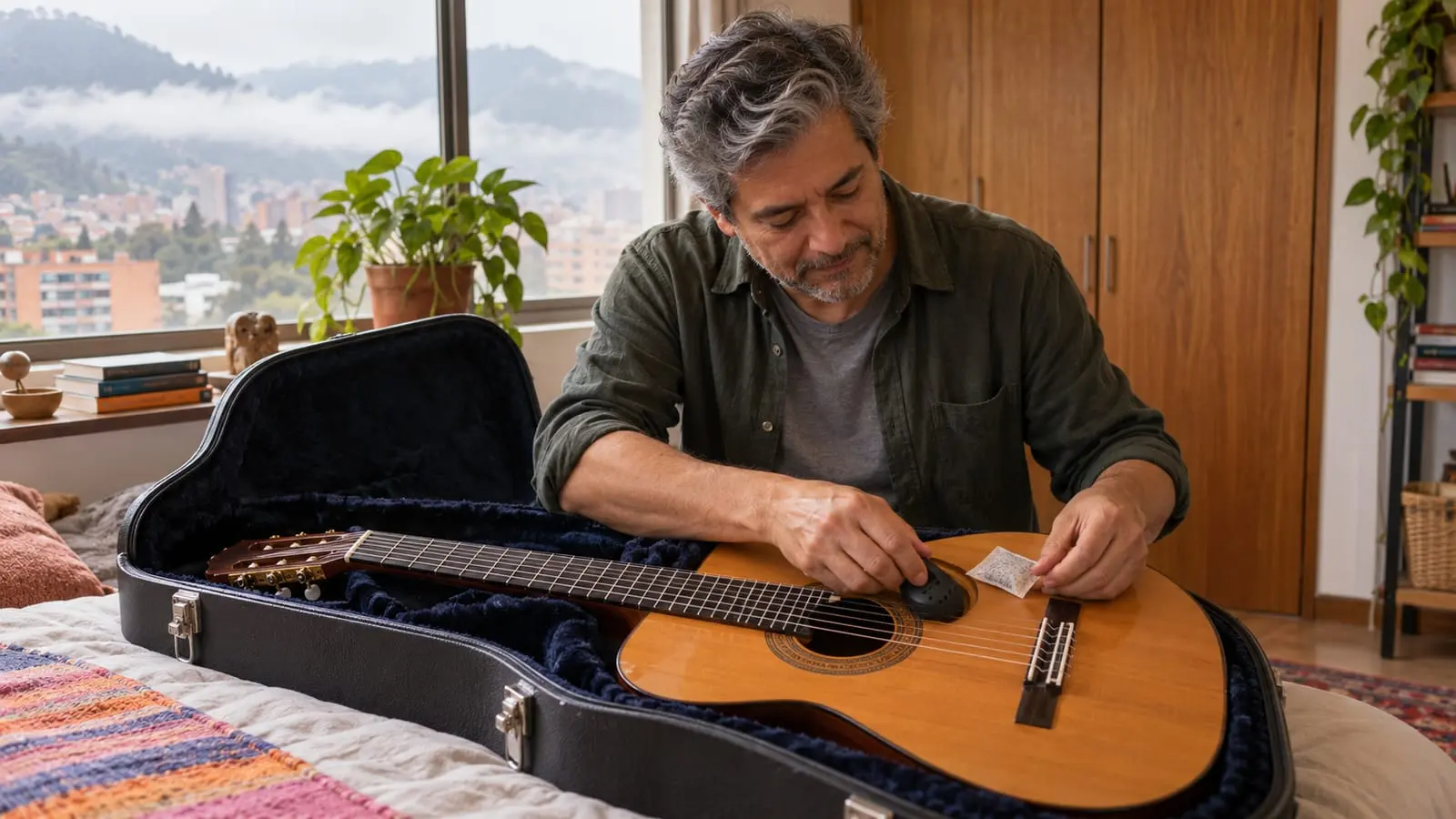
Store your instruments in their cases indoors, away from windows, exterior walls, and heat sources, and never in a closed car. In Bogotá, protect them from sudden temperature changes and dry seasons; on the coast and in hot regions, from excessive humidity and salt air. Before buying a humidifier or dehumidifier, measure the humidity with a hygrometer.
In Colombia, a couple of hours on the road can take you from the cold Bogotá plateau to a hot, humid valley. For an instrument made of wood or leather, or one with key pads, that change puts real stress on it. This guide helps you prepare.
In short
- Most wooden instruments do well at moderate relative humidity, roughly between 40 and 60 %.
- Measure before making adjustments: an inexpensive hygrometer tells you whether to add moisture, remove it, or do nothing.
- Sudden changes do more damage than an extreme but stable climate.
- Never leave an instrument in a closed car in the sun, even briefly.
- When you arrive in a different climate, keep the case closed for a while before opening it.
How humidity and temperature affect instruments
Wood constantly absorbs and releases moisture: it swells in humid air and shrinks in dry air. The leather in drumheads and key pads, along with felt and adhesives, also reacts. The problem is less the climate itself than a rapid change from one extreme to another.
| Instrument | Very dry air or a sudden change to cold conditions | Very humid air or heat |
|---|---|---|
| Guitar, tiple, and bandola | Cracks in the top, fret ends protruding from the neck, lower action and fret buzz. | Higher string action, dull tone, rusty strings; intense heat can loosen the bridge. |
| Violin, viola, and cello | Cracks, open seams, and loose tuning pegs. | Stuck tuning pegs, dull tone, and seams opening in the heat. |
| Acoustic piano | Unstable tuning and, in extreme cases, soundboard cracks. | Sluggish or sticking keys, rusty strings, and tuning problems. |
| Clarinet, oboe, and other wooden woodwinds | Cracks, especially when blowing warm air into a cold instrument. | Swollen pads that don't seal and mold in the case. |
| Brass instruments and saxophone | Little direct effect; cold thickens grease and oils. | Salt-air corrosion near the sea and sticky saxophone pads. |
| Percussion with natural skin heads | Overtight drumheads that may tear. | Loose drumheads with a weak sound. |
| Digital pianos and amplifiers | Little direct effect. | Condensation and corrosion on contacts and circuits. |
As a guideline, luthiers and technicians generally recommend moderate relative humidity for wooden instruments, roughly between 40 and 60 %, and above all, stable conditions.
Bogotá, the coast, and hot regions: different risks
Bogotá and colder cities
The risk isn't just cold but variation: chilly mornings, strong midday sun, dry seasons, and rainy seasons with high humidity. Add electric heaters that dry out room air, and apartments with damp walls, where a case stored against the wall can develop mold.
- Don't put the instrument near a heater or by a window that gets afternoon sun.
- Don't store cases against exterior walls or on the floor of damp rooms.
- If your wooden wind instrument has been in the cold, warm it in your hands before blowing into it.
The Caribbean and Pacific coasts
Heat and high humidity almost year-round, plus salt air near the sea. Strings rust within weeks, metal tarnishes, pads swell, and closed cases smell damp.
- Always dry the instrument after playing and leave the case open in the shade for a while to air out.
- Wipe strings, keys, and chrome-plated parts with a dry cloth after each use.
- A room with air conditioning or a dehumidifier offers more protection than any trick inside the case.
Hot inland regions
In warm inland valleys, the main risk is direct heat: an instrument on a sunny terrace or beside a window can become much hotter than the room's air. Play and store it in the shade, in the coolest part of the house.
Hygrometers, humidifiers, and dehumidifiers
The first step isn't buying a humidifier: it's measuring. A small digital hygrometer inside the case or in the room where you keep your instrument shows you the actual humidity throughout the week.
| Situation | What to do |
|---|---|
| Low humidity for several days | A case humidifier for guitars and bowed strings, or a room humidifier if you store several instruments or a piano. |
| Consistently high humidity | A room dehumidifier or air conditioner, plus silica gel packets in the case, replaced or regenerated when saturated. |
| Fluctuating humidity | Two-way humidity-control packets inside the case, which absorb or release moisture as needed. |
| Moderate, stable humidity | Nothing. Don't add equipment you don't need. |
- Never use a soaking sponge that drips: direct contact with water stains and warps wood.
- Don't use a case humidifier on the coast or during the rainy season without measuring first: you could make the problem worse.
- Refill case humidifiers according to their instructions; a dry one does nothing, and a neglected one can grow mold.
- For an acoustic piano, ask your piano technician whether a humidity-control system would be appropriate.
Where to store instruments at home
- In their cases if you won't use them for several days. For daily practice, a sturdy stand in a safe corner is fine.
- By an interior wall, away from windows, exterior doors, the kitchen, and the bathroom.
- Away from heaters, fireplaces, stoves, and air-conditioning vents.
- Out of reach of pets and small children, and never leaning against a wall or lying on a bed.
- Keep the piano by an interior wall, out of direct sunlight; if you move it, expect it to need tuning.
- Connect digital pianos and amplifiers to a voltage regulator or surge protector.
If you store several instruments, a ventilated closet by an interior wall is usually better than a storage room against the building's exterior. For instrument-specific care, see our guides to acoustic guitars, violins, pianos, and clarinets.
Road trips: trunks and cars in the sun
A closed car in the sun gets very hot very quickly, much hotter than the air outside. That heat softens guitar and violin adhesives, can loosen bridges and seams, warps reeds and pads, and makes brass-instrument grease run.
- Keep the instrument in the passenger compartment with the air conditioning, rather than in the trunk.
- Shield the case from sunlight through the window with a blanket or cover.
- Don't leave it in the car when you stop for lunch or run an errand, even with the windows partly open.
- When you arrive, bring the case indoors and leave it closed for a while before opening, especially if you've gone from cold to hot conditions or vice versa. This helps avoid condensation and sudden changes.
- On a weekend trip, such as going from Bogotá to a hot region, check the instrument's tuning and condition on arrival and before heading back.
Flying with an instrument
- Before buying your ticket, ask the airline whether your instrument can travel in the cabin and under what conditions. Policies change and depend on its size.
- If it can travel in the cabin, take it with you: you'll avoid impacts and temperature changes in the cargo hold.
- If it must go in the cargo hold, use a good-quality hard case, pad empty spaces so the instrument can't move, and label it fragile.
- For guitars, tiples, and other string instruments traveling in the cargo hold, many musicians lower the tuning slightly to reduce tension without completely loosening the strings.
- For wind instruments, remove the mouthpiece, reeds, and strap, and put them in their designated case compartments.
- When you land in a different climate, keep the case closed for a while before opening it.
Keep a basic kit in the case: a cloth, spare strings or reeds, a small hygrometer if your instrument needs one, and your phone with the online tuner ready to use. If you take violin lessons or lessons on another instrument, your teacher can also help you spot climate-related problems early.
Frequently asked questions
Is it better to keep a guitar in its case or on a stand?
For daily use, a sturdy stand in a sheltered spot is fine and encourages you to practice. If you won't play for days, the climate changes sharply, or there are children and pets around, a case offers better protection.
How can I tell if humidity is affecting my instrument?
Look for signs: string action rising or falling for no clear reason, tuning that won't hold, a damp smell in the case, rust on strings or keys, and, in wooden instruments, cracks or protruding fret ends. A hygrometer can confirm your suspicion.
Does putting rice or salt in the case help remove moisture?
It's not a good idea: they shed dust, may attract insects, and don't control humidity reliably. Silica gel or humidity-control packets made for instruments work better.
What should I do if my instrument got wet in the rain?
Dry the outside immediately with a soft cloth and leave the case open in a ventilated, shaded spot. Don't use a hair dryer or put it in the sun. If water got into a piano, amplifier, or instrument with key pads, have it inspected.
Sources
We checked the facts in this article against these sources on October 22, 2026.
- Martin Guitar: frequently asked questions (relative humidity of 45 to 55 % and storage temperature)
- Yamaha: caring for string and wooden instruments in dry or cold weather
- Pirastro: string manual (ideal humidity and sudden changes in climate)
- Yamaha: how to care for your piano (humidity, windows, and direct sunlight)