
How do you tune a violin? Pegs, fine tuners and fifths
The violin's strings are G, D, A and E, tuned in fifths. Learn to use the pegs and fine tuners without forcing anything, and to check the bridge afterwards.
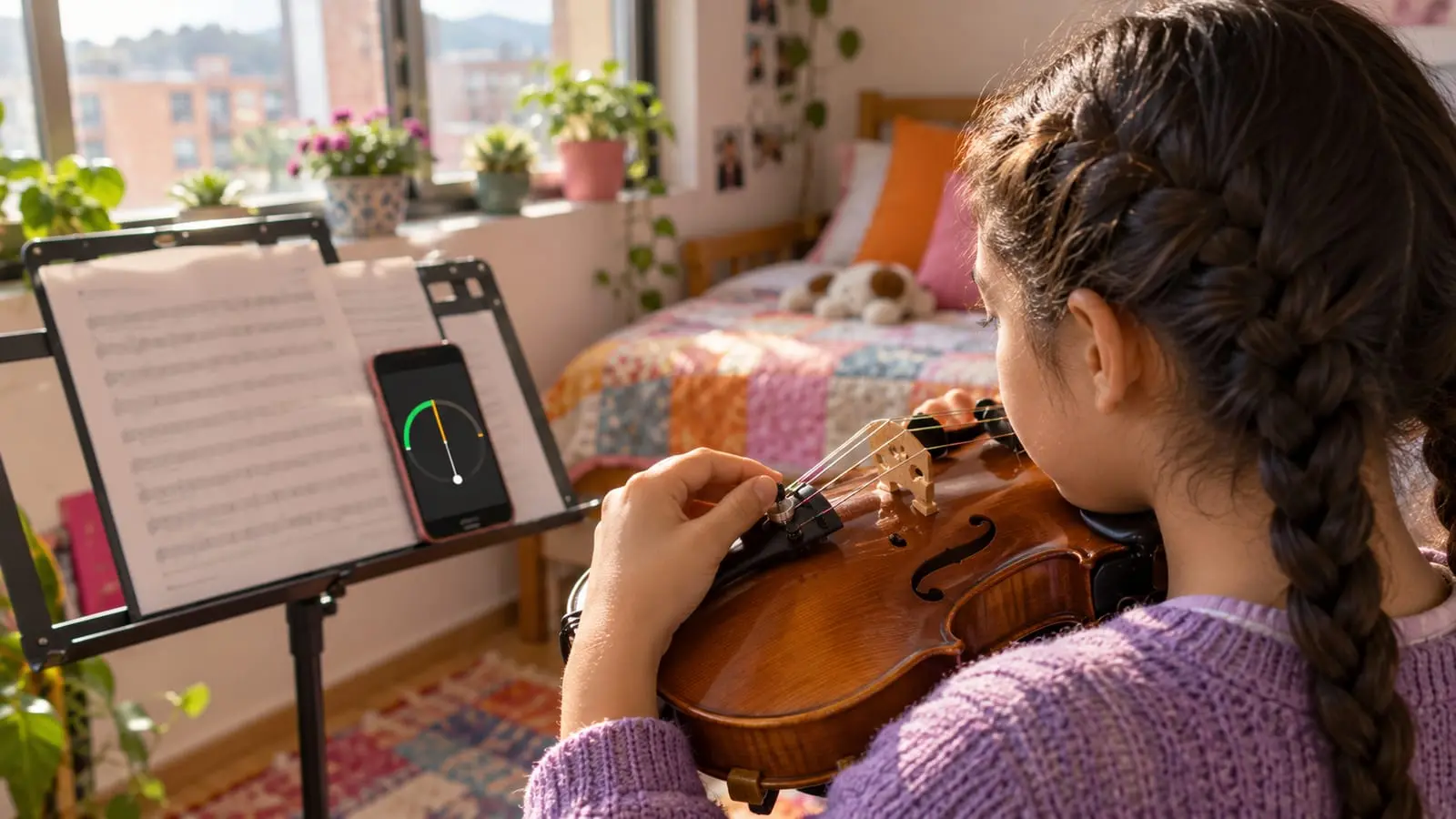
The violin is tuned in fifths: from thickest to thinnest string, G, D, A, E (G, D, A, E). Tune A first—the orchestra's reference note—then tune the others from there. Use the fine tuners on the tailpiece for small adjustments; use the pegs only when a string is far from its target pitch.
With a tuner and a little care, tuning takes a couple of minutes. The tricky part is turning the pegs without letting them slip and keeping an eye on the bridge, rather than finding the note.
In short
- Violin strings, low to high: G (G3), D (D4), A (A4) and E (E5).
- Tune A to 440 Hz first, then D, G and E.
- Use fine tuners for small adjustments; use pegs only when the pitch is far off, pushing them inward as you turn.
- Two well-tuned neighboring strings form a perfect fifth that sounds steady, without pulsing.
- After tuning, check that the bridge is still upright: tension tends to pull it toward the fingerboard.
Violin string notes
| String | Note | Symbol | Frequency |
|---|---|---|---|
| 4th (thickest) | G | G3 | 196 Hz |
| 3rd | D | D4 | 293.66 Hz |
| 2nd | A | A4 | 440 Hz |
| 1st (thinnest) | E | E5 | 659.25 Hz |
Each string is a perfect fifth above the next lower one: five note names counting both ends (G-A-B-C-D). That's why we say the violin is “tuned in fifths.” The viola uses the same intervals, a fifth lower: C, G, D, A; if you play viola, use the viola tuner.
A vocabulary detail that often causes confusion: in Spanish, “diapasón” means both the black fingerboard where you press the strings and the metal tuning fork that gives you A. In this article, we use “tuning fork” when referring to the reference pitch.
Pegs or fine tuners: which to use
| Tuning pegs | Fine tuners | |
|---|---|---|
| Where they are | In the pegbox, next to the scroll | On the tailpiece, at the other end of the strings |
| What they're for | Large changes: a new or very out-of-tune string | Small adjustments when the pitch is already close |
| How far to turn | Very little: a millimeter makes a big difference in pitch | Half a turn or less |
| Risk | Slipping or breaking the string | Reaching the limit and scratching the top |
| Who uses them | Students with some experience or the teacher | Anyone, including children with help |
Many student violins have four fine tuners; on more advanced violins, it's common to have just one on the E string, which is steel and very sensitive. If a string on your violin has no fine tuner, tune it with the peg alone.
How to turn a peg without letting it slip
- Rest the violin vertically on your leg with the scroll pointing up, or hold it in playing position.
- Find the correct peg by tracing the string with your finger. The G and E pegs are closer to the nut; the D and A pegs are closer to the scroll.
- Pluck the string pizzicato to hear its current pitch.
- Turn the peg a tiny amount while gently pushing it inward, into the pegbox. That pressure keeps it in place.
- Go slightly below the target pitch, then tune up to it; never raise the pitch suddenly.
- Finish the adjustment with the fine tuner.
How to use fine tuners
Turning the screw clockwise (viewed from above) raises the pitch; turning it counterclockwise lowers it. Check occasionally that it isn't screwed all the way in: the lever underneath can touch and scratch the top. If it is, loosen the fine tuner to the middle of its range and bring the string back to pitch with the peg.
How to tune a violin with a tuner, step by step
You can use a clip-on tuner attached to the scroll to read vibrations, or a microphone-based tuner such as our online violin tuner, which works on your phone or computer. The same tuner has modes for viola, cello and double bass.
- Find a quiet place and open the tuner. If you're using the web tuner, allow microphone access.
- Play the A string pizzicato or with the bow, using a steady sound without excessive pressure.
- If the tuner shows the pitch is flat (♭), turn the fine tuner clockwise; if it's sharp (♯), turn it counterclockwise.
- If the string reads a different note, such as G♯ or A♯, it's far off: use the peg first.
- Tune D, then G, and finally E.
- Make a second pass: tuning one string slightly changes the tension of the others.
Once you're comfortable with the bow, use it to tune instead of pizzicato: the note sustains and the tuner gives a steadier reading. If you're still working on your grip, review how to hold a violin bow.
How to tune a violin by ear, in fifths
This is how orchestral violinists tune: they take A from the oboe or piano, then tune the remaining strings in pairs, using double stops. At home, your reference can be a piano, a tuning fork or a tuner used just for A.
| Step | Strings you play together | Which string to adjust |
|---|---|---|
| 1 | A alone, against the reference | A |
| 2 | D + A | D |
| 3 | G + D | G |
| 4 | A + E | E |
- Bow both strings at once, distributing the weight between them and keeping the sound relaxed.
- Listen: if the fifth is out of tune, you'll hear pulsing or “beats,” as though the sound were trembling.
- Adjust the string you're tuning. The slower the pulsing, the closer you are.
- When the sound becomes steady and full, almost like a single note, the fifth is pure.
For the curious: perfectly pure fifths are slightly wider than piano fifths. Tuning by ear from A puts G about 4 cents (hundredths of a half step) lower and E about 2 cents higher than a tuner would. That's normal. If you're playing with piano, your teacher may ask for slightly narrower fifths.
The bridge: check it every time you tune
The bridge isn't glued down: only string pressure holds it in place. As you increase tension with the pegs, the strings gradually pull it toward the fingerboard. If it leans too far, it can warp or fall.
- Look at the violin from the side: the face of the bridge toward the tailpiece should be almost perpendicular to the top.
- If you notice it leaning toward the fingerboard, ask your teacher to show you how to straighten it, or take it to a luthier. Don't try to force it into place with very tight strings.
- Never loosen all the strings at once: without pressure, the soundpost (the small wooden piece inside the violin) can fall, requiring a visit to a luthier.
- If the bridge falls, don't put it back yourself. Put the violin away and take it to be checked.
Why violins go out of tune so often
- Climate: in Bogotá's dry cold, wood contracts and pegs tend to loosen; in hot, humid regions, they swell and can stick. When traveling, leave the violin in its case for a while before opening it and tuning.
- New strings: they stretch during the first few days and drop in pitch several times.
- Poorly fitting pegs: if a peg keeps slipping even when you push it in, a luthier can adjust it or apply peg compound.
Tuning is part of every practice session, before scales or warm-ups. In our violin lessons, the teacher checks tuning with you at the start until you can do it confidently. For other maintenance, read how to clean and care for a violin.
Frequently asked questions
How often should you tune a violin?
Every time you play. A small fine-tuner adjustment will usually be enough; if the violin has been stored for days or moved to a different climate, you may need the pegs.
Should a violin be tuned to 440 or 442 Hz?
For practice, 440 Hz is the usual reference and the default on tuners. Some orchestras tune a little higher, such as 442 Hz; if you play in one, follow the conductor's or concertmaster's instructions.
What should I do if the E string breaks while tuning?
This usually happens when you turn the peg too far or the string is worn where it rests on the fine tuner. Replace the string and raise its pitch slowly, checking the tuner so you reach E without going past it. While changing one string, keep the other three under tension so the bridge and soundpost stay in place.
Can you tune a violin without a tuner?
Yes, with a reference A (a piano, tuning fork or another tuned instrument) and the remaining strings tuned in fifths. Without any reference, the violin can be in tune with itself but won't match other instruments.
Sources
We checked the facts in this article against these sources on October 22, 2026.